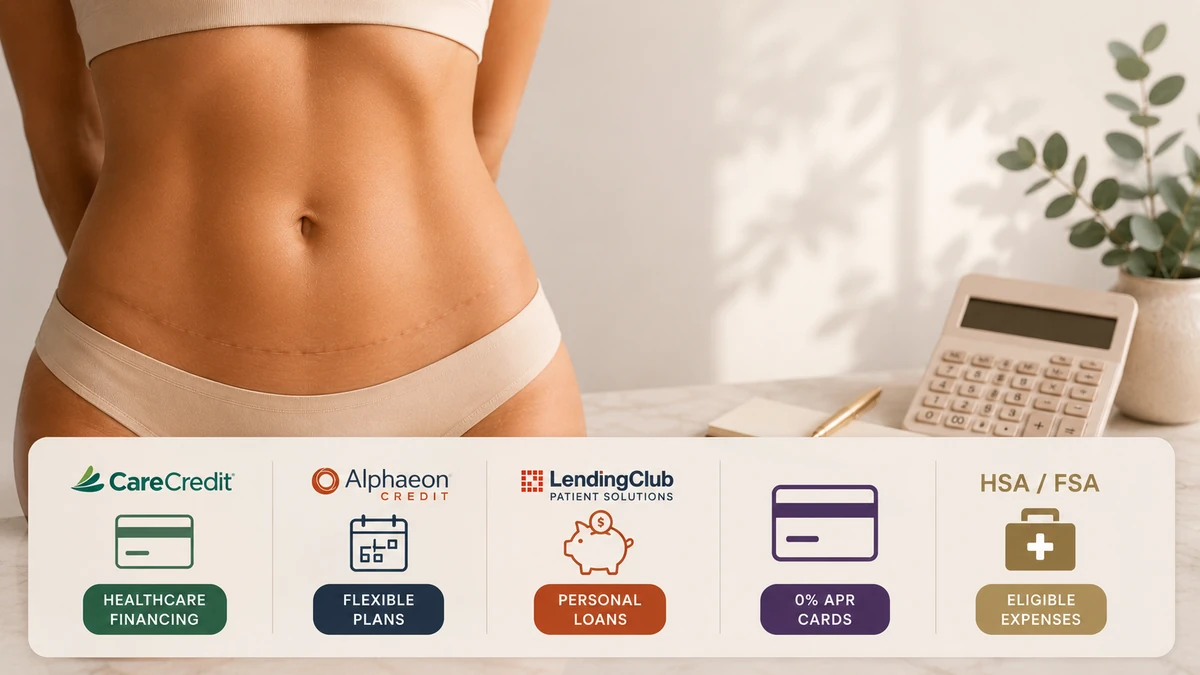
Financing a tummy tuck is where the "$14,000 for the surgery" number can quietly become "$18,000, $20,000, or $22,000 by the time you've paid it off." The lending ecosystem is designed to make monthly payments feel small — but the total cost including interest is what actually matters. This guide walks through every honest option, the traps to avoid, and the total-cost math on realistic scenarios.
The Real Options
| Option | Typical APR | Best for |
|---|---|---|
| Cash / savings | 0% | Patients with liquid savings; simplest |
| 0% APR credit card (regular) | 0% promo / 20–29% after | Patients who can repay in promo window |
| CareCredit (promo) | 0% promo / 29–33% retroactive | Amounts $200+; office-based sign-up |
| Alphaeon Credit | Similar to CareCredit | Cosmetic surgery focus |
| LendingClub Patient Solutions | 8–30% APR fixed | Longer terms without retroactive risk |
| Prosper Healthcare Lending | 8–30% APR | Larger amounts, fixed terms |
| Personal loan (bank / credit union) | 7–15% good credit | Best rates for good-credit patients |
| HELOC (home equity) | 7–12% variable | Homeowners with equity — but home is collateral |
| HSA / FSA | Effectively 0% (pre-tax) | Only functional / medically necessary cases |
CareCredit — The Big One, With a Catch
CareCredit is a health-and-wellness credit card issued by Synchrony Bank, accepted at over 260,000 US healthcare providers including most cosmetic surgeons.1 For transactions of $200 or more, it offers promotional financing periods (typically 6, 12, 18, or 24 months) with no interest if the balance is paid in full by the end of the promotional period.
The catch — printed in the terms and disclosed at signup, but often overlooked — is retroactive interest. If any balance remains at the end of the promotional period, interest is charged from the original transaction date at CareCredit's standard variable APR (currently around 29–33% depending on the specific card). This is called "deferred interest" and it is legally required to be disclosed but is easy to miss.
The math on missing the deadline
Say you finance $12,000 on 18-month promotional CareCredit. Monthly payment to clear it in the window is $667. Suppose you make $600/month payments for 17 months, then can't quite make the final $2,000 balloon. Balance at month 18: $2,000. Retroactive interest on the original $12,000 for 18 months at 30% APR: roughly $3,000 added to the balance. What looked like a 0% loan just became $3,000 more expensive — for missing the deadline by one month.
This is the biggest single financing trap in cosmetic surgery. CareCredit works well if you can genuinely pay it off in the window; it is expensive if you can't.
Personal Loans — Often the Best Real Option
A traditional personal loan from a bank, credit union, or online lender (SoFi, Marcus, Discover Personal Loans) at a fixed APR is often the best-value option for patients who can't pay cash and can't reliably pay off a promotional card in the window.
Typical rates:
- Excellent credit (720+ score): 7–10% APR
- Good credit (680–719): 10–15% APR
- Fair credit (640–679): 15–22% APR
- Poor credit (below 640): 22%+ APR, or often decline
Personal loans have fixed terms (typically 24–72 months), fixed rates (no retroactive-interest surprise), and predictable monthly payments. They usually don't require collateral. The disadvantages: shorter terms mean higher monthly payments, and rates depend heavily on credit score.
The math example
$12,000 at 10% APR over 36 months: monthly payment ~$387, total paid ~$13,940 (interest cost ~$1,940). Same amount at 25% APR over 60 months: monthly payment ~$352, total paid ~$21,130 (interest cost ~$9,130). Same monthly payment, hugely different total cost.
Medical Financing Platforms
Platforms specifically designed for medical procedures (LendingClub Patient Solutions, Prosper Healthcare Lending, United Medical Credit, and others) sit in between traditional personal loans and medical credit cards. They typically:
- Offer fixed APRs (no retroactive-interest trap).
- Cover higher amounts than CareCredit ($40,000+ possible).
- Have terms up to 72 months.
- Are often partnered with surgeon offices for streamlined application.
- Have APRs typically 8–30% depending on credit.
For higher-cost cosmetic procedures ($15,000+), or when your credit is on the fair side, medical financing platforms often beat both personal loans and medical credit cards. Compare offers.
HSA / FSA — Mostly Not Allowed
IRS Publication 502 governs what medical expenses qualify for tax-advantaged treatment through Health Savings Accounts (HSA) and Flexible Spending Accounts (FSA).2 Cosmetic surgery is explicitly excluded as a non-qualifying expense.
Two limited exceptions where HSA/FSA money may be usable for related procedures:
- Panniculectomy for medical necessity — chronic skin infections, ulceration, functional impairment. Requires physician documentation of medical necessity.
- Diastasis recti repair when documented as functional (chronic back pain, hernia risk, urinary symptoms). Insurance carrier decides; HSA/FSA follows the coverage decision.
Using HSA/FSA money on a non-qualified expense triggers a 20% penalty plus income tax on the withdrawal. This is a large tax hit for guessing wrong. When in doubt, ask your HSA/FSA administrator in writing before spending, and obtain a letter of medical necessity from the surgeon.
Full detail on which procedures may qualify for insurance / HSA / FSA in our insurance guide.
Realistic Financing Scenarios
| Path | Monthly | Total paid | Interest cost |
|---|---|---|---|
| Cash | — | $14,000 | $0 |
| CareCredit 18-mo promo, paid off in window | ~$780 | $14,000 | $0 |
| CareCredit 18-mo promo, $2K balance at end (30% APR retroactive) | Varies | ~$17,500 | ~$3,500 |
| Personal loan 10% APR × 36 mo | ~$452 | ~$16,270 | ~$2,270 |
| Personal loan 15% APR × 60 mo | ~$333 | ~$19,980 | ~$5,980 |
| Medical loan 25% APR × 60 mo | ~$411 | ~$24,660 | ~$10,660 |
| Turkey option ($5,600 all-in), personal loan 10% × 24 mo | ~$259 | ~$6,200 | ~$600 |
The bottom row is worth pausing on. Choosing the Turkey option and financing the smaller amount at a good rate costs less than half the interest of a mid-range US financing scenario and less than a quarter of a high-APR long-term US loan. (The $14,000 baseline used in these scenarios reflects the typical US full-TT all-in range consistent with ASPS national statistics.3) The Turkey saving isn't just the surgery — it dramatically reduces financing burden too. Detail in our Turkey cost guide.
Financing Traps to Avoid
- The retroactive-interest deadline miss. The single most expensive mistake in cosmetic-surgery financing. Only use promotional 0% financing if you have a concrete monthly payment plan that clears the balance with room to spare.
- The long-term high-APR loan. 60- or 72-month loans at 20–30% APR can more than double the total cost. Always compare total cost, not monthly payment.
- The "minimum payment" trap. On a medical credit card, paying only the minimum during the promotional period leaves a huge balance at the end — which then gets hit with retroactive interest.
- Debt stress affecting recovery. Financial anxiety during recovery is well-documented to negatively affect healing, sleep, and psychological wellbeing. Financing only what you can comfortably repay is a medical decision as well as a financial one.
- Financing on top of financing. Adding a tummy tuck loan to existing credit card or student loan debt can push debt-to-income above thresholds for other important loans (mortgage refinance, home purchase).
The Decision Framework
A simple sequence:
- Can I pay cash? If yes, do that. Simplest, cheapest.
- Can I confidently pay off a promotional 0% offer within the window? If yes, use it (with a written monthly plan and a buffer).
- Can I qualify for a personal loan at <12% APR? If yes, prefer it over medical financing platforms.
- Is my credit rate borderline for a personal loan? Compare medical financing platform offers.
- Would the Turkey option make the total amount financeable at low interest cost? Often yes. See our Tummy Tuck in Turkey guide.
Ultimately: choose the operation and the surgeon first (see real cost guide, choosing a surgeon). Then find the financing path that gives you the lowest total cost — not the lowest monthly payment.
FAQ
Can you finance a tummy tuck?
Yes — cosmetic surgery is one of the most commonly financed elective medical procedures in the US, with a well-developed lending ecosystem. Options include specialized medical-credit platforms (CareCredit, Alphaeon Credit, LendingClub Patient Solutions, Prosper Healthcare Lending), personal loans from banks and credit unions, 0-percent-APR credit cards, and cash / savings. Most surgeon offices partner with at least one of the medical-credit platforms and can process an application at consultation. Approval, terms, and monthly payment depend on your credit score and the loan amount. The important question is not "can I finance it" but "what does financing actually cost me in total, including interest?"
What is CareCredit and how does it work for a tummy tuck?
CareCredit is a health-and-wellness credit card issued by Synchrony Bank that is accepted at over 260,000 healthcare providers in the US, including most cosmetic surgeon offices.1 For amounts of $200 or more, CareCredit offers promotional financing periods (typically 6, 12, 18, or 24 months) with no interest if the balance is paid in full within the promotional window. If the balance is not paid in full by the end of the promotional period, interest is charged retroactively from the original transaction date at CareCredit's standard variable APR (currently around 29 to 33 percent). This retroactive-interest structure is the biggest catch — the effective cost is huge if you miss the deadline. CareCredit works best for patients who can genuinely repay in the promotional window.
Can I use HSA or FSA money for a tummy tuck?
Generally no for cosmetic abdominoplasty. HSA (Health Savings Account) and FSA (Flexible Spending Account) funds are limited by IRS Publication 502 rules to expenses that are medically necessary.2 Cosmetic tummy tuck is explicitly excluded as a cosmetic procedure. Two exceptions where HSA/FSA money can potentially be used: (1) panniculectomy for medical reasons (chronic infections, functional impairment) with proper documentation, or (2) diastasis recti repair when documented as functional (not cosmetic). Even in these cases, the insurance carrier's letter of medical necessity is typically required. When in doubt, ask your HSA/FSA administrator in writing before spending — using HSA/FSA money on a non-qualified expense triggers a 20 percent penalty plus income tax.
What is the best way to finance a tummy tuck?
For most patients, the ranking by total cost from lowest to highest is: (1) Cash / savings — zero cost of borrowing; (2) 0-percent-APR credit card or CareCredit promotional if you can genuinely pay it off in the window; (3) Personal loan from a bank or credit union at competitive rates (7 to 15 percent APR for good credit); (4) Medical financing platforms like LendingClub Patient Solutions or Prosper Healthcare Lending (rates 8 to 30 percent depending on credit); (5) Medical credit cards outside promotional window (25 to 35 percent APR). The best option depends on your credit score, your ability to repay, and whether you can meet promotional-period requirements. For the Turkey option, the total cost is smaller, so financing needs are smaller too.
Does financing a tummy tuck affect my credit score?
Yes, in the same way any credit application affects your score. Applying for a medical credit card or medical loan triggers a hard credit inquiry, which typically drops your score by 5 to 10 points for a few months. Opening the new account changes your available credit, credit utilisation, and average account age — mostly modest effects. What matters more than the initial application is how you manage the debt: paying on time supports your score; missing payments or maxing out utilisation harms it significantly. High-balance medical debt can also affect debt-to-income ratio for other loans (like mortgages). Financing a tummy tuck responsibly is neutral to slightly positive for credit; financing it and missing payments is highly negative.
Are there any risks to financing a tummy tuck?
Yes — the biggest risk is not surgical, it is financial. The three most common financing traps: (1) Retroactive interest — CareCredit and similar cards charge interest back to day one if the promotional balance is not paid off in time, effectively turning a 12-month interest-free loan into a 25-percent-APR loan. (2) Long-term high-interest medical loans — 60- or 72-month terms at 20 to 30 percent APR can double or triple the total cost of the surgery. (3) Debt stress affecting recovery — financial anxiety during recovery negatively affects healing, sleep, and psychological outcomes. Realistic advice: only finance what you can comfortably repay within the promotional window if using promotional financing, or within 2 to 3 years if using a personal loan. Consider the Turkey option to reduce the total amount needing financing.