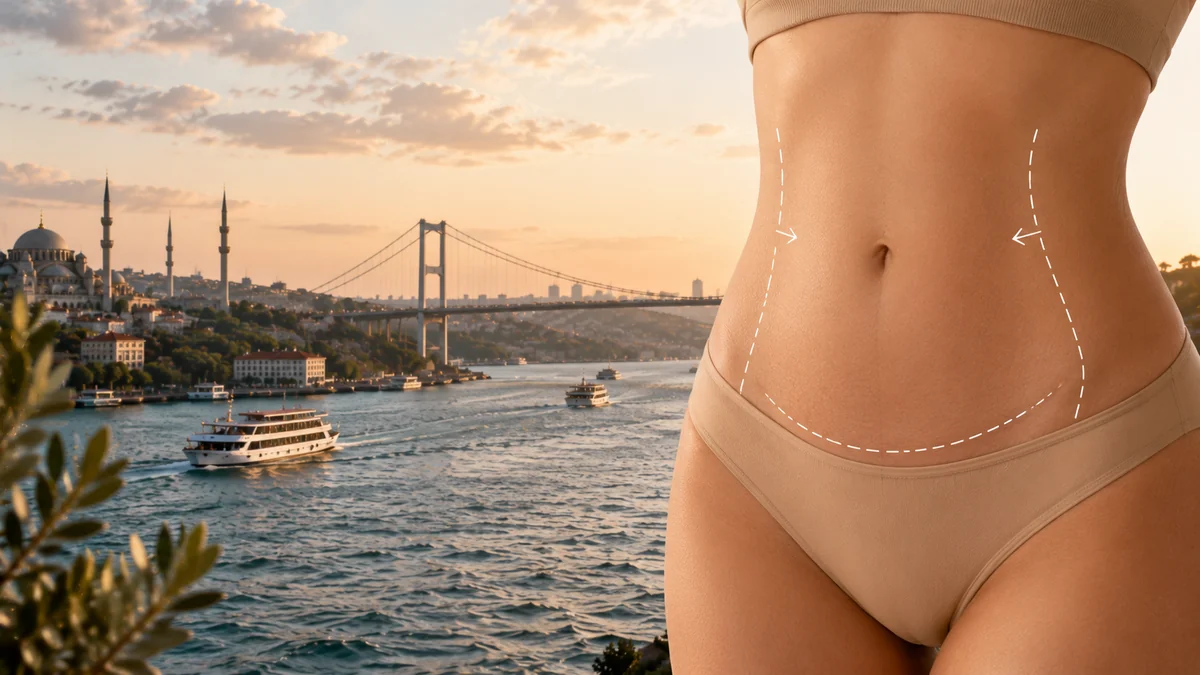
Turkey has become one of the most-searched destinations for a tummy tuck, and the reasons are straightforward: a well-known surgical culture, a large international-patient infrastructure, and prices that undercut US totals by roughly two-thirds. For US patients considering it, the honest question is not whether Turkey can deliver a good abdominoplasty — it clearly can, and does, for large numbers of patients every year — but whether your specific situation makes the trade-offs worth it, and whether you are prepared to do the vetting the process requires.
This guide is written from the patient side, not the clinic side. We are not a clinic, we do not perform surgery, and we do not receive booking commissions. The goal is a clear-eyed read on cost, safety, credentialing, packages, the day-by-day patient journey (particularly the flight home), and the red flags that show up repeatedly in adverse-outcome reports. Everywhere possible, the specific data is cited to a source you can read yourself.
Why US Patients Consider Turkey
Three factors drive the search: cost, volume of experienced surgeons, and package convenience.
The cost gap is the most cited: a full tummy tuck that averages $10,000–$18,000 total in the US is available for $3,500–$5,500 all-in through Turkish package providers. That is not a headline-fee comparison — the Turkish number includes anaesthesia, hospital fee, garment, medications, and follow-ups during the stay. See our full US-vs-Turkey cost breakdown for the line-by-line.
Second, Turkey has genuine volume. Per ISAPS global statistics, Turkey ranks among the top 4 countries worldwide for total aesthetic surgical procedures, with abdominoplasty specifically one of the most-performed body procedures.1 Volume matters clinically — high-volume surgeons and facilities tend to have better outcomes, more predictable workflows, and better complication management.
Third, Turkish clinics offer a level of logistical convenience US practices generally do not: package pricing, airport pickup, English-speaking coordinators, hotel arrangements, and an infrastructure specifically built around international patients. That convenience is real value — but it also lowers the friction of booking, which is a double-edged sword when the diligence work still needs to happen.
The Risks & Trade-offs to Weigh
Honest risk framing is the most valuable single thing any Turkey guide can offer. There are two categories: surgical risks (the same wherever the operation happens) and medical-tourism-specific risks (added by travel and distance).
Surgical risks are country-agnostic
The largest US abdominoplasty safety review — CosmetAssure, 25,478 patients — reported an overall 4.0% major complication rate, higher than most other cosmetic operations.3 That baseline applies to abdominoplasty as an operation, regardless of country. What moves the needle is the surgeon's experience and the accreditation of the facility, not the flag on the building. A board-certified plastic surgeon operating in an accredited Turkish hospital will typically have complication rates similar to a US colleague of comparable experience; an unaccredited "aesthetic center" with an out-of-scope operator anywhere in the world will not.
Medical-tourism-specific risks
A peer-reviewed analysis of cosmetic-surgery tourism complications presenting to public hospitals identified a repeatable pattern: patients returning with wound infections, dehiscence, seroma, and thromboembolic events after operations performed abroad.5 A dedicated adverse-outcomes analysis of cosmetic surgery medical tourism found similar themes: unaccredited facilities, uncertain surgeon credentials, premature return flights, and gaps in follow-up.4
Each of these is avoidable, and that is the practical point: the "Turkey risk" is not a country-level property, it is a decision-level property. The decisions that most reliably create bad outcomes are choosing the cheapest option, flying home too soon, and failing to arrange local follow-up.
Continue: Is a tummy tuck in Turkey safe? — evidence-based deep dive →How Much Does It Cost in Turkey vs the US?
| Type | US total | Turkey all-in | Typical savings |
|---|---|---|---|
| Mini | $6,000 – $12,000 | $2,500 – $4,000 | ~55–65% |
| Full (standard) | $10,000 – $18,000 | $3,500 – $5,500 | ~65–70% |
| Extended | $12,000 – $20,000 | $4,000 – $6,500 | ~65–70% |
| Fleur-de-Lis | $15,000 – $24,000 | $5,500 – $8,000 | ~60–70% |
| + Lipoabdominoplasty | +$2,000 – $4,000 | +$800 – $1,500 | — |
The Turkish price usually includes: surgeon fee, anaesthesia, accredited hospital, pre-op tests, medications, garment, follow-ups during stay, hotel (typically 5–7 nights), airport transfers. It usually does not include: your international flight, travel insurance, extended-stay hotel days if recovery slows, revision surgery if needed later, and follow-ups back in the US. Full breakdown in our cost guide and our detailed Turkey pricing analysis.
Is It Safe? What the Data Says
The regulatory picture in Turkey has two layers. The domestic layer is the Turkish Ministry of Health, which licenses hospitals and physicians and sets scope-of-practice rules; specialist board certification in plastic surgery is a Ministry-recognized process. The international layer is JCI (Joint Commission International) accreditation, held by many of the hospitals that operate on international patients — a standardised international benchmark that covers patient safety, infection control, staff training, and clinical governance.2
Turkey's health system has been the subject of formal reviews (including the Health Systems in Transition series) documenting substantial structural investment over the past two decades, particularly in tertiary hospital capacity.6 That is not a claim that every clinic operating on international patients is equally regulated — it is a claim that the regulatory floor exists and can be verified for a given facility. Verification is the patient's job before booking, and it can be done.
Continue: Is a tummy tuck in Turkey safe? — regulations, complication data, risk reduction →Choosing a Qualified Surgeon
The single highest-leverage decision in this whole process is who operates on you — not the city, not the hotel, not the package, not the discount. A few concrete verification steps replace most of the risk premium:
- Specialty title: the surgeon should be a board-certified plastic surgeon (in Turkish: Plastik, Rekonstrüktif ve Estetik Cerrahi uzmanı), not a "cosmetic doctor," "aesthetic physician," or a specialist in a non-surgical field who has added cosmetic work.
- International membership: verify the surgeon is listed with ISAPS (International Society of Aesthetic Plastic Surgery) or EBOPRAS (European Board of Plastic, Reconstructive and Aesthetic Surgery). Both maintain directories you can search.
- Facility accreditation: ask which hospital the operation will be performed in and confirm its licence and, ideally, its JCI accreditation.
- Consultation quality: a serious consultation involves examining you (usually by video), taking a full medical history, discussing candidacy honestly (including "no" answers when appropriate), and providing written documentation of the plan.
- Volume of the specific operation: ask specifically how many abdominoplasties the surgeon performs per year and how many of those are the specific variant you need (mini, full, extended, fleur-de-lis).
If any of these steps hits vague or evasive answers, treat it as a data point and keep looking. The market is large enough that you do not need to accept a poorly-answered consultation to travel — our choosing a surgeon guide walks through the full vetting process.
What "All-Inclusive Package" Really Means
Package pricing is one of Turkey's biggest advantages and also one of the areas where quotes can hide the most. A well-constructed package covers the medically essential components with clear line items; a poorly-constructed one is a headline number with vague inclusions and a very different final invoice.
| Item | Should be included | Usually not included |
|---|---|---|
| Surgeon fee | Yes | — |
| Anaesthesia | Yes | — |
| Accredited hospital / OR | Yes | — |
| Pre-op tests (blood, EKG) | Yes | — |
| Medications during stay | Yes | Take-home prescriptions may be extra |
| Compression garment | Yes | — |
| Follow-ups during stay | Yes | — |
| Hotel accommodation | Usually 5–7 nights | Extra nights extra |
| Airport transfers | Yes | — |
| International flight | No | Patient books |
| Travel insurance | No | Strongly recommended separately |
| Complications / revision | Rarely | Ask specifically before booking |
| US follow-up care | No | Patient arranges locally |
Request a written itemised quote before booking — not just a total. A one-line "$3,500 tummy tuck" that arrives without a breakdown is not a quote, it is a marketing message. Our packages guide details exactly what to look for line by line.
The Patient Journey — Travel, Stay, Flying Home
Pre-travel (weeks before)
Book flights, hotel (usually included), and travel insurance that specifically covers medical procedures abroad (many standard policies exclude planned surgery). Stop smoking at least 4 weeks before surgery. Complete any pre-op tests requested by the surgeon. Bring copies of medical history and current medications.
Arrival and pre-op day
Airport pickup by the clinic. Hotel check-in. In-person consultation and pre-op assessment (blood work, EKG, sometimes imaging). Written informed consent that covers the specific operation, risks, revision policy, and follow-up plan.
Operation day and first days
Surgery under general anaesthesia (2–5 hours for a full tummy tuck). Hospital stay usually one to two nights. Return to the hotel with a compression garment and, if used, drains. Daily walks to reduce venous thromboembolism risk. First few days are the most uncomfortable; pain is managed with a regimen the surgeon prescribes.
Recommended stay length
Most surgeons ask for 7 to 10 days total in Turkey after a full abdominoplasty. This covers the initial critical window when early wound checks, drain removal (if used), and observation for early seroma or infection are most useful. It also puts your return flight outside the concentrated post-op VTE window.
Flying home safely
The flight home is the single most tourism-specific medical decision. Long-haul flights within the first 5–7 days after abdominoplasty combine three VTE risk factors in one setting: post-op hypercoagulability, immobility, and dehydration. Concrete mitigation:
- Follow the stay-length recommendation your surgeon gives (usually 7–10 days minimum).
- Wear graduated compression stockings on the flight.
- Walk in the aisle every 60–90 minutes; do calf pumps while seated.
- Hydrate well; avoid alcohol.
- Arrange local US follow-up before you travel — do not assume you'll figure it out after landing. Know the post-op warning signs before you fly.
Red Flags to Avoid
- Below-market pricing ($2,000-range full tummy tucks) — Turkey is affordable, but not that affordable. Prices well below the market baseline usually mean unaccredited facility, non-plastic-surgery operator, or bait pricing.
- Vague surgeon identity in marketing ("our expert team of surgeons") without a specific named surgeon and credentials.
- No written quote or contract — everything by WhatsApp, no itemised inclusions, no revision policy.
- Pressure to book same-day discount. Legitimate clinics do not discount elective surgery based on urgency.
- Vague or missing facility name. Ask specifically which hospital the operation is performed in, then verify it independently.
- Very short recommended stay (e.g. "you can fly home 48 hours after surgery") — this indicates either a mini procedure being called a tummy tuck, or a clinic willing to accept preventable travel risk to save you a hotel bill.
- Marketing that leads with celebrity mentions or reality-TV imagery rather than clinical detail and named surgeons.
- Combined procedures pitched as "package upgrades" without a serious risk conversation — combined breast + abdominoplasty in particular raises reoperation risk in some multi-center analyses and should be discussed as clinical decision, not a menu add-on.
FAQ
-
Is a tummy tuck in Turkey worth it for US patients?
For patients who can screen carefully, the cost savings are meaningful — a full tummy tuck in Turkey typically runs $3,500–$5,500 all-in versus $10,000–$18,000 in the US. But "worth it" depends on more than price: you take on travel-related risks (particularly venous thromboembolism from long flights), you must manage any complications from thousands of miles away, and you have to vet the surgeon and facility yourself. It is worth it for well-informed patients with a straightforward operation and no unstable medical conditions.
-
How do I know if a Turkish clinic is legitimate?
Verify three things: the hospital or surgical facility is Turkish Ministry of Health licensed (and ideally JCI-accredited for international standards); the operating surgeon is board-certified in plastic surgery — check ISAPS or EBOPRAS directories — not just "aesthetic medicine" or "cosmetology"; the clinic can produce a written quote with each cost line separately, a written revision/complication policy, and clear post-op follow-up arrangements. If any of these is missing or evasive, treat it as a red flag.
-
When can I fly home after a tummy tuck in Turkey?
Most surgeons ask patients to stay 7 to 10 days after a full abdominoplasty before the return flight — long enough for early wound checks, drain removal (if used), and to reduce the concentrated post-operative window when venous thromboembolism (blood clot) risk is highest. Long-haul flights within the first week are strongly discouraged because of the combined effects of surgery, immobility, and dehydration on clot risk. Wear compression stockings, walk every 1–2 hours in the aisle, and hydrate well on the return flight.
-
What does an "all-inclusive" tummy tuck package in Turkey actually include?
A legitimate all-inclusive package usually covers the surgeon fee, anaesthesia, accredited hospital/facility fee, pre-op lab tests, medications, compression garment, follow-up visits during your stay, hotel accommodation for the recovery days, and airport transfers. What it does not usually cover: your international flight, travel insurance, complications requiring extra hospital days, any revision needed after you return home, and follow-ups back in the US. Always request a written itemised package before booking.
-
What are the biggest risks of a tummy tuck in Turkey?
The two biggest risk categories are the operation itself — which carries the same complication rate anywhere it is done (roughly 4.0% major complications from the largest US safety review)3 — and travel-related risks specific to medical tourism: venous thromboembolism from long-haul flights close to surgery, difficulty managing complications after you return home, communication gaps that lead to under-reported issues, and the temptation to choose an unaccredited facility because it is cheaper.4 Choosing a board-certified surgeon operating in an accredited facility eliminates most of the surgical risk premium; timing the flight home eliminates most of the travel risk.
-
Can I combine a tummy tuck with liposuction or breast surgery in Turkey?
Yes — combined procedures like "mommy makeover" (tummy tuck plus breast surgery) and lipoabdominoplasty (tummy tuck plus liposuction) are commonly performed in Turkey. Evidence from multi-center US databases suggests combined breast plus abdominoplasty does not increase overall complication rates but can raise reoperation risk. Combined operations require an experienced surgeon and full risk assessment; they are not a routine "add-on" and should be discussed at consultation, not booked as a package upgrade.