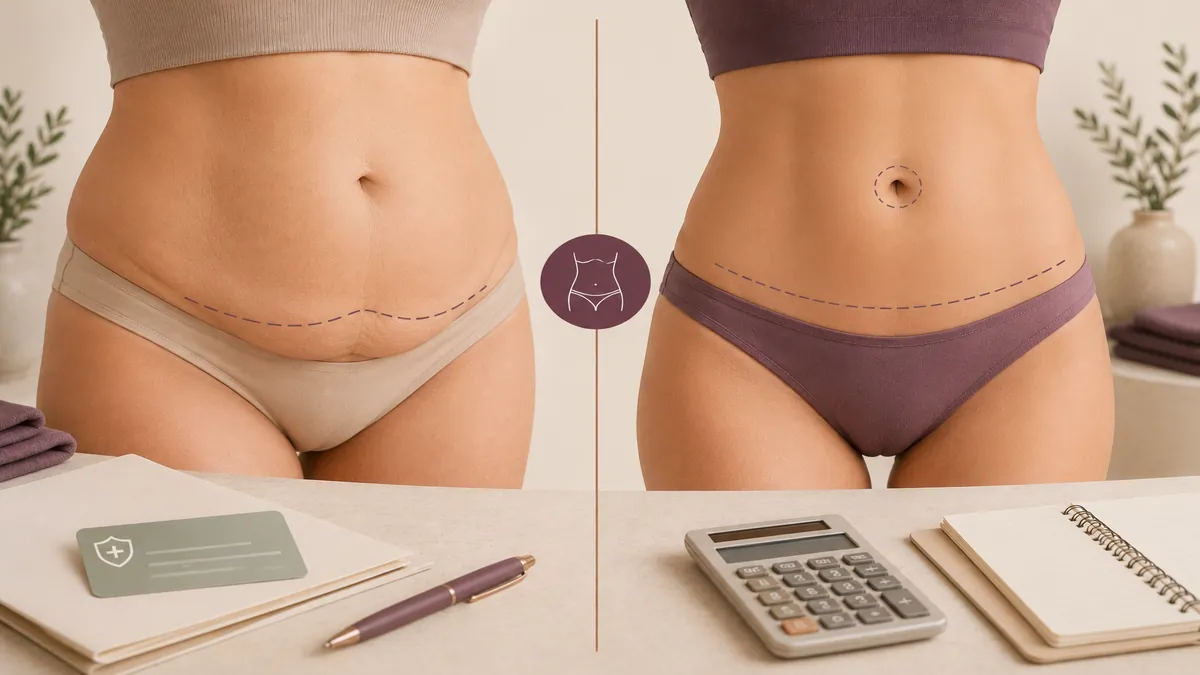
Patients considering abdominal surgery often hear both terms — panniculectomy and tummy tuck — and struggle to tell which one they need. The confusion is understandable: both remove abdominal skin, both leave a hip-to-hip scar, both require general anaesthesia. But they are meaningfully different operations, with meaningfully different insurance implications and meaningfully different results. If you're still exploring all tummy tuck types, start there for the full picture. This guide walks through the honest picture of what each does, when insurance covers what, and when a combined operation makes sense.
What a Panniculectomy Is
A panniculectomy is a functional surgical operation that removes the pannus — the overhanging apron of excess skin and fat that hangs below the natural belt line. The pannus most commonly develops after massive weight loss (bariatric surgery, medically-supervised weight loss, natural weight loss) or after multiple pregnancies with significant weight fluctuation. It can cause chronic skin infections, ulceration, rashes (intertrigo), mobility limitations, and hygiene difficulties.
What the operation does:
- Removes the pannus — typically a large ellipse of skin and underlying fat, from hip to hip.
- Leaves a horizontal scar in the lower abdomen (similar location to a tummy tuck scar).
- Reduces or eliminates the functional problems caused by the hanging skin.
What the operation does not do:
- Does not repair separated abdominal muscles (no rectus plication).
- Does not reposition the belly button (umbilicus stays where it is).
- Does not tighten the upper abdominal skin (the "flat contour" of a tummy tuck).
- Does not typically produce a sculpted, refined aesthetic result — the goal is functional relief.
What a Tummy Tuck Is
A tummy tuck (abdominoplasty) is a cosmetic surgical operation that produces a flat, refined abdominal contour. Full detail in our What Is a Tummy Tuck? guide. The operation includes:
- Skin removal (similar to panniculectomy but typically a smaller amount, more precisely tailored).
- Rectus muscle plication — the two separated abdominal muscles are re-approximated at the midline, restoring waist definition. See our muscle repair surgery guide.
- Umbilicus (belly button) repositioning.
- Skin tightening across the entire abdomen, not just the lower portion.
- Frequently, additional liposuction to the flanks (lipoabdominoplasty).
The result is a fundamentally different aesthetic outcome — the tummy tuck patient has a flat midline and defined waist that the panniculectomy patient does not.
Side-by-Side Comparison
| Feature | Panniculectomy | Full Tummy Tuck |
|---|---|---|
| Type of operation | Functional / reconstructive | Cosmetic |
| Removes hanging apron | Yes (primary goal) | Yes (part of the operation) |
| Muscle repair (plication) | No | Yes (standard) |
| Umbilicus repositioning | No | Yes |
| Upper-abdomen tightening | No | Yes |
| Aesthetic result | Functional flatter profile | Sculpted, contoured |
| Scar | Hip-to-hip (larger typically) | Hip-to-hip + umbilicus circle |
| Insurance coverage | Sometimes (medically necessary) | Almost never |
| Operation time | 2–3 hours | 3–5 hours |
| Recovery — desk work | 2 weeks | 10–14 days |
| Cost — US (self-pay) | $8,000 – $15,000 | $10,000 – $18,000 |
| Ideal candidate | Post-MWL / bariatric, functional issues | Post-partum / MWL wanting aesthetic result |
The Insurance Difference
The single most practically important difference between the two operations is insurance coverage.
Panniculectomy — sometimes covered
Panniculectomy is classified as a functional / reconstructive operation and can qualify for US health insurance coverage when documented as medically necessary. A cross-sectional analysis of 55 US insurers found 98% covered panniculectomy under documented criteria, while only 30% also covered any component of abdominoplasty. Common insurance criteria:1
- Documented chronic intertrigo (skin rash under the pannus) not responding to at least 3–6 months of conservative treatment (topical antifungals, hygiene measures).
- Documented recurrent skin infections requiring antibiotics.
- Documented functional impairment — difficulty with ambulation, hygiene, or activities of daily living.
- Documented weight loss with stable weight for typically 6–12 months (post-bariatric patients most common).
- Photographs documenting the pannus and any skin condition.
Each insurer has specific policy criteria; coverage is not automatic and requires pre-authorization. Full documentation guide in our Panniculectomy & Insurance guide.
Tummy tuck — almost never covered
Cosmetic abdominoplasty is essentially never covered by US health insurance. The only limited exception: the muscle repair component (rectus plication) is sometimes covered separately when documented as functional (severe diastasis with hernia or functional impairment), though most US insurers still classify it as cosmetic. Full detail in our tummy tuck insurance guide.
Combined Operations — The Common Scenario
Many patients who present for consultation have both a functional pannus AND cosmetic goals that only a tummy tuck can achieve. The typical scenario: a post-bariatric patient who has lost 100+ pounds, has a large hanging pannus causing chronic rashes, and also has significant diastasis recti from prior pregnancies. Neither operation alone gives the full result.
The common solutions:
- Combined panniculectomy + tummy tuck in one operation. The most common approach when the patient is a good candidate. The panniculectomy portion may be insurance-covered while the cosmetic tummy tuck component (muscle repair, umbilicus repositioning, additional skin tightening) is self-pay. Combined single-operation approach is often preferable because it avoids the risks of a second anaesthetic.
- Staged operations. Panniculectomy first for functional relief (potentially insurance-covered), then cosmetic tummy tuck later once healed. Total cost is similar; single anaesthetic risk is doubled; total recovery time is longer.
The CosmetAssure database analysis of 25,478 abdominoplasty cases documented that combined procedures have safety profiles that reflect both operations' risks additively.2 Combined operations are not more dangerous than separate operations when performed by experienced surgeons in appropriate patients; they are more dangerous than a single operation alone.
Special Considerations for Post-Bariatric Patients
Post-bariatric patients are the most common population presenting for panniculectomy and are also a higher-risk surgical group. The ACS-NSQIP analysis of 18,891 abdominal contouring cases documented that higher BMI is associated with elevated rates of wound complications, DVT, seroma, and reoperation — post-bariatric patients often have BMI still elevated even after weight loss.3
Best-practice guidelines for post-bariatric abdominal contouring:
- Weight stable for at least 6–12 months before contouring surgery.
- BMI ideally under 30 (below 32 acceptable to many surgeons; above 35 elevated risk).
- Full nutritional assessment — protein status is critical for wound healing.
- DVT prophylaxis protocol (see our DVT/PE guide) is essential — post-bariatric patients are higher-risk for VTE.
- Realistic expectations about scar quality — post-bariatric skin often heals with wider, thicker scars.
Which Is Right for You?
A simple framework:
| Your situation | Best fit |
|---|---|
| Functional problems from hanging pannus, no aesthetic priority | Panniculectomy alone |
| Cosmetic goals, no significant functional issues | Tummy tuck alone |
| Both functional pannus AND cosmetic goals | Combined operation |
| Post-bariatric with pannus and diastasis | Combined; insurance may cover pann portion |
| Post-partum with muscle separation, no pannus | Tummy tuck alone |
| Uncertain — cannot self-assess | Consult board-certified plastic surgeon; get insurance opinion in parallel |
FAQ
What is the difference between a panniculectomy and a tummy tuck?
A panniculectomy is a functional operation that removes the overhanging apron of excess skin and fat — the "pannus" — that hangs below the belt line. It does not tighten the remaining skin, does not repair the abdominal muscles, and does not reposition the belly button. A tummy tuck (abdominoplasty) is a cosmetic operation that removes excess skin AND tightens the abdominal wall by repairing separated muscles (rectus plication) AND repositions the umbilicus for a contoured, refined result. The key difference: panniculectomy addresses functional / medical problems caused by a hanging pannus (rashes, hygiene issues, infections); tummy tuck addresses aesthetic goals (flat contour, restored waist). Insurance coverage tracks this distinction: panniculectomy can be covered when medically necessary; tummy tuck almost never is.
Is a panniculectomy covered by insurance?
Yes, sometimes — panniculectomy can be covered by US health insurance when documented as medically necessary (per a 55-insurer review).1 Common insurance criteria include: chronic skin rashes or ulcerations under the pannus that have not responded to at least 3 months of conservative treatment; documented recurrent skin infections (intertrigo); functional impairment (limited ambulation, difficulty with hygiene); and typically a specific weight-loss history (often post-bariatric with stable weight for 6+ months). Coverage is not automatic and requires pre-authorization with documentation from dermatology, primary care, and often photos. Full detail on documentation and criteria is in our insurance coverage guide.
Does a panniculectomy repair muscles?
No. A panniculectomy is a pure skin-and-fat removal operation — it does not include repair of separated abdominal muscles (diastasis recti). This is one of the most important distinctions from a tummy tuck, which typically does include muscle repair (rectus plication). Patients who have both a hanging pannus AND significant diastasis recti often need a combined operation: panniculectomy for the skin removal (potentially insurance-covered), plus a separate cosmetic tummy tuck component for the muscle repair (self-pay). Some patients choose to have just the panniculectomy for functional relief; others add the tummy tuck component for the cosmetic result.
Can you get a panniculectomy without a tummy tuck?
Yes, absolutely — and this is the most common scenario for insurance-covered panniculectomies. A standalone panniculectomy removes the hanging apron, relieves the functional symptoms (rashes, infections, mobility issues), and produces a flatter lower abdominal profile without addressing muscle repair, upper-abdomen skin tightening, or belly button repositioning. The result is functional rather than cosmetic — the abdomen looks better because the pannus is gone, but it will not have the sculpted look of a tummy tuck. Many post-bariatric patients start with a standalone panniculectomy and later add a cosmetic tummy tuck for the aesthetic result once they've recovered.
Which is cheaper — panniculectomy or tummy tuck?
When paid out-of-pocket in the US, panniculectomy typically costs $8,000 to $15,000 and a full tummy tuck typically costs $10,000 to $18,000 — so panniculectomy alone is somewhat cheaper. But the cost picture changes dramatically with insurance: if your panniculectomy qualifies for insurance coverage, your out-of-pocket cost may be limited to your deductible and coinsurance ($1,000 to $5,000 typical), while a cosmetic tummy tuck is fully self-pay. Combined operations (panniculectomy + cosmetic tummy tuck) typically cost $12,000 to $20,000 out-of-pocket, or the panniculectomy portion may be partially covered with the cosmetic component self-pay. Insurance status is often more relevant than the base cost difference.
Which is right for me — panniculectomy or tummy tuck?
Panniculectomy is right for you if: (1) your primary concern is functional — rashes, infections, mobility issues from a hanging pannus; (2) you are post-massive-weight-loss (often post-bariatric) with stable weight; (3) you are pursuing insurance coverage and meet medical necessity criteria; (4) you don't have significant diastasis recti or don't care about restoring waist definition. A tummy tuck is right for you if: (1) your primary concern is cosmetic — flat contour, restored waist, refined result; (2) you have diastasis recti that needs repair; (3) you have upper-abdominal skin laxity that panniculectomy alone won't address; (4) you're self-paying and want the full aesthetic outcome. Many patients need both — a combined panniculectomy + tummy tuck operation gives the functional relief AND the cosmetic result.