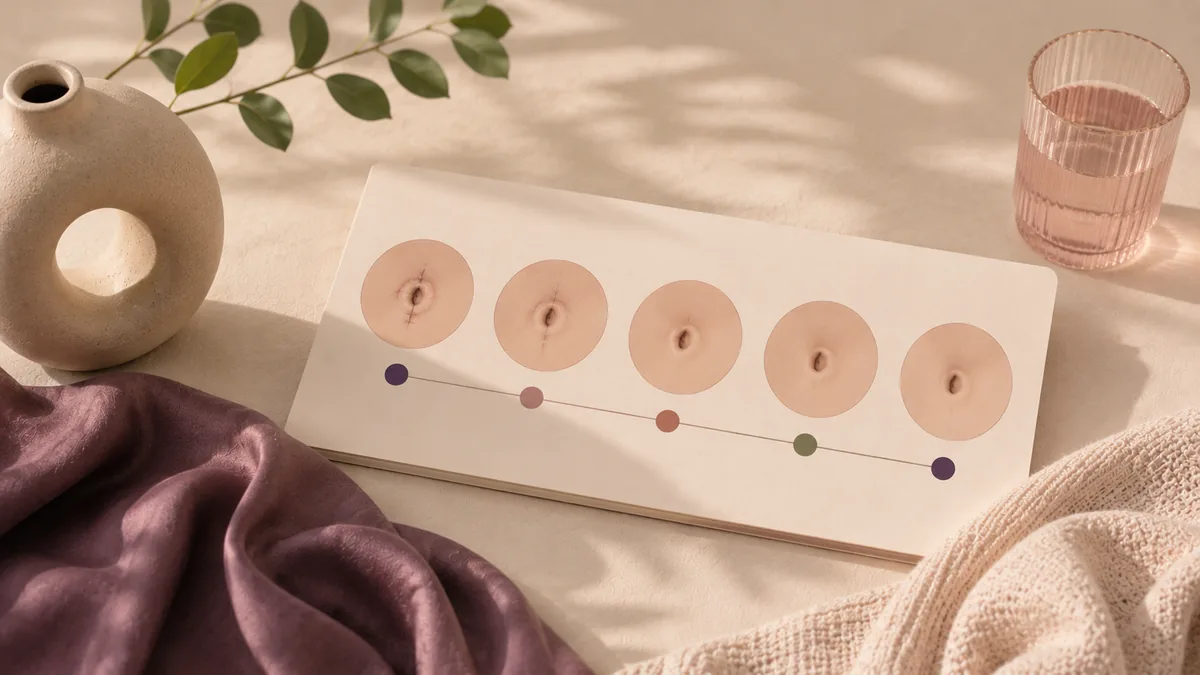
The belly button is a small but visually important part of a tummy tuck result. Patients often think about scars and contour and forget about the umbilicus until they are looking in the mirror at week 6 and wondering whether it is supposed to look the way it does. This page — part of our full recovery guide — answers what patients actually need to know: why the belly button is repositioned, what "well-done" looks like, how it heals, how to care for it, and what warning signs matter.
Why the Belly Button Is Repositioned
A full or extended tummy tuck involves lifting the abdominal skin flap from the underlying muscle wall from the incision up to the ribs, pulling it down, and trimming the excess at the lower incision. The umbilical stalk — which is anchored to the underlying rectus fascia and connected to the underlying abdominal structures — cannot move. So as the skin above it is drawn downward, the original skin position no longer matches the umbilicus's anatomical location.
The surgeon's solution: make a new opening in the drawn-down skin at the correct anatomical level, deliver the umbilical stalk through it, and suture the umbilicus to the surrounding skin. The result is the umbilicus in its correct anatomical position, with a small circular scar around it where the new skin opening was made.
Mini tummy tucks do not include this step. A mini leaves the skin above the umbilicus untouched, so the umbilicus keeps its original skin position and no repositioning is needed. This is one of the specific structural differences between mini and full — see our mini vs full guide.
What a Natural-Looking Belly Button Looks Like
Surgeon technique varies, but the aesthetic goals converge on the same features:
- Vertical orientation rather than perfectly round — a round belly button reads as artificial.
- Slight hooding of skin above it, giving depth and a natural profile.
- Slightly recessed rather than flat — natural belly buttons have depth.
- Correct anatomical level — approximately at the level of the top of the pelvic bones (iliac crests).
- Small, inconspicuous circular scar around it that pales over 12–18 months.
- Symmetrical relative to the midline and to the horizontal scar.
Specific technique variations — "inverted V" incision, "diamond," "oval," "trap door" flap — all aim for these same aesthetic properties. Technique matters less than the surgeon's judgement about level, size, depth, and symmetry. This is one of the small-detail areas where a portfolio review reveals a lot about a surgeon.
Healing Timeline
| Timeframe | What to expect |
|---|---|
| Days 0–3 | Belly button swollen, may look distorted, small sutures visible |
| Days 3–7 | Peak swelling; belly button may look shallow or off-shape |
| Weeks 2–3 | Sutures often dissolve or are removed; early wound closed |
| Weeks 3–6 | Swelling reducing; shape emerging; still evolving |
| Months 2–3 | Close to final shape; some residual swelling; circular scar most active |
| Months 6–12 | Final depth achieved; scar flattening and paling |
| 12–18 months | Scar mature; permanent appearance |
The umbilical scar follows the same broad 12-to-18-month maturation pattern documented in systematic-review literature for surgical scars generally — raised-and-pink through months 0–6, flattening and paling through 6–12, mature at 12–18 months.1 For a detailed look at how tummy tuck scars look after five years, see our long-term scar guide. Full scar care detail is in our tummy tuck scars guide.
How to Care for Your Belly Button
Follow your surgeon's specific protocol; general principles:
- Keep clean and dry per surgeon's instructions — typically gentle cleaning with saline or mild soap once permitted (usually after the first day or two).
- Do not pick at sutures or scabs — small crusts around the umbilicus are normal and will resolve.
- Wear the compression garment as prescribed — modern garments accommodate the umbilicus without pressing it flat.
- Avoid soaking — no baths, pools, hot tubs, or ocean until surgeon clears (usually 4–6 weeks).
- Watch for signs of infection — increasing redness, warmth, pus, foul odour, spreading redness beyond the immediate scar area.
- Once the scar is fully sealed, silicone gel or sheeting can be applied to the circular scar to support maturation (same as for the horizontal scar).
- Sun protection for the first 12 months — the circular scar tans darker than the surrounding skin if exposed.
Belly Button Complications
Umbilicus-specific complications are a subset of the overall abdominoplasty complication rate (~4% major complications in the largest US safety database).2 The specific issues that can affect the umbilicus:
Umbilical necrosis
Partial or complete loss of the umbilical tissue from inadequate blood supply. This is rare but serious. Smoking is the biggest single modifiable risk factor — nicotine constricts small blood vessels including those supplying the umbilical stalk. Diabetes and specific anatomical factors also raise risk. Prevention is stopping smoking at least 4 weeks pre-op and 4 weeks post-op (see the candidacy guide). Treatment is wound care and sometimes revision.
Malposition or asymmetry
The belly button placed too high, too low, or off-center. Usually a technical/judgement issue at surgery. Minor issues often self-correct with continued healing; significant malposition may require revision at 6–12 months.
Umbilical hernia recurrence
If a pre-existing umbilical hernia was repaired at the tummy tuck, it can recur — particularly in higher-BMI patients, those with connective-tissue conditions, or those who resume heavy lifting too early. Higher BMI is independently associated with elevated complication rates across abdominoplasty and panniculectomy including wound and hernia complications.3
Poor scar quality
Hypertrophic scarring or (rarely) keloid at the circular scar. Silicone-based treatment starting once the wound is fully sealed is the evidence-based first-line management for hypertrophic scars generally.4
Persistent drainage or stitch abscess
Small amounts of drainage in the early weeks are normal. Persistent or increasing drainage, foul smell, or a small firm bump that appears weeks later may indicate a stitch abscess (deep suture reacting) or umbilical stalk issue. Contact the surgeon.
Evaluating a Surgeon's Umbilical Results
The belly button is a small but revealing part of a surgeon's before/after portfolio. When reviewing:
- Do the umbilical results look natural — vertical, slightly recessed, well-hooded — across multiple patients?
- Is the belly button at the correct level in the after photos? Too high or too low is a specific technical marker.
- Is the circular scar visible — or has it healed well and inconspicuously?
- Is there consistency across the portfolio, or do some results look natural and others artificial?
A surgeon whose before/after portfolio shows consistently natural-looking umbilical results is a specific safety marker — this is a technique that improves with volume and cannot be faked in photos.
FAQ
Why does the belly button get repositioned during a tummy tuck?
The belly button (umbilicus) is not removed during a full tummy tuck — its stalk stays attached to the abdominal wall. What is "repositioned" is the skin around it. Because the abdominal skin above the belly button is pulled downward during the operation, the original skin position no longer matches the umbilical stalk's anatomical location. A new opening is made in the drawn-down skin at the correct anatomical level, and the umbilicus is sutured to it. This creates the small circular scar around the belly button that is characteristic of a full abdominoplasty. Mini tummy tucks do not include this step because they do not undermine the skin above the umbilicus.
What should my belly button look like after a tummy tuck?
A well-executed repositioned umbilicus should look natural — small, vertically oriented rather than round, with a slight hooding of skin above it, and slightly recessed rather than flat. It should sit at the correct anatomical level (approximately at the level of the top of the pelvic bones). The circular scar around it should be inconspicuous and eventually pale over 12–18 months. The specific shape varies by surgeon technique — "inverted V," "diamond," and "oval" incision patterns all aim for a natural result. What matters more than the exact technique is that the belly button is at the right level, has natural depth, and the scar heals well.
When does the umbilical scar fully mature after a tummy tuck?
The circular umbilical scar follows the same 12-to-18-month maturation as the main horizontal scar — raised and pink through months 0–6, flattening and paling through 6–12, mature at 12–18 months.1 Depth also settles over time: the belly button often looks slightly shallow in the first months and deepens as underlying swelling resolves. Final belly-button appearance is typically achieved by 6–12 months, with scar color continuing to fade through month 18. For a phase-by-phase view of what to expect at week 1, week 2, month 1, month 3, month 6, and month 12, see our week-by-week belly button healing timeline.
How do I care for my belly button after a tummy tuck?
Follow your surgeon's specific protocol, but general principles: keep the area clean and dry as instructed (typically gentle cleaning with saline or mild soap once permitted); watch for signs of infection (increasing redness, warmth, pus, foul odour) or umbilical stalk problems (persistent drainage, sutures not dissolving); wear the compression garment as prescribed — modern garments accommodate the umbilicus; avoid soaking (baths, pools, hot tubs) until the surgeon clears it, usually 4–6 weeks. Once the scar is fully sealed, silicone gel or sheeting can be applied to help the circular scar mature well, same as for the main horizontal scar.4
What complications can affect the belly button?
The most common belly-button-specific complications are: umbilical necrosis (partial or complete loss of the umbilicus — rare but serious; smoking is the biggest single risk factor); asymmetric or off-center positioning (technical, usually correctable at revision); umbilical hernia recurrence (if a pre-existing hernia was repaired at the operation); stitch abscess or persistent drainage at the umbilicus; and poor scar quality at the circular scar (hypertrophic scarring, keloid). The overall abdominoplasty complication rate is around 4% in the largest US safety review;2 umbilicus-specific complications are a subset of that.
Can the belly button look bad after a tummy tuck?
Yes, in rare cases — this is one of the technical judgement-driven aspects of abdominoplasty that most reflects the surgeon's experience. A poorly-executed umbilicus can look too round (rather than natural vertical), too flat (rather than slightly recessed), off-center, or scarred with visible hypertrophic tissue. The largest single risk factor for a poor umbilical outcome is choosing a low-experience surgeon or one whose before-and-after portfolio does not show consistent natural-looking umbilical results. This is a specific thing to check when reviewing surgeon before/afters — the belly button is a small but visible part of the result.