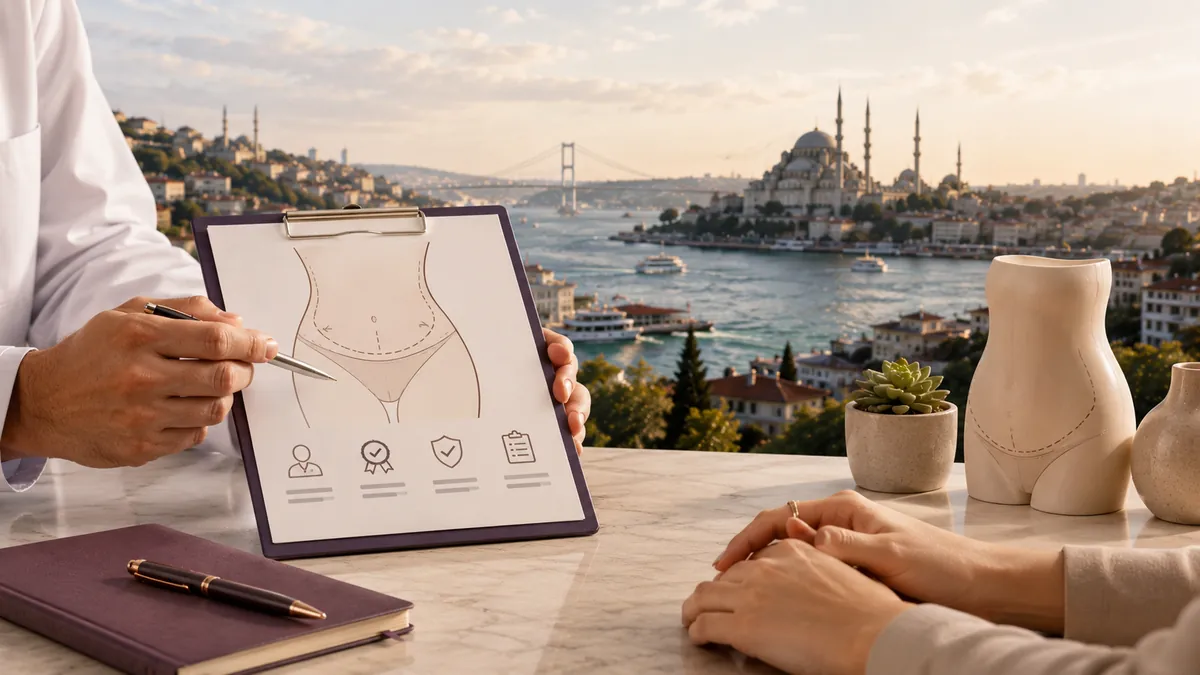
Every published safety analysis of medical tourism converges on the same finding — as our tummy tuck in Turkey guide explains — the biggest determinant of outcome is not the country, it is the surgeon and the facility. A well-credentialed plastic surgeon operating in a JCI-accredited hospital in Istanbul is not, in safety terms, meaningfully different from the same operation performed by an equivalent surgeon in Miami or New York. An unqualified operator working in an unaccredited facility is unsafe regardless of country. What follows is the checklist that separates the two.
This guide is written for the pre-consultation stage — the point where you have shortlisted 2–5 potential providers in Turkey and need to verify each of them before booking a video call, before paying a deposit, and certainly before flying.
1. Surgeon Credentials to Verify
Three credentials matter for a Turkish plastic surgeon, in order of importance:
Turkish national board (TSPRAS / TPRECD)
The Turkish Society of Plastic Reconstructive and Aesthetic Surgeons (TSPRAS, also referred to as TPRECD in Turkish) is the national specialty society. Turkey has formal board certification in plastic surgery through the Ministry of Health training pathway; TSPRAS membership is the professional-community equivalent. Any legitimate plastic surgeon in Turkey holds this — it is comparable to US board certification by the American Board of Plastic Surgery (ABPS).
How to verify: The TSPRAS website publishes a member directory. Search by name and city. A surgeon who claims plastic surgery training but does not appear in the directory should be treated with caution.
ISAPS (International Society of Aesthetic Plastic Surgery)
ISAPS membership is a widely-recognized international credential for aesthetic plastic surgeons. Members go through a peer-review admission process, must hold local board certification, and are held to a common code of ethics.1 ISAPS is a strong secondary credential — not a substitute for national board certification, but a meaningful international overlay.
How to verify: The ISAPS "Find a Surgeon" tool at isaps.org/find-a-surgeon/ lets you search by country and city. Verified members have a full profile.
EBOPRAS (European Board of Plastic Reconstructive and Aesthetic Surgery)
EBOPRAS is the European specialty board equivalent, applying a common standard across EU and associated countries. A Turkish surgeon holding EBOPRAS certification has met a rigorous continental-level standard.
How to verify: The EBOPRAS website publishes a certified surgeons directory.
Turkish Ministry of Health licence
Every practising physician in Turkey has a Ministry of Health licence number. This is a basic verification step — any surgeon should be able to provide their licence number on request, and it is cross-referenceable in the Ministry's registry. If a "surgeon" cannot provide this, they may not actually be a licensed doctor.
2. Hospital & Facility Accreditation
Turkish plastic surgery is often performed in one of three settings, in order of preferred safety:
- JCI-accredited private hospitals — the gold standard, with international safety systems, formal sterile-technique protocols, credentialed anaesthesia teams, ICU backup, and formal complication management pathways. Turkey has more JCI-accredited hospitals than any other country in the world.2
- Non-JCI accredited private hospitals — most are still perfectly safe for elective plastic surgery; they hold Ministry of Health private hospital licensing and often ISO 9001 quality certification.
- Ambulatory surgical centres / "clinics" — vary widely. Some are excellent day-surgery facilities; others lack the overnight-stay capacity and ICU backup that abdominoplasty warrants. The critical question is: where do you go if there is a complication overnight?
For a full tummy tuck (larger operation, one to two nights hospital stay), the safest structure is JCI-accredited hospital, in-patient stay. This is what leading Turkish plastic surgeons for international patients use as their default.
How to verify JCI status: The JCI accreditation directory at jointcommissioninternational.org lists every accredited hospital globally. Filter by country: Turkey. A surgeon who claims JCI-accreditation for their operating hospital should have that hospital appear in the directory.
3. Video Consultation Structure
The video consultation is your one pre-trip opportunity to build a real surgeon-patient relationship. The specific requirements:
Who attends
- The actual operating surgeon, not a "patient coordinator" or salesperson.
- Optionally with a translator, if the surgeon's English is not fluent.
- You (and, if you want, your traveling companion).
If the person you speak to on video is not the surgeon who will operate on you, you are speaking to a marketing operation — decline and move on.
What you bring
- Front, side, and back photos of your abdomen, in good light, in fitted clothing.
- Full medical history: prior operations, medications, allergies, medical conditions, BMI and weight-stability history, pregnancies and C-sections, smoking status.
- Specific questions you want answered.
4. Ten Questions That Reveal the Surgeon
A structured question set separates real surgeons from marketing operations:
- "Are you the surgeon who will perform the operation, and is your name on the informed-consent document?" Yes, must be specific.
- "Which specific accredited hospital will the operation be performed in?" Named hospital, verifiable accreditation.
- "Based on my photos and history, what variant do you recommend and why?" Should be specific to your anatomy — mini vs full vs extended vs fleur-de-lis reasoning.
- "What is your seroma rate and your overall complication rate?" A surgeon who tracks this rigorously will share numbers; vague answers are weaker.
- "Do you use progressive tension sutures / drainless technique?" — see our drainless guide.
- "What VTE (DVT/PE) prophylaxis protocol do you use?" Should specifically mention early ambulation, mechanical prophylaxis (SCDs), and chemical prophylaxis where indicated.
- "How many nights in hospital, and how many nights in hotel before flying home?" A full tummy tuck warrants at least 1–2 nights hospital + at least 5–6 nights before flying.
- "Who covers the cost if I have a complication during my stay?" Included in package or specifically stated.
- "What is the post-return-home follow-up protocol — video visits, communication with my home primary care physician (PCP) if needed?" Structured, not ad-hoc.
- "Can you share before/after photos of your own patients with a similar body type?" Should be able to; generic stock photos are a red flag.
The surgeon's answers on these ten questions collectively tell you more about the safety of the operation than their marketing website ever will.
5. Red-Flag Patterns
The specific patterns that should end the conversation:
- The operation performed by a "team" rather than a named surgeon, or the surgeon-of-record differs from who you consulted with.
- Unnamed or unverifiable hospital.
- All consultation done via WhatsApp with no video call.
- Surgeon not listed in ISAPS / EBOPRAS / TSPRAS directories.
- Pressure to book within hours of first contact.
- Refusal to itemise what the package includes — see the Turkey cost guide.
- Suggestion that hospital stay can be skipped or shortened to save cost.
- Prices well below the sustainable market (under $2,500 all-in for a full tummy tuck).
- Claims that combined procedures (mommy makeover plus additional work) are risk-free — the safety-database evidence on combined procedures shows they have specific, real risk considerations.3
- Refusal to name the anaesthesiologist or confirm they will be present throughout the operation.
- "Verified by our own review platform" as the primary trust marker (rather than independent credentialing).
- The surgeon operates alone with no formal facility or accreditation.
Any single one of these should raise concern; two or more should end the process. There are enough well-credentialed surgeons in reputable JCI-accredited hospitals in Turkey that you never need to compromise on any of these.
6. Practical Shortlisting Process
A workable process from initial research to booking:
- Long list (5–10 candidates) from initial research — a mix of surgeon-first (individual practices) and hospital-affiliated names.
- First-pass credential check: does each surgeon appear in TSPRAS + ISAPS or EBOPRAS? Drop any that fail. Typically leaves 4–7.
- Hospital verification: which hospital do they operate in, and is it JCI-accredited (or at minimum, a well-established private hospital)? Drop any that fail.
- Written package request: itemised breakdown of what is included, hospital name, hotel name, transfer arrangements, follow-up structure, complication policy.
- Video consultation (2–3 surgeons): structured 30–45 minute video with the actual surgeon, using the ten-question set.
- Choose the surgeon whose answers were most specific and whose communication was clearest. Not necessarily the cheapest.
- Written contract before deposit — including named surgeon, named hospital, package inclusions, timeline, and complication policy.
- Book flights only after contract is signed and deposit paid; not before.
Time from starting research to booking: typically 2–6 weeks for a considered decision. Anyone pressuring you to compress that timeline is optimising for their close rate, not your outcome.
FAQ
How do I know if a Turkish plastic surgeon is board-certified?
Three verifiable credentials to look for: (1) membership in the Turkish Society of Plastic Reconstructive and Aesthetic Surgeons (TSPRAS/TPRECD) — the national board equivalent; (2) European Board certification via EBOPRAS; (3) international society membership in ISAPS.1 All three publish member directories that you can search directly. Any legitimate surgeon should hold at least the Turkish national board equivalent — that is the equivalent of US board-certification in plastic surgery. ISAPS and EBOPRAS are additional international credentialing.
What hospital accreditation should I look for in Turkey?
The gold-standard accreditation is JCI (Joint Commission International) — the international arm of the same body that accredits US hospitals. JCI publishes a searchable directory of accredited hospitals globally, and Turkey has more JCI-accredited hospitals than any other country.2 Alternative or supplementary accreditations include ISO 9001 for quality management, ESQH (European Society for Quality in Healthcare), and Turkish Ministry of Health private hospital licensing (baseline requirement). For international patients, JCI accreditation on the hospital where your operation will actually be performed is the single most useful verifiable safety marker.
What questions should I ask at video consultation?
Ten questions that separate real surgeons from marketing operations: (1) Are you the surgeon who will perform the operation, and is your name on the informed-consent document? (2) Which specific accredited hospital will the operation be performed in? (3) Based on my photos, what variant do you recommend and why? (4) What is your seroma rate and your complication rate? (5) Do you use progressive tension sutures / drainless technique? (6) What VTE prophylaxis protocol do you use? (7) How many nights in hospital, and how many nights in hotel before flying home? (8) Who covers the cost if I have a complication during my stay? (9) What is the post-return-home protocol — video follow-ups, communication with my home primary care physician (PCP) if needed? (10) Can you share before/after photos of your own patients with a similar body type?
How do I verify a Turkish surgeon's credentials?
Concrete steps: (1) Search the ISAPS member directory at isaps.org — the surgeon should appear with a verified profile, city, and hospital affiliation. (2) Search the EBOPRAS certified surgeons directory. (3) Search the TSPRAS member listing. (4) Ask directly for the surgeon's Turkish Ministry of Health licence number (mandatory) and cross-reference against the Ministry's registry. (5) Verify the specific hospital's JCI accreditation status directly at jointcommissioninternational.org. If any of these searches turn up empty, that is a serious red flag.
What are the biggest red flags when choosing a Turkey surgeon?
The specific patterns that should end the conversation: (1) the operation performed by a "team" rather than a named surgeon, or the surgeon-of-record differs from who you consulted with; (2) unnamed or unverifiable hospital; (3) all consultation done via WhatsApp with no video call; (4) surgeon not listed in ISAPS/EBOPRAS/TSPRAS directories; (5) pressure to book within hours of first contact; (6) refusal to itemise what the package includes; (7) suggestion that hospital stay can be skipped or shortened to save cost; (8) prices well below the sustainable market (under $2,500 all-in for a full tummy tuck); (9) claims that combined procedures (mommy makeover plus other work) are risk-free;3 (10) refusal to name the anaesthesiologist or confirm they will be present throughout the operation.
Do most Turkey tummy tuck patients see the same surgeon before and during?
With reputable providers, yes. The correct structure is: initial photos and history reviewed by the actual operating surgeon; video pre-op consultation with the surgeon themselves; in-person pre-op consultation on arrival (usually the day before surgery) with the same surgeon; operation performed by that surgeon; post-op checks and discharge by that surgeon or their trained team. If the person consulting you on video is a "patient coordinator" and the actual surgeon is only introduced on the day of surgery, that is a marketing-agency structure rather than a proper surgeon-patient relationship.