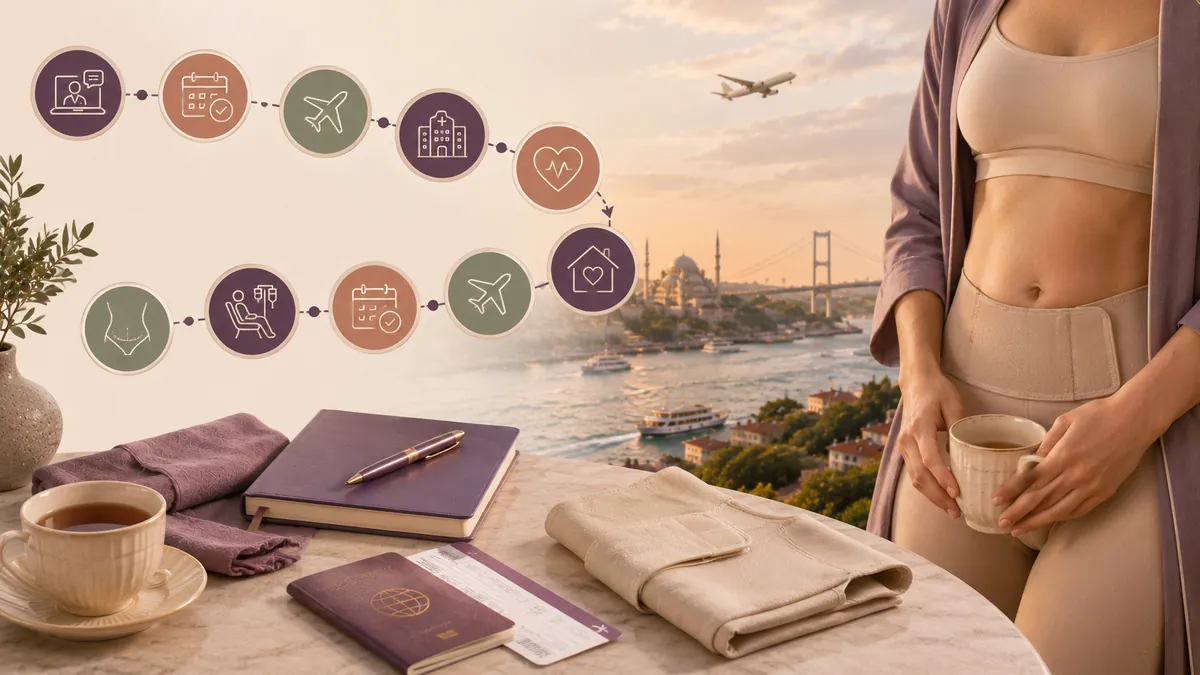
Medical travel for a tummy tuck is a logistics exercise as much as a medical one — our tummy tuck in Turkey guide covers the broader picture. The operation itself takes 2 to 4 hours; the surrounding trip takes 7 to 10 days and includes visa considerations, flight timing, hospital admission, hotel recovery, and a carefully-timed return flight. This page walks through the whole thing day by day, with the specific decisions that peer-reviewed analyses of cosmetic-tourism complications4 and dedicated adverse-outcomes analysis of cosmetic surgery medical tourism3 identify as decisive.
Before Booking (Weeks −8 to −4)
The most consequential decisions happen before you book. In the weeks before travel:
- Verify the surgeon's board status — Turkish plastic surgeons should be listed in the ISAPS directory and hold TSPRAS national board certification.2 Full detail in our choosing a surgeon guide.
- Verify the hospital's accreditation — JCI accreditation is the international gold standard and is directly verifiable in the JCI directory.2
- Have a video consultation with the operating surgeon (not just a coordinator). Get the surgeon's name, credentials, and specific technique recommendation in writing.
- Establish a local follow-up plan — identify a local PCP or plastic surgery office at home willing to review your incision if needed after return.
- Book flights that keep you on the ground for at least 7 days post-op — outbound flight day −1 or day −2 of surgery; return flight day +7 to +10 minimum.
- Purchase travel insurance that covers medical repatriation. Most standard travel policies exclude complications of elective cosmetic surgery; specialist medical-tourism cover exists.
- Complete pre-op requirements: stop smoking 4+ weeks pre-op (evidence-based safety requirement — see our candidacy guide), stabilise weight, arrange time off work.
Day-by-Day: The Trip Itself
Day 0 — Arrival
Arrive at the Turkish airport (Istanbul IST or SAW; Antalya; Izmir; Ankara depending on your surgeon's location). Reputable packages include an airport pickup by driver — confirm the driver's name and vehicle in advance. Transfer to the hotel (typically 30–60 minutes from Istanbul airports). Rest, hydrate, adjust to time zone. Avoid alcohol.
Day 1 — In-Person Consultation and Medical Workup
First in-person meeting with the surgeon at their clinic or the hospital. Physical exam, photographs, and confirmation of the operative plan. Pre-op blood tests (typically CBC, coagulation, kidney/liver function, blood glucose), ECG, and anaesthesia consultation. Signing of informed consent documents. This is your opportunity to raise any final questions — the surgeon should confirm technique (drainless vs drain, mini vs full), extent of muscle repair, incision plan, and specific expected recovery.
Day 2 — Surgery
Admitted to the hospital early morning. Fasting from midnight the night before. Preparation includes pre-op VTE prophylaxis (compression stockings, sometimes low-dose anticoagulant), marking of the incision, and anaesthesia induction. The operation itself takes 2 to 4 hours for a standard full tummy tuck, longer for extended or combined operations. Recovery in the post-anaesthesia unit, then transfer to a room. First few hours: sips of water, gradual mobilisation to a chair, early walking under supervision. The largest US abdominoplasty safety review emphasises that early ambulation is a specific DVT-reduction measure.5
Days 3–4 — Hospital Recovery
One to two nights in the hospital. Overnight nursing care, IV fluids and analgesia, monitoring for early complications (bleeding, low blood pressure, urinary retention). Progressive mobilisation — walking to the bathroom, walking short distances in the corridor, drinking, eating soft food. Compression garment fitted before discharge. Discharge to the hotel typically Day 3 or Day 4.
Days 5–7 — Hotel Recovery
Hotel-based recovery with daily walking, garment wear, prescribed medications, and a clinic follow-up mid-week for drain check or PTS-technique verification, dressing change, and clinical review. This is when the operation starts to feel more normal — pain reduces meaningfully by Day 5, mobility improves, and most patients are managing basic self-care independently by Day 7. Companion involvement remains helpful for mobility and monitoring warning signs.
Days 8–10 — Final Follow-up and Return Home
Final in-person follow-up with the surgeon. Wound check, garment review, discussion of the home recovery plan (scar care, activity restrictions, when to resume work and exercise), removal of any remaining sutures, and written safe-to-fly clearance. Airport transfer, flight home. On the flight: walk every 60–90 minutes, hydrate, wear the compression garment and stockings continuously — the specific measures that address the DVT risk of long-haul travel post-surgery.1
After You Return Home
The most consequential ongoing risks are DVT/PE, seroma, and wound complications. In the first 4 weeks after return: continue garment wear, continue walking daily, follow scar-care instructions, and stay in WhatsApp contact with the Turkey surgeon.
Warning signs that warrant local emergency care (not waiting for a Turkey consultation): chest pain or shortness of breath (possible PE — call emergency services), calf pain or swelling on one side (possible DVT), fever above 38.5 °C / 101.3 °F, spreading redness or foul-smelling drainage from the incision, rapidly enlarging fluid collection (possible seroma or hematoma), wound edges pulling apart. See our warning signs guide and DVT/PE guide.
What Not to Do (Cosmetic-Tourism Failure Patterns)
The dedicated adverse-outcomes analysis of cosmetic surgery medical tourism identifies specific recurring patterns in complications.3 Reading these as a checklist of what to avoid:
- Choosing on price alone — treating this as a normal purchase decision rather than an elective operation with a real complication rate.
- Booking a flight home earlier than Day 7 post-op — the biggest single tourism-specific safety error.
- Skipping the video consultation and booking from photos and price.
- Assuming a "5-star" hotel means a well-accredited hospital — they are unrelated.
- Combining multiple large operations in one trip to "make the flight worth it."
- No plan for local follow-up on return.
- Not disclosing full medical history to save time or embarrassment.
FAQ
-
How long does the whole trip take?
A standard full tummy tuck trip to Turkey is 7 to 10 days from arrival to safe-to-fly clearance. Typical breakdown: Day 0 arrival, Day 1 consultation and pre-op workup, Day 2 operation, Days 3–4 hospital, Days 5–7 hotel recovery with drain removal or PTS check, Days 8–10 final follow-up and safe-to-fly clearance. Extended or fleur-de-lis operations may add 1–2 days.
-
When is it safe to fly home after a tummy tuck in Turkey?
Most surgeons clear patients to fly home 7 to 10 days post-op after a standard full tummy tuck, once the immediate wound-healing and swelling are stable. Flying before day 7 is generally discouraged because the combination of recent abdominal surgery and prolonged sitting on a long-haul flight raises the risk of deep vein thrombosis.1 On the flight home, walking every 60–90 minutes, staying hydrated, wearing compression stockings, and continuing the abdominal compression garment are the specific measures that reduce that risk.
-
What documents do I need before I fly to Turkey for surgery?
US passport holders need a Turkish e-Visa (currently $50, applied for online, typically issued within 24 hours). You should bring: a passport with at least 6 months' validity, an appointment confirmation from your surgeon, your medical history and any relevant records, a list of current medications, travel insurance that covers medical repatriation, and a credit card for incidentals. Some clinics send a formal invitation letter for immigration purposes — carry a printed copy.
-
What should I pack for a tummy tuck trip to Turkey?
Loose-fitting clothes that pull on rather than over the head (button-front tops), slip-on shoes (bending is difficult early post-op), a small pillow for the flight home to press against the abdomen when coughing, all your prescription medications in original bottles, glasses and contacts, phone chargers with a Type F plug adapter (Turkey uses the EU-standard round two-pin plug — US chargers will not fit without one), a small first-aid kit for the hotel days (acetaminophen/Tylenol, small dressings), and clothes to accommodate the compression garment. Most clinics provide the garment; confirm before packing your own.
-
What if I develop a complication after I return home?
Establish a local plastic surgeon or primary care physician (PCP) willing to review your incision, drains (if applicable), or any complication before you travel. Bring your operative report and post-op instructions on your phone and printed. Your Turkey surgeon should provide a phone/WhatsApp channel for follow-up questions for at least 6 months. Any serious symptom — chest pain, shortness of breath, calf swelling, fever, spreading redness, or wound dehiscence — is a local emergency and should go to the local emergency department, not wait for a Turkey consultation. Emergency care in your home country is not affected by having had surgery abroad.
-
Can I bring a companion? Is it required?
Bringing a companion is strongly recommended and some clinics require it for the hospital and immediate post-op period. A companion helps with mobility (getting to the bathroom, walking during recovery), watches for warning signs during the higher-risk early period, manages practicalities during the days you are least mobile, and provides psychological support in a foreign environment. Most all-inclusive packages include a hotel room adequate for two people; confirm at booking.