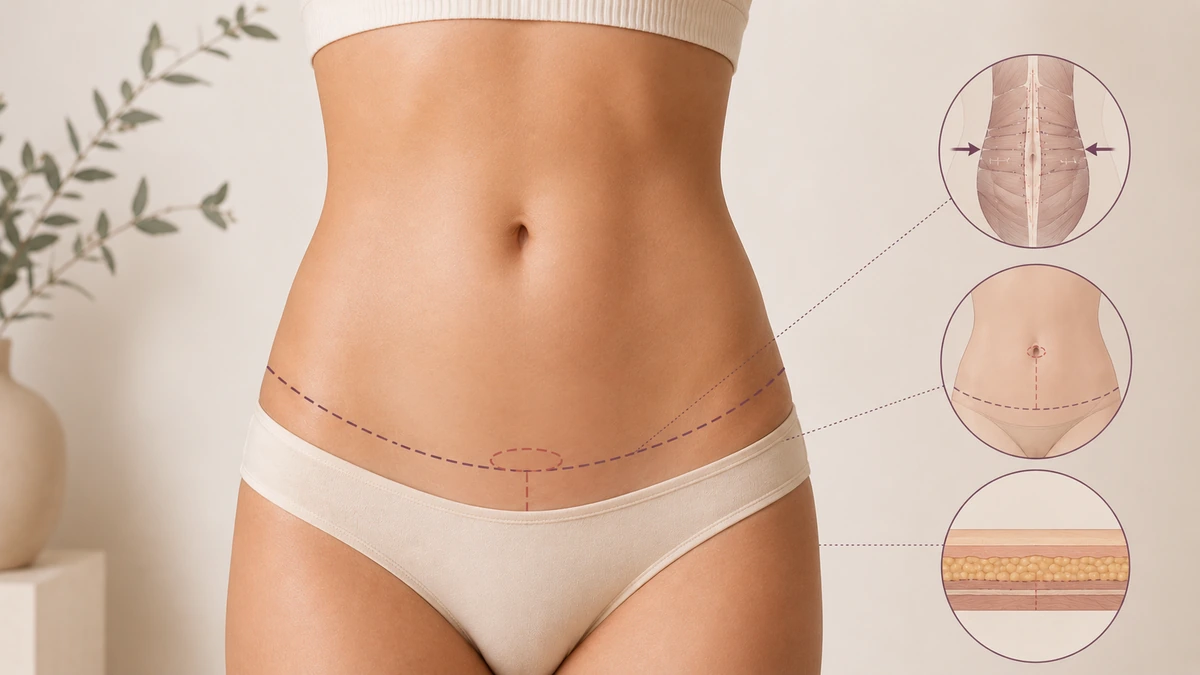
A mini tummy tuck is the shorter, gentler cousin of the standard abdominoplasty — but the word "mini" hides more than it reveals. It is a real operation, not a lunchtime procedure, and it fixes a specific and relatively narrow problem: laxity of the skin below the belly button. If your concerns extend above the umbilicus, into the flanks, or involve separated abdominal muscles from pregnancy, a mini will not be enough. Understanding exactly what it does — and what it doesn't — is the difference between a result you love and a costly compromise.
Most people searching "mini tummy tuck" are trying to avoid the longer scar and recovery of a full abdominoplasty. That instinct is understandable. But candidacy, not preference, decides which operation fits. This guide walks through what a mini actually is, who it fits (and who it doesn't), the scar and procedure, realistic results, recovery week-by-week, and honest cost ranges for the US and Turkey — with a clear read on when to consider a full instead.
What Is a Mini Tummy Tuck?
A mini tummy tuck — clinically a partial or mini abdominoplasty — is a body-contouring operation that removes excess skin and a small amount of fat from the area below the belly button only. The original technique was described in 1987 as a way to address lower-abdominal laxity without the extensive undermining and long scar of a full abdominoplasty.3 The idea was simple: many patients only have a small skin excess in the lower abdomen — why put them through a hip-to-hip incision and a repositioned belly button when a shorter operation can address the same complaint?
Compared with a full abdominoplasty, a mini is characterised by four things: a shorter horizontal incision (typically 4 to 6 inches, above the pubis), skin lift and excision only below the umbilicus, an umbilicus that is preserved in place rather than repositioned through a new opening, and — usually — no full muscle repair. The full-length guide to what a tummy tuck is explains why those three surgical steps (skin, muscle, belly button) matter; a mini deliberately keeps two of them out of the operation.
Mini vs Full Tummy Tuck — Key Differences
The single most common conversation about a mini is whether it is enough. A side-by-side comparison makes the trade-offs concrete.
| Feature | Mini Tummy Tuck | Full Tummy Tuck |
|---|---|---|
| Skin removed | Lower abdomen only (below navel) | Full abdomen (rib cage to pubis) |
| Scar length | Short: 4 – 6 in. | Hip-to-hip |
| Belly button | Preserved (no ring scar) | Repositioned through new opening |
| Muscle repair | Limited (usually none) or infraumbilical only | Full plication, sternum to pubis |
| Surgery time | 1 – 2 hours | 3 – 5 hours |
| Anaesthesia | General or IV sedation + local | General |
| Desk work | 1 – 2 weeks | 2 – 4 weeks |
| Full recovery | 4 – 6 weeks | 6 – 12 weeks |
| Best for | Isolated lower-belly skin laxity, minimal or no diastasis | Most post-pregnancy and post-weight-loss patients |
| US surgeon fee | $4,500 – $8,500 | $8,000 – $13,500 |
Retrospective series that classify abdominoplasty variants place the mini at one end of a continuum — a shorter, more limited operation appropriate for a specific patient subset, and not intended to replace a full for patients who need muscle repair or full-length skin excision.4 Modern variants have also expanded the mini's usefulness — for example, techniques that combine mini-abdominoplasty with limited plication of the lower rectus fascia when infraumbilical diastasis is present.1
Continue: Mini vs Full Tummy Tuck — the full decision guide →Who Is a Good Candidate?
Candidacy is where most mini vs full decisions actually get made. A mini looks tempting on paper — shorter scar, faster recovery, lower cost — but if your anatomy needs more, the mini simply cannot deliver it. Overselecting a mini is one of the most common causes of an unhappy tummy-tuck patient.
You may be a good mini candidate if:
- Your skin excess and laxity are confined to below the belly button. Pinch tests done standing and lying show loose skin only in the infraumbilical region.
- You have minimal or no diastasis recti above the umbilicus — or a small area of infraumbilical separation only.
- Your upper abdominal skin has good elasticity and snaps back when pulled.
- Your BMI is under 30 and you are weight-stable for at least 6 months.
- You are a non-smoker, or willing to stop for at least 4 weeks before and after surgery.
- You are done having children — future pregnancy can undo the aesthetic result and stretch even repaired lower muscles.
- You are in otherwise good general health (no active infection, uncontrolled diabetes, bleeding disorder, or serious cardiac/pulmonary condition).
- You have realistic expectations — a flatter lower belly with a short horizontal scar, not a complete "reset" of the entire abdomen.
A mini is not right for you if:
- You have skin laxity that extends above the belly button (visible when you bend forward or wear low-rise clothing) — a mini leaves that skin exactly where it is.
- You have significant diastasis recti above the umbilicus, especially post-pregnancy. Learn more about the condition in our diastasis recti guide.
- You have stretch marks running from the ribs down to the pubis — a mini removes only the lower marks; the upper ones remain.
- Your goal is a fully flat, tight midsection after multiple pregnancies. That result almost always requires a full tummy tuck.
- Your BMI is above 30 or you have plans for further significant weight loss.
A well-published umbilical-float mini-abdominoplasty series specifically emphasises patient selection as the single biggest factor in outcome quality — the operation works well for the anatomy it was designed for and disappoints when stretched beyond it.2 The full candidacy guide walks through each BMI, health, and lifestyle threshold in more detail.
Continue: Am I a candidate for a tummy tuck? — Full BMI & health guide →The Procedure & Scar
A mini tummy tuck is a short, well-defined operation, but it is still major surgery — performed in an accredited surgical facility, under anaesthesia, with the same infection-control, monitoring, and thromboprophylaxis standards as any abdominal procedure.
What happens in the operating room
After you are anaesthetised, the surgeon makes a low horizontal incision above the pubic hairline — typically 4 to 6 inches long. In patients with a prior C-section scar, the mini incision is often placed within or extended from the existing scar so no new visible line is created. The surgeon lifts the skin of the lower abdomen off the underlying muscle up to the level of the belly button, exposes the infraumbilical area, and — if diastasis is present in that area only — may place a limited row of plication sutures in the lower rectus fascia.
In a classic mini, the belly button remains attached to its stalk and untouched; no new opening is cut in the skin around it. In an umbilical-float mini, the belly button is temporarily detached from the skin, the skin above it is pulled down, and the belly button is re-attached slightly lower — still without a visible ring scar around it. The excess skin below is trimmed, and the incision is closed in layers. Drains are used less often than in a full tummy tuck; many surgeons place progressive-tension sutures instead of drains. The operation typically takes 1 to 2 hours, and most patients go home the same day.
The scar
The visible scar after a mini tummy tuck is a single short horizontal line above the pubis. Its length depends on how much skin is removed and how the surgeon tapers the ends to avoid "dog ears" (small folds of extra skin at the corners). Positioned correctly, the scar sits below the waistline of most underwear and bikini bottoms. Like any surgical scar, it looks red or pink for the first several months, then fades over 12 to 18 months. Scar quality depends on genetics, skin type, smoking status, and post-op care — silicone gel or sheeting and sun protection are the two most evidence-supported home measures. Because the belly button is preserved, there is no periumbilical scar — one of the main aesthetic reasons patients specifically request a mini.
Before & After: Realistic Expectations
A well-executed mini tummy tuck delivers a flatter, tighter lower abdomen with a short concealable scar and no belly-button ring. The upper abdomen — from the belly button to the rib cage — looks essentially the same as it did before, because the operation does not touch it. That is the honest trade-off.
Patients who accept that trade-off tend to be delighted; patients who expected a "full reset" often report their result "looks half done" — because in a sense, it does. If you have any doubt about whether your issues stop at the belly button, book two consultations, ask both surgeons to draw the planned excision zone on your skin, and see how much of your concern falls above the marked line. If a lot of it does, that is the mini's honest limitation showing itself, not a shortcoming of the surgeon.
Results are considered stable at around 3 to 6 months post-op, when swelling has fully resolved. As with any body-contouring result, weight change and pregnancy after the operation can alter the outcome — the mini tummy tuck's result depends on the abdominal skin and (if repaired) fascia holding steady over time.
Recovery & Downtime
The main practical appeal of a mini over a full is recovery. The operation removes less tissue, involves less undermining, and — if muscle repair is skipped or limited — puts far less mechanical load on the abdominal wall. That translates to a shorter, more predictable recovery for most patients.
First few days
Most patients go home the same day, wearing a compression garment. Pain is manageable with a mix of acetaminophen, an NSAID (as approved by your surgeon), and — for the first 24 to 48 hours — a short course of low-dose opioids. If drains are used, they are typically removed within a few days. Patients are asked to walk short distances several times a day starting the evening of surgery to reduce the risk of venous thromboembolism.
Weeks 1 to 4
Most patients return to desk-based work at 1 to 2 weeks, though sleeping on the back with knees bent (to protect the incision) and continuous garment wear are usually required through week 4. Light walking is encouraged from week 1; brisk walking and non-abdominal light exercise from week 3. Swelling peaks around days 3 to 5 and gradually declines through weeks 2 to 6.
Weeks 4 to 6
Most restrictions lift between weeks 4 and 6: return to gym-level exercise, resumption of core work (started cautiously if any muscle repair was performed), and driving without restrictions. Full recovery — meaning you are back to your baseline, not a textbook average — is usually complete by week 6, with residual minor swelling that resolves over the following 2 to 3 months.
When to call your surgeon
Any elective abdominal surgery carries a small but real risk of serious complications — the largest US safety review of over 25,000 abdominoplasties reported an overall major complication rate of about 4.0% across all variants, higher than most other cosmetic procedures.5 While mini abdominoplasties are on the lower end of that risk (less undermining and shorter operating time), the specific warnings still apply. Call your surgeon promptly for calf pain or swelling (possible DVT), sudden shortness of breath (possible pulmonary embolism), fever above 38.5 °C / 101.3 °F, spreading redness or drainage from the incision, or a rapidly enlarging fluid collection (seroma).
Mini Tummy Tuck Cost
US costs for a mini tummy tuck are meaningfully lower than a full — but they are still a significant financial commitment, and quoted numbers vary widely by geography, surgeon experience, and facility type. The American Society of Plastic Surgeons publishes annual average surgeon fees; the numbers below reflect typical US ranges as of 2026.6
| Component | US | Turkey |
|---|---|---|
| Surgeon fee | $4,500 – $8,500 | Included in package |
| Anaesthesia | $700 – $1,500 | Included |
| Facility / OR | $800 – $2,000 | Included |
| Garment, follow-ups, meds | $200 – $500 | Included |
| Hotel/transfer | — | Included in most packages |
| Typical total | $6,000 – $12,000 | $2,500 – $4,000 all-in |
Insurance rarely covers a mini tummy tuck. It is considered a cosmetic operation, and no medical-necessity exception typically applies (unlike a panniculectomy for a hanging pannus, which can be insurance-eligible when documented). Financing plans and medical credit lines are the most common alternatives when the operation is not affordable out-of-pocket. Full US-vs-Turkey cost analysis is in our tummy tuck cost guide.
Continue: Mini Tummy Tuck Cost — a full breakdown →FAQ
-
What is the difference between a mini and a full tummy tuck?
A mini tummy tuck removes skin only from the lower abdomen (below the belly button), uses a short 4–6 inch scar, usually preserves the belly button, and rarely includes full muscle repair. A full tummy tuck removes skin from the entire abdomen (rib cage to pubis), uses a hip-to-hip scar, repositions the belly button through a new opening, and includes full rectus muscle plication. Most post-pregnancy patients need a full, not a mini — see our mini vs full decision guide.
-
Am I a good candidate for a mini tummy tuck?
You may be a good candidate if your excess skin and laxity are confined to below the belly button, you have minimal or no diastasis recti above the umbilicus, your BMI is under 30, you are a non-smoker, weight-stable, and done having children. If you have loose skin above the belly button, significant muscle separation, or stretch marks running from the ribs down, a full tummy tuck is usually the right operation.
-
How long is the recovery for a mini tummy tuck?
Most patients return to desk work in 1–2 weeks and light activity by 3–4 weeks; full recovery — including return to gym-level exercise — is usually 4–6 weeks. This is significantly shorter than a full tummy tuck (typically 6–12 weeks). Recovery depends on whether limited muscle repair was performed, drain use, and individual healing.
-
Does a mini tummy tuck include muscle repair?
Usually no, or only very limited repair. A classic mini abdominoplasty addresses skin and modest fat below the belly button and does not perform full rectus plication. If your surgeon finds diastasis in the lower abdomen only, they may add limited infraumbilical plication.1 If you have significant separation above the belly button, a mini will not fix it — you need a full tummy tuck.
-
How much does a mini tummy tuck cost?
In the US, surgeon fees for a mini tummy tuck typically run $4,500–$8,500, with total cost (anesthesia, facility, garment, follow-ups) reaching $6,000–$12,000. In Turkey, all-inclusive package pricing ranges from about $2,500–$4,000. Insurance rarely covers a mini tummy tuck because it is considered cosmetic. See our tummy tuck cost guide for the full US-vs-Turkey breakdown.
-
Will I have a belly button scar after a mini tummy tuck?
Usually no. In a classic mini tummy tuck the original belly button is left attached to its stalk and no new opening is cut in the skin around it — so there is no periumbilical scar. In an umbilical-float mini, the belly button is temporarily detached and lowered slightly, but there is still no visible ring scar around it.2 Your only visible scar is the short low horizontal incision above the pubic hairline.