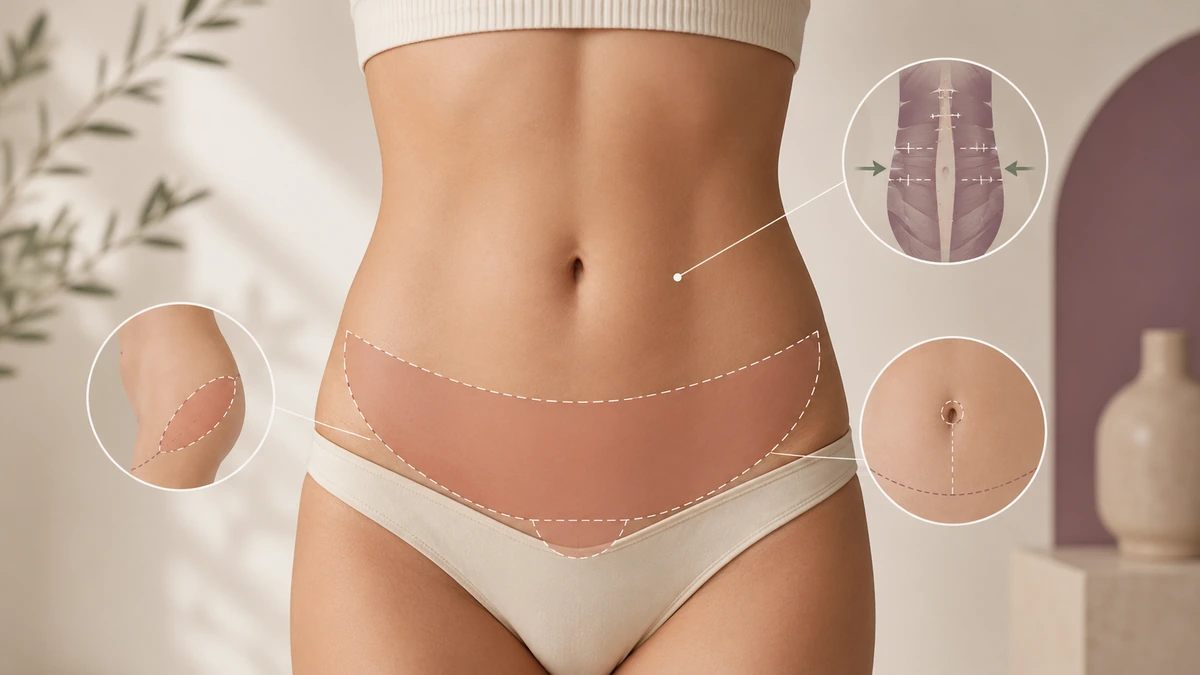
A tummy tuck — the term almost every US patient uses — is a plastic-surgery procedure that reshapes the lower abdomen. Surgeons and insurance companies call it abdominoplasty. In one operation it does three things: removes the loose skin left after pregnancy or major weight loss, tightens the abdominal wall by stitching the separated rectus muscles back together, and lowers and repositions the belly button so the result looks natural. What it is not is a shortcut to weight loss or a treatment for the deep fat that sits inside the abdominal cavity behind the muscles.
Most people searching "what is a tummy tuck" are trying to answer a bigger question: is this the right operation for me, or do I need something else? The honest answer depends on which of three problems you actually have — excess fat, excess skin, or muscle separation. This guide is a plain-English walk-through of the procedure, the main variants, who is (and isn't) a good candidate, how much a tummy tuck costs, and how it compares to related operations like liposuction and panniculectomy.
What a Tummy Tuck Is — and What It Isn't
According to the American Society of Plastic Surgeons (ASPS) procedural overview, an abdominoplasty is defined as the surgical removal of excess skin and fat from the middle and lower abdomen combined with tightening of the muscles of the abdominal wall.1 That definition matters because it clarifies what tummy-tuck patients often misunderstand.
What a tummy tuck is not
- It is not a weight-loss operation. The scale barely moves. The visual difference comes from removing skin and flattening the abdominal wall, not from removing large volumes of body mass. Bariatric surgery is a different specialty for a different problem.
- It is not liposuction. Liposuction removes fat. A tummy tuck removes skin (plus a modest amount of fat) and repairs muscle. Patients with good skin elasticity and localized fat may only need liposuction; patients with loose skin need a tummy tuck. The two are often combined (see below).
- It does not treat visceral fat. The hard, deep belly fat that sits behind the abdominal wall (the "beer-belly" pattern) cannot be reached with a tummy tuck. That fat is metabolic and responds to weight loss, not surgery.
- It is not a stretch-mark treatment. Stretch marks below the belly button are removed with the skin excision, but marks above are simply repositioned lower. A tummy tuck is not sold as a stretch-mark procedure.
What It Removes & Repairs
Every full tummy tuck combines three surgical steps. Understanding them makes the recovery and the scar make sense.
1. Excess skin removal
The surgeon makes a low horizontal incision from hip to hip, just above the pubic hairline, plus a second small incision around the belly button. The skin between the ribcage and the pubis is lifted like a sheet, drawn downward, and the excess is cut away. The remaining skin is re-draped and closed under gentle tension. The lower stretch marks come off with the skin; the upper ones are pulled lower and often become less visible. A permanent horizontal scar is unavoidable — its length depends on the type of tummy tuck (mini, full, extended, fleur-de-lis).
2. Muscle repair (rectus plication)
Pregnancy, rapid weight change, or a genetic predisposition can leave the two halves of the rectus abdominis muscle separated in the midline — a condition called diastasis recti. Sit-ups and planks cannot rejoin the fascia in significant cases. During a tummy tuck the surgeon stitches the two muscle bellies back together in the midline, from the sternum down to the pubis. This step — called rectus plication — is what actually gives the "flat" result and improves core function, and it is why post-pregnancy patients often need a tummy tuck rather than liposuction. A recent randomized trial of 86 women found no difference in one-year recurrence between suture-only plication and mesh-supported repair, supporting the use of the traditional plication technique for most patients.3
Continue: Muscle repair & diastasis recti — the full guide →3. Belly button repositioning (neoumbilicoplasty)
When the skin is pulled downward, the original belly button ends up in the wrong place. In a full tummy tuck the surgeon leaves the belly button attached to its underlying stalk, cuts a new small opening in the re-draped skin at the correct anatomical height, and sutures the original belly button through it. In a mini tummy tuck — where less skin is removed — the belly button is usually left alone or "floated" slightly. Belly-button appearance is one of the most-searched worries after surgery; the healing timeline is covered in our belly button after a tummy tuck guide.
Tummy Tuck Types at a Glance
"Tummy tuck" is an umbrella term. The variants differ in how much skin is removed, where the scar sits, and whether muscle repair is included. The type framework surgeons still use today traces back to the Matarasso classification system — one of the most-cited papers in the abdominoplasty literature — which grouped patients into four types by skin laxity, fat volume, and muscle diastasis to match the extent of surgery to the specific deformity.4
| Type | What It Addresses | Scar | Muscle Repair? |
|---|---|---|---|
| Mini | Lower-belly skin excess only, minimal | Short, low, above pubis | Limited or none |
| Full (standard) | Full-length lax skin, most post-pregnancy cases | Hip-to-hip, low | Yes — full plication |
| Extended | Skin excess extending onto the flanks | Extends past the hips | Yes |
| Fleur-de-Lis | Massive weight loss — vertical + horizontal excess | Anchor-shaped (horizontal + vertical) | Yes |
| Drainless | Same as full; no post-op drains via progressive-tension sutures | Same as full | Yes |
| Reverse / 360 | Upper-abdominal laxity (reverse) or circumferential (360) | Under the breast fold (reverse) or belt-line (360) | Situational |
The single most common conversation in a plastic surgeon's office is mini vs full. A mini looks tempting because the scar is short and downtime shorter — but for most post-pregnancy patients it does too little, and a full is what actually solves the problem. Fleur-de-lis is reserved for massive-weight-loss patients where a horizontal-only excision cannot remove enough skin — the full evidence base for this variant is covered in the dedicated fleur-de-lis guide.
Continue: Compare all tummy tuck types side by side →Am I a Candidate?
Plastic surgeons apply the same core screening for a tummy tuck regardless of the variant. A tummy tuck is considered elective — it should only be offered when the health risks are as low as they can reasonably be. Most surgeons require all of the following:
- BMI under 30 (some accept up to 32–35 with additional screening). A 2025 ACS-NSQIP analysis of 18,891 patients found obesity is an independent, dose-dependent predictor of complications after abdominoplasty.5
- Weight-stable for at least 6 months. Losing further weight after surgery re-creates skin laxity; gaining changes the result.
- Non-smoker, or willing to stop for at least 4 weeks before and after. Smoking cessation is one of the single most impactful things a candidate can do for a smooth recovery.
- Done having children, ideally. A future pregnancy can undo the muscle repair.
- No active infection, bleeding disorder, uncontrolled diabetes, or serious cardiac / pulmonary condition.
- Realistic expectations — a flatter, firmer midsection with a permanent low scar; not a "before/after" that erases years or pregnancies from your body.
Patients who don't yet meet these thresholds aren't rejected forever — most surgeons will help you plan (weight goals, smoking cessation, medical clearance) rather than operate on an elevated-risk candidate. The full candidacy guide walks through each threshold in detail with the exact medical evidence.
Continue: Am I a candidate for a tummy tuck? — Full BMI & health guide →Tummy Tuck vs Related Procedures
Three procedures are commonly confused because they all reshape the abdomen. The differences are functional, not cosmetic — each one solves a different problem.
| Feature | Tummy Tuck | Liposuction | Panniculectomy |
|---|---|---|---|
| Removes excess skin | Yes (defining feature) | No | Yes (the hanging apron only) |
| Removes fat | Modest amount | Yes (defining feature) | Only what is within the apron |
| Repairs muscles | Usually yes | No | No |
| Repositions belly button | Yes (full) | No | Sometimes |
| Insurance coverage | Rare (cosmetic) | None (cosmetic) | Sometimes (functional) |
| Typical patient | Post-pregnancy or moderate weight-loss | Localised fat, good skin | Post-bariatric with hanging pannus |
Tummy tuck vs liposuction
The rule of thumb: if you can pinch it and the skin snaps back, liposuction is enough. If the skin doesn't snap back — or you have a "shelf" that sits over the pants when you sit down — you need a tummy tuck. The two are often combined in a single operation called lipoabdominoplasty, where liposuction contours the flanks and back at the same time — the evidence base and candidacy for that combined approach is covered in our dedicated liposuction vs tummy tuck guide.
Continue: Liposuction vs Tummy Tuck — which do you actually need? →Tummy tuck vs panniculectomy
A panniculectomy removes only the excess skin apron (pannus) that hangs over the pubic area after major weight loss — no muscle repair, no contouring above the umbilicus. It is often considered a functional/reconstructive operation, and — unlike a cosmetic tummy tuck — can be covered by insurance when documented as medically necessary (our insurance coverage guide walks through the criteria) (chronic rash, infection, or functional impairment under the pannus). Coverage varies enormously by insurer and policy; a cross-sectional analysis of 55 US insurers found 98% covered panniculectomy under documented criteria, while only 30% also covered any component of abdominoplasty.6
Continue: Panniculectomy & insurance — when it's covered →FAQ
-
What is a tummy tuck?
A tummy tuck — clinically known as abdominoplasty — is a surgical procedure that removes excess skin and fat from the lower abdomen and, in most cases, repairs separated abdominal muscles (diastasis recti). It is a body-contouring operation, not a weight-loss treatment. The result is a flatter, firmer midsection; a permanent horizontal scar low on the abdomen is expected.
-
Is a tummy tuck the same as abdominoplasty?
Yes. "Tummy tuck" is the common patient term; "abdominoplasty" is the medical term used by plastic surgeons and in insurance paperwork. Both refer to the same category of surgery. Variants include mini abdominoplasty, full (standard) abdominoplasty, extended, fleur-de-lis, and reverse.
-
What does a tummy tuck actually remove?
A tummy tuck removes excess skin (the loose "apron" that remains after pregnancy or major weight loss), a modest amount of subcutaneous fat, and — when muscle repair is included — corrects the separation of the rectus abdominis muscles. It does not remove large volumes of fat (that is liposuction) and does not treat visceral fat inside the abdominal cavity.
-
Is a tummy tuck considered major surgery?
Yes. A full tummy tuck is a major operation performed under general anaesthesia, lasting 2–5 hours. It carries the usual risks of major surgery — bleeding, infection, and, at a higher rate than most cosmetic operations, venous thromboembolism (DVT/PE). The largest US safety review — 25,478 patients (CosmetAssure) — reported a major-complication rate of about 4.0%, higher than other aesthetic procedures.2 Choosing a board-certified plastic surgeon operating in an accredited facility is the single most effective risk-reduction step.
-
How is a tummy tuck different from liposuction?
Liposuction removes subcutaneous fat only — it does not tighten loose skin or repair separated muscles. A tummy tuck removes skin, tightens the abdominal wall, and repositions the belly button. Patients with good skin elasticity and localized fat need liposuction; patients with loose skin, an apron, or diastasis recti after pregnancy need a tummy tuck. The two can be combined in a single operation called lipoabdominoplasty in appropriate candidates.
-
How is a tummy tuck different from a panniculectomy?
A panniculectomy removes only the excess skin/fat "apron" (pannus) that hangs over the pubic area — usually after major weight loss. It does not include muscle repair or contouring. A tummy tuck does all three. Panniculectomy is often considered functional/reconstructive and may be covered by insurance when documented as medically necessary; a cosmetic abdominoplasty rarely is.