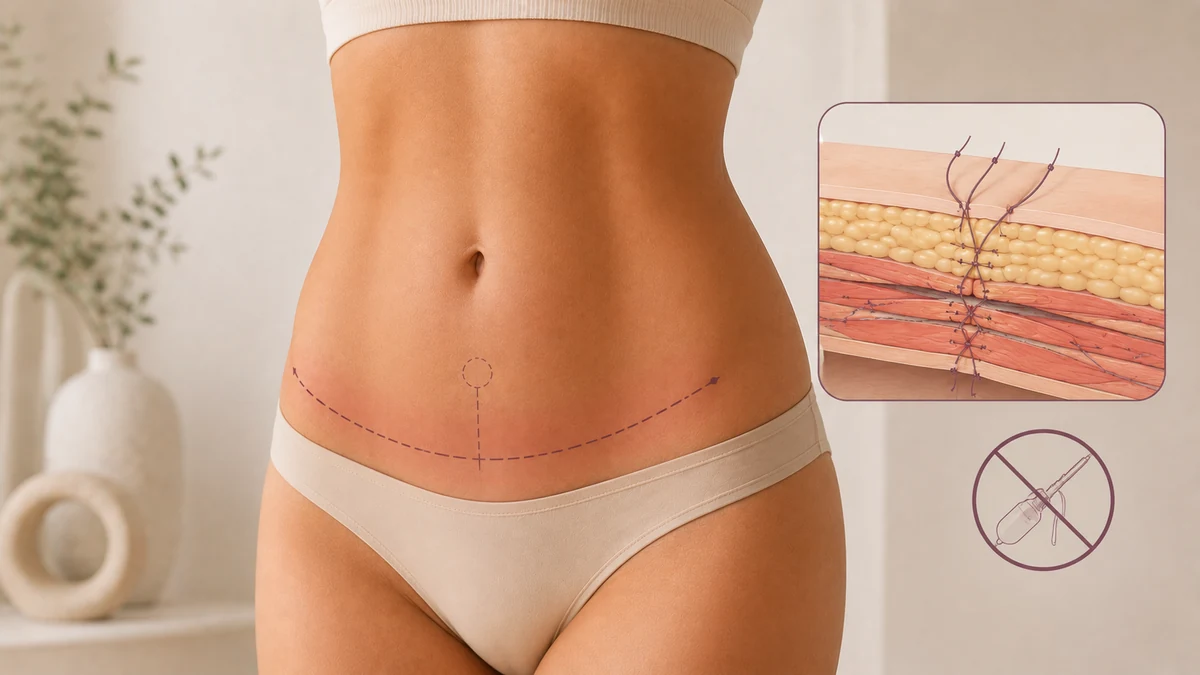
"Drainless tummy tuck" is one of the most-marketed and least-understood terms across all tummy tuck types. Patients often arrive at consultation thinking of it as a separate, distinctly-better operation. It is not — it is a technique choice applied to the standard abdominoplasty family. The underlying operation, the recovery arc, the safety envelope, and the final result are the same. What changes is the internal closure and, most tangibly for the patient, the first 1–2 weeks of post-op experience without drains to manage.
This page covers what "drainless" actually means, how progressive tension sutures work, the evidence on seroma rates, honest trade-offs, and how to evaluate whether a surgeon's drainless offer is a genuine technique or a marketing frame.
What Is a Drainless Tummy Tuck?
A drainless tummy tuck is a standard abdominoplasty performed with an internal suture technique — progressive tension sutures (PTS) — that eliminates the need for post-operative drains. It is not a new operation or a shorter operation; the sequence is the same as a full abdominoplasty: incision, skin flap elevation, muscle repair, umbilicus repositioning, skin excision, and closure. The change is at closure: rows of internal absorbable sutures secure the underside of the abdominal skin flap to the underlying rectus fascia at intervals.
These internal sutures serve two purposes: they reduce tension on the final skin closure (making the visible scar heal under less strain), and they close the small "dead spaces" between the flap and the muscle wall where lymphatic fluid, blood, and inflammatory exudate would otherwise pool as a seroma. Because that potential space is now closed by the sutures rather than kept clear by drains, drains become unnecessary.
How Progressive Tension Sutures Work
Progressive tension sutures are internal absorbable sutures — typically Vicryl or PDS — placed in rows at roughly 2–3 cm intervals across the entire abdominal flap. Each suture takes a bite of the underside of the flap and a bite of the underlying fascia, and is tied to bring the flap in direct apposition to the muscle wall at that point.
As each row is placed, the flap is progressively drawn inferiorly toward the incision line — this is the "progressive tension" the technique is named after. By the time the final row is placed, the skin at the closure line requires much less tension than a standard closure because most of the tension has already been distributed across the entire flap-to-fascia interface.
The technique was formally described by Harlan Pollock and Todd Pollock in a 2000 paper in Plastic and Reconstructive Surgery.1 It has since been studied in numerous single-surgeon and multi-center series, and modern meta-analytic evidence supports comparable-or-lower seroma rates versus drain-based closures in experienced hands.2
The Seroma-Rate Evidence
The main comparative-evidence claim for drainless is seroma rate comparable to or lower than drain-based closure. In the modern PTS literature, published series consistently report seroma rates in low single digits — often 1–3% — versus a wider range with drain-based closures.2 This is a meaningful comparison because seroma is the single most common complication after abdominoplasty and one of the most consequential in terms of patient comfort and time-to-return-to-normal.
The important caveat: seroma-rate comparisons are surgeon- and series-dependent, and the highest-quality drain-based closures also achieve low seroma rates. The claim is not "PTS is strictly better than drains" but "PTS is at least as good as drains when performed by a surgeon experienced with the technique — while eliminating drain-related morbidity."
What Changes for the Patient
Drain management eliminated
Patients with standard drains carry them for typically 5 to 14 days post-op. Management includes: emptying and measuring the drain output several times daily, recording volumes in a log, protecting the drain tubes during showering, sleeping with them attached to the body, and returning for drain-site care until removal. Drainless patients skip all of this. In reported patient-experience surveys, this is the single biggest satisfaction driver of the drainless technique.
No drain-site scars
Standard drain sites leave small (2–3 mm) puncture-hole scars, usually placed within the horizontal incision or hidden nearby. These heal well and are cosmetically minor, but they exist. Drainless patients have no drain-site scars.
Longer operation
Placing the PTS rows adds 20–40 minutes of operative time. For an already 2–4 hour full abdominoplasty, this is a modest addition; for a longer combined procedure, it can push the total OR time meaningfully. This is the main downside of the technique from an OR-planning perspective.
What does not change
The compression garment, post-op restrictions on activity, return-to-work timeline, return-to-exercise timeline, scar maturation timeline, and final result are all the same as a drain-based abdominoplasty. The underlying operation is unchanged; drainless does not shorten recovery, it changes the first 1–2 weeks of comfort. Full recovery arc in our recovery timeline guide.
Who Is a Candidate
Most standard abdominoplasty candidates are also drainless candidates. The technique applies across the abdominoplasty family:
- Mini tummy tuck — drainless is often the default for mini because the operation is smaller and the potential space more limited.
- Full abdominoplasty — drainless is now the standard for many high-volume surgeons.
- Extended — technically possible; some surgeons still use drains for the largest cases because of the larger raw surface area.
- Fleur-de-lis / post-bariatric — surgeon-dependent; the larger operation and post-bariatric tissue quality mean many surgeons still prefer drains in this population.
Individual factors that may weigh against drainless in a specific patient: extremely thin patients with minimal subcutaneous tissue (where PTS placement is more difficult), pre-existing wound-healing concerns, and specific coagulation issues. Combined procedures (particularly with breast surgery or lipoabdominoplasty involving large-volume liposuction) may still use drains at the surgeon's discretion.
General abdominoplasty candidacy considerations — BMI, smoking, comorbidities, weight stability — apply identically to drainless as to standard technique. Obesity independently raises complication rates across abdominoplasty variants regardless of drain approach.4 See our candidacy guide.
Questions to Ask at Consultation
The specific questions that separate a genuine drainless technique from a marketing frame:
- "Do you use progressive tension sutures as your primary technique?" The right answer is a yes with detail on how the surgeon learned it and how long they have used it.
- "What is your seroma rate?" A surgeon who tracks this rigorously — and shares it — is a good sign. "Very low" without a number is a weaker answer than "our published series shows X%."
- "When do you still use drains?" An honest surgeon will describe specific scenarios where they revert to drains (very large operations, specific tissue findings). "Never" is a less credible answer than "in most cases but for X patient profile I add a drain."
- "Does drainless cost more?" If the answer is a meaningful yes, question why — see the cost section below.
Cost
In practice, drainless does not cost meaningfully more than standard drain-based technique when performed by a surgeon who uses PTS as their default. The added OR time is typically absorbed into standard pricing. Cost ranges follow the underlying operation:
| Underlying operation | US all-in | Turkey all-in |
|---|---|---|
| Mini + drainless | $6,000 – $12,000 | $2,500 – $4,000 |
| Full + drainless | $10,000 – $18,000 | $3,500 – $5,500 |
| Extended + drainless | $12,000 – $20,000 | $4,000 – $6,500 |
If a surgeon quotes a substantial "drainless premium" (say $1,500+ over the same surgeon's drain-based price), treat it as a marketing framing rather than a genuine technique cost difference. Full pricing structure in our cost guide.
FAQ
-
What is a drainless tummy tuck?
A drainless tummy tuck is a standard abdominoplasty performed with a suture technique — progressive tension sutures (PTS) — that eliminates the need for post-operative drains. The underlying operation is unchanged: skin removal, muscle repair, umbilicus repositioning. What differs is the closure: rows of internal sutures secure the abdominal skin flap to the underlying muscle wall at intervals, closing the potential space where fluid would otherwise collect. In appropriately selected patients, published series report seroma rates comparable to or lower than standard drain-based closures.2
-
How do progressive tension sutures work?
Progressive tension sutures (PTS) are internal absorbable sutures placed in rows between the underside of the abdominal skin flap and the underlying rectus fascia. Each suture reduces tension on the final skin closure and closes off a small volume of the potential "dead space" where lymphatic and inflammatory fluid would otherwise pool as seroma. Rows are placed at roughly 2–3 cm intervals across the entire flap. The technique was first described by Pollock and Pollock in 20001 and has since been studied in numerous single-surgeon and multi-center series.
-
Is drainless safer than a drain-based tummy tuck?
Neither is intrinsically "safer" — both are safe in the right hands. Published series and meta-analyses of PTS report seroma rates comparable to or lower than standard drain-based closures.2 What the drainless technique removes is a specific set of drain-related complications (drain-tract infection, patient discomfort managing drains at home, minor drain-site scars). What it adds is a longer operative time (typically 20–40 minutes) and dependence on surgeon technique — PTS requires specific training and consistent execution. Overall abdominoplasty complication rates from large databases apply to both approaches;3 the difference is in the trade-offs, not the safety envelope.
-
Does a drainless tummy tuck feel better in recovery?
For most patients, yes — the drain-management burden of the first 1 to 2 weeks is real. Patients with standard drains have to empty and measure output multiple times daily, sleep with them attached, shower carefully, and manage the small ongoing discomfort of the drain tubes. Drainless patients skip all of that. Reported patient-satisfaction scores are typically higher for the drainless approach in comparative series. Note that this comfort benefit does not change post-op restrictions on activity, garment wear, or exercise — those follow the same timeline as any full abdominoplasty.
-
Am I a candidate for a drainless tummy tuck?
Most standard tummy tuck candidates are also drainless candidates — the technique is applicable to mini, full, and extended abdominoplasty. The primary requirement is that your surgeon is experienced with PTS and comfortable using it as their standard approach. Some surgeon-specific factors may guide selection: extremely thin patients with minimal subcutaneous tissue and certain patients with pre-existing wound-healing concerns may still benefit from a drain. Post-bariatric patients undergoing large operations (fleur-de-lis) may or may not be drainless depending on surgeon preference. The right question at consultation: "Do you use progressive tension sutures, and what is your seroma rate?"
-
Does drainless tummy tuck cost more?
In practice, no — most surgeons who offer drainless use it as their standard technique and charge the same fee as they would for a drain-based operation. The technique adds 20–40 minutes of operative time, which theoretically raises facility cost slightly, but this is typically absorbed into standard package pricing. Turkey packages that offer drainless technique typically do not price it separately either. If a surgeon quotes a meaningfully higher price for "drainless" specifically, treat it as a red flag for a marketing framing rather than a genuine technique difference.