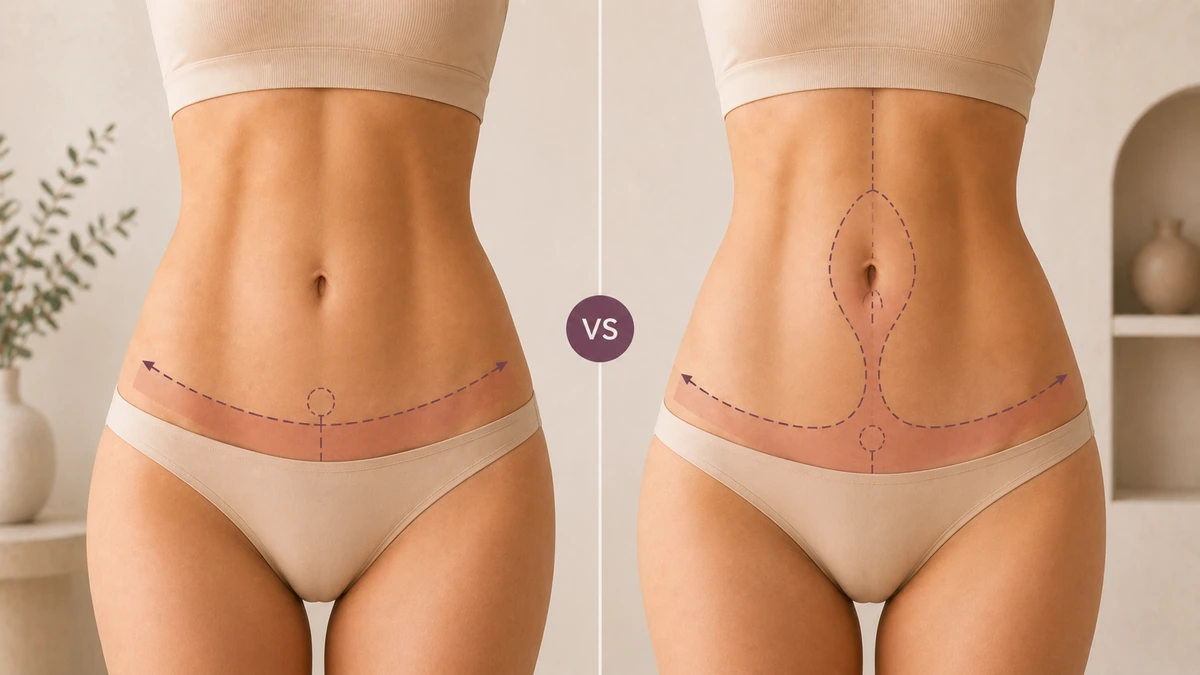
"Should I have a mini or a full tummy tuck?" is one of the two or three most-asked questions before any abdominoplasty consultation — and it is among the most important decisions in our tummy tuck types guide. Patients often arrive hoping for a mini tummy tuck because the scar is shorter, the recovery slightly faster, and the cost lower. Those are real benefits — but only when the mini is the right operation for your body. Choosing a mini when the physical exam calls for a full is one of the most common candidacy mistakes, and it usually shows up months later as visible upper-abdominal skin laxity, an unrepaired "pooch" above the belly button, or a request for revision.
This page is a side-by-side comparison to help you understand the decision before your consultation. The single most useful takeaway: the mini-vs-full decision is made by anatomy, not preference. Your surgeon confirms candidacy at physical exam; this guide helps you know what they will be looking at and why.
At-a-Glance Comparison
| Feature | Mini Tummy Tuck | Full Tummy Tuck |
|---|---|---|
| Anatomical scope | Lower abdomen (below umbilicus) only | Entire abdomen (ribs to pubis) |
| Skin removal | Below belly button | Above and below belly button |
| Muscle repair (diastasis) | Below umbilicus if needed | Full length of abdomen |
| Umbilicus repositioning | No — belly button stays | Yes — repositioned |
| Scar | 4–8 in horizontal (like low C-section) | Hip-to-hip + small circle around belly button |
| Operative time | 1–2 hours | 2–4 hours |
| Anaesthesia | General or sedation | General |
| Hospital stay | Same day or overnight | 1–2 nights typical |
| Back to desk work | 7–10 days | 10–14 days |
| Unrestricted exercise | 4–6 weeks | 6 weeks |
| Cost — US all-in | $6,000 – $12,000 | $10,000 – $18,000 |
| Cost — Turkey all-in | $2,500 – $4,000 | $3,500 – $5,500 |
| Ideal candidate | Mild lower laxity, no upper diastasis | Post-pregnancy, moderate to significant laxity |
| How common | Uncommon — narrow candidate profile | The standard operation |
Which One Are You a Candidate For?
The candidacy question decomposes cleanly into three anatomical questions. Answering them honestly (or, at physical exam, having your surgeon answer them) points to one variant.
Question 1: Where is your loose skin?
If loose skin is only below the belly button — a "pouch" or apron that does not extend above the umbilicus, and the skin above the umbilicus looks and feels normal — you may be in mini territory. If loose skin is above the belly button as well (visible as a horizontal fold, wrinkling, or looseness when you lean forward), you need a full.
Question 2: Do you have muscle separation, and where?
Rectus diastasis (separation of the two front abdominal muscles) is checked at consultation by feeling the midline between the muscles while you do a small crunch. A mini can address diastasis below the umbilicus only. Diastasis above the umbilicus requires a full — no other option. A published randomized clinical trial with 1-year follow-up confirmed rectus diastasis repair is durable at that time point, giving the muscle-repair decision meaningful long-term weight.1
Question 3: How is your belly button?
If the umbilicus itself is well-positioned, not distorted, not stretched, not herniated, and the skin around it is intact — mini leaves it alone. If it has been distorted by pregnancy or weight change (elongated, off-center, hernia present, poor skin around it), a full is needed to reposition it correctly.
A published anatomical and clinical classification framework proposed exactly this kind of tissue-based decision approach for choosing between abdominoplasty variants.2 The framework's central insight: the correct variant is decided by measurable findings, not patient preference or marketing.
Beyond anatomy — general health and BMI
Both operations have the same general candidacy requirements: stable weight, non-smoker (or 4+ weeks pre-op cessation), controlled comorbidities, completed childbearing (if applicable), realistic expectations. BMI matters similarly for both — an ACS-NSQIP analysis of 18,891 patients showed obesity is independently associated with higher complication rates after abdominoplasty and panniculectomy, and most surgeons prefer BMI under 30 for routine cases.3 See our candidacy guide for the full picture.
Scar & Recovery Compared
Scar differences
The scar is the most visible day-to-day difference between the operations. A mini scar is typically 4 to 8 inches, similar in length to a low C-section scar, sitting well within the underwear or bikini line. A full scar is longer, typically hip-to-hip, plus a small circular scar around the repositioned belly button.
Both scars follow the same 12-to-18-month maturation trajectory, moving from raised-and-pink (months 0–6) through flattening and paling (months 6–12) to final mature scar (12–18 months).4 The scar-care basics — silicone (sheets or gel) once the incision is sealed, sun protection for the first 12 months — apply the same way to both variants. See our tummy tuck scars guide for detail.
Recovery differences
The recovery difference is real but modest:
| Milestone | Mini | Full |
|---|---|---|
| Most uncomfortable phase | Days 1–3 | Days 1–3 |
| Drains (if used) removed | End week 1 | End week 1 – week 2 |
| Standing fully upright | ~Week 2 | ~Week 3 |
| Return to desk work | 7–10 days | 10–14 days |
| Return to physical work | 3–4 weeks | 4–6 weeks |
| Light exercise reintroduced | 3–4 weeks | 4–6 weeks |
| Unrestricted exercise | 4–6 weeks | 6 weeks |
| Swelling substantially settled | Month 2–3 | Month 3 |
| Scar mature | 12–18 months | 12–18 months |
Choosing a mini solely for the recovery benefit — when your physical exam calls for a full — is one of the most common regret patterns. The recovery saving is a few days to a couple of weeks; the operation trade-off is a decade or more of an unbalanced result.
Cost Compared
Cost is the second-most-common reason patients gravitate toward a mini. The saving is real: a mini is typically 30–40% cheaper than a full for the same surgeon and location. But this saving only counts if the mini is the right operation. Paying for the wrong operation is not a saving.
| Location | Mini | Full | Mini vs full saving |
|---|---|---|---|
| US — average metro | $6,000 – $10,000 | $10,000 – $14,000 | ~$4,000 |
| US — coastal / premium | $8,000 – $12,000 | $14,000 – $18,000 | ~$5,000 – $6,000 |
| Turkey — package | $2,500 – $4,000 | $3,500 – $5,500 | ~$1,000 – $1,500 |
Neither variant is covered by US insurance when performed for cosmetic reasons. Only medically necessary panniculectomy (a different operation removing only the pannus) may qualify — see our insurance coverage guide. For the Turkey option, see the tummy tuck in Turkey guide.
The Post-Partum Question
A large fraction of tummy tuck patients are post-pregnancy — and this population deserves specific attention on the mini-vs-full question because the intuition often points the wrong way.
After pregnancy, the abdominal wall has typically been stretched in three ways: (1) the skin from ribs to pubis has been stretched, particularly the lower half; (2) the two rectus muscles have separated in the midline (diastasis recti), and this separation typically extends both above and below the umbilicus; (3) the umbilicus itself has often been stretched, distorted, or shifted.
A mini addresses only the below-umbilical portion of (1), a limited portion of (2), and none of (3). For most post-pregnancy patients, that leaves the majority of the pregnancy's abdominal changes unaddressed. The result is a scar-and-partial-improvement outcome that patients often describe as "it looked better, but I still have the mom pouch above the scar."
For a very small subset of post-pregnancy patients — those with mild lower changes only, no upper diastasis, and preserved umbilicus — a mini can be right. For the majority, a full is the operation that addresses what pregnancy actually did.
The muscle-repair decision has particular weight for post-partum patients. The randomized trial evidence for durability of rectus repair at 1 year1 means that when the repair is done, it holds. When it is not done — either because a mini did not reach the upper diastasis or because it was skipped — the muscle separation persists and continues to affect the abdominal contour and, for some patients, core function.
Decision Checklist
Before your consultation, work through the following. This is not a substitute for physical exam, but it gets you to the right conversation.
You are more likely to be a mini candidate if:
- Your loose skin is only below the belly button.
- You do not have visible upper-abdominal skin laxity or a horizontal fold above the umbilicus.
- You can feel no muscle separation above the belly button on self-check (or a physician has told you it is limited).
- Your belly button is well-positioned and normal-looking.
- You are at or very close to your long-term stable weight.
- You are otherwise healthy, non-smoker, and complete with childbearing (if applicable).
You are more likely to be a full candidate if any of the following apply:
- You have had one or more pregnancies.
- You have visible skin laxity or "pouch" above the belly button.
- You can see or feel muscle separation (diastasis) extending above the umbilicus.
- Your belly button has been distorted, stretched, or has a hernia.
- You have significant weight-fluctuation history that has left skin laxity across the whole abdomen.
- Upper-abdominal skin quality is loose or stretched.
At consultation, ask the surgeon specifically: "Based on my physical exam, would you recommend a mini or a full — and why?" A good surgeon will explain the tissue findings driving the recommendation and will not upsell you to a full if a mini is genuinely the right operation for your body.
FAQ
-
What is the main difference between a mini and a full tummy tuck?
The main difference is anatomical scope. A mini tummy tuck addresses only the lower abdomen below the belly button — it does not reach above the umbilicus and does not include muscle repair there or umbilicus repositioning. A full tummy tuck addresses the entire abdomen from ribs to pubis, includes muscle repair across the full length, and repositions the belly button. Scar length, recovery time, and cost all follow from that difference in scope.
-
Am I a candidate for a mini tummy tuck?
You may be a mini candidate if all of the following apply: loose skin is limited to below the belly button; there is no muscle separation (diastasis recti) above the umbilicus on physical exam; the belly button itself is well-positioned and not distorted; upper-abdominal skin quality is good; and you are close to your long-term stable weight. This is a specific and relatively uncommon profile — most post-pregnancy patients have diastasis extending above the umbilicus and need a full.2 Candidacy is confirmed at consultation with a board-certified plastic surgeon.
-
Do most post-pregnancy patients need a mini or a full?
Most post-pregnancy patients need a full. Pregnancy stretches the abdominal wall in a specific way — the rectus muscles separate (diastasis recti) starting near the umbilicus and typically extending both above and below it. A mini cannot repair diastasis above the umbilicus because it does not have surgical access to that area. Choosing a mini when the physical exam shows above-umbilical diastasis leaves the upper abdomen unaddressed and produces an unbalanced result. Occasionally a patient with very mild post-partum changes and no upper diastasis qualifies for mini; most do not.
-
How much shorter is the scar with a mini vs a full?
A mini tummy tuck scar is typically 4 to 8 inches long — similar in length to a low C-section scar. A full tummy tuck scar is longer, typically hip-to-hip, plus a small circular scar around the repositioned belly button. Both scars are placed low across the abdomen to sit within the underwear or bikini line. Extended and fleur-de-lis variants have even longer scars. Scar length is a real trade-off between operation types but should not drive the decision — the correct operation for your body is the one that addresses your specific tissue findings.
-
Is a mini tummy tuck recovery really quicker?
Somewhat, yes — but the gap is smaller than most patients expect. A mini typically has a slightly shorter operation, less tissue undermining, and a somewhat shorter timeline: return to desk work often 7–10 days vs 10–14 days for a full; return to unrestricted exercise typically 4–6 weeks vs 6 weeks for a full. Both operations follow the same broad recovery arc,4 and the difference is modest. Choosing a mini for the recovery benefit alone — when the physical exam calls for a full — is one of the most common candidacy mistakes patients make.
-
How much cheaper is a mini vs a full?
In the US, a mini tummy tuck typically costs $6,000 to $12,000 all-in versus $10,000 to $18,000 for a full — the mini is roughly 30–40% cheaper. In Turkey, a mini typically runs $2,500 to $4,000 all-in versus $3,500 to $5,500 for a full — a similar ratio. Cost saving is a real benefit of the mini for appropriate candidates, but the correct operation is the one that fits your body. Paying less for the wrong operation is a false saving; it often leads to a revision that costs more in total.