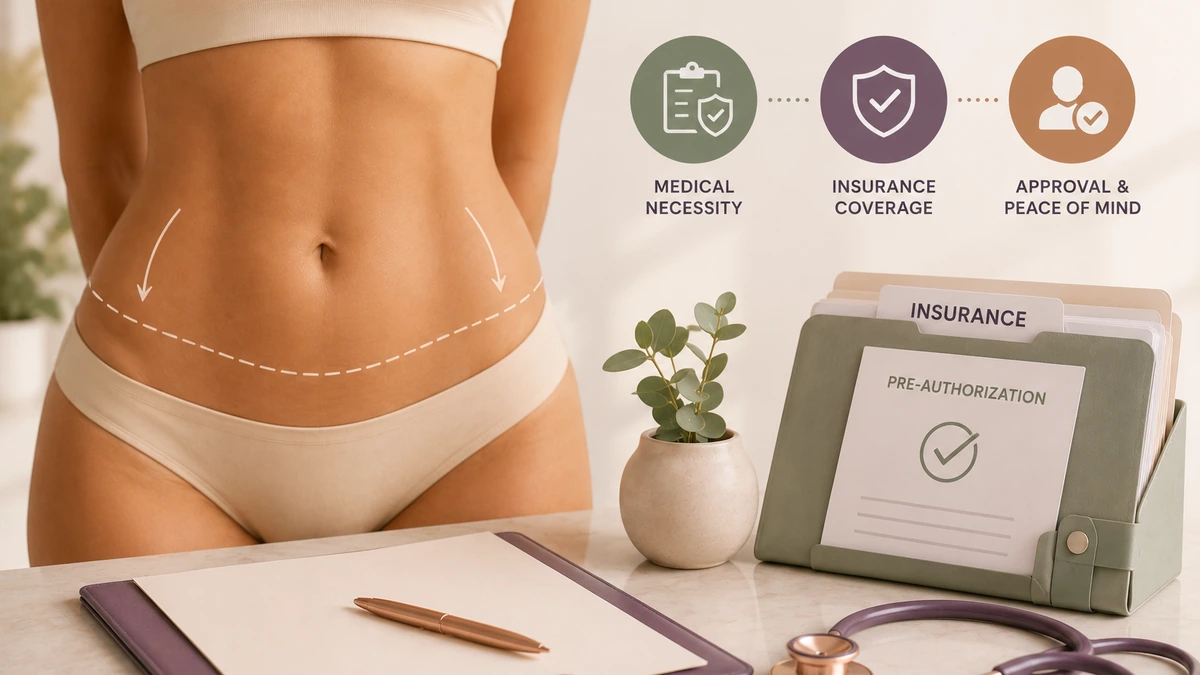
Getting a panniculectomy covered by US health insurance is possible — but the process is documentation-intensive, often takes months, and denials are common on the first submission. This guide is the honest walkthrough: what insurers actually look for, how to build the strongest possible case, and what to do when the first answer is no. The published post-bariatric coverage review confirms coverage is achievable when the clinical criteria are genuinely met and the documentation supports it.1
Why Some Panniculectomies Are Covered and Tummy Tucks Aren't
US health insurance covers what is medically necessary and excludes what is cosmetic. The distinction is not about the operation itself — it's about the clinical problem being addressed.
- Panniculectomy can address documented medical problems: chronic skin infections and rashes under the pannus, functional impairment, ulceration. When those problems are documented, the operation is treating a medical condition — and can qualify for coverage.
- Tummy tuck (cosmetic abdominoplasty) addresses aesthetic goals (flat contour, restored waist). No matter how motivated the patient is, "wanting to look better" is not a covered indication.
Some abdominal contouring cases genuinely need both — the functional pannus + the cosmetic aesthetic. These are typically handled as combined operations where the panniculectomy portion may be covered and the cosmetic tummy tuck components are self-pay. Full comparison in our panniculectomy vs tummy tuck guide.
The Specific Insurance Criteria
While each insurer publishes its own specific criteria, the following requirements appear across most major US insurers:
1. Documented skin problems under the pannus
The most important single criterion. Typical documented conditions:
- Intertrigo — chronic inflammation and rash where the skin folds meet.
- Recurrent cellulitis — bacterial skin infection under the pannus.
- Ulceration — actual skin breakdown from chronic moisture, friction, or infection.
- Fungal infections — chronic candidal or dermatophyte infections.
Documentation typically includes: primary care or dermatology notes with diagnosis codes; photographs; prescription history for topical or oral treatments.
2. Failed conservative treatment
Insurers typically require documented failure of conservative treatment for a minimum of 3–6 months before considering surgery. Conservative measures include:
- Topical antifungal creams (nystatin, clotrimazole).
- Topical steroid creams for inflammation.
- Daily hygiene measures — thorough drying, absorbent powders, barrier creams.
- Weight loss counselling if applicable.
"Failed" does not mean "made no difference" — it means the problem persists despite reasonable conservative treatment. Photographs before and after treatment help document this.
3. Functional impairment
Documentation of how the pannus limits daily life:
- Difficulty with ambulation or mobility.
- Difficulty with hygiene (cleaning, dressing).
- Impact on ability to work or perform activities of daily living.
- Recurrent back pain associated with weight of the pannus.
Sometimes physical therapy or occupational therapy notes support this section. Photographs showing the pannus size relative to the patient's body are frequently included.
4. Stable weight
Most insurers require stable weight for at least 6 months, often 12 months, before covering panniculectomy:
- Post-bariatric patients: at least 6 months post-bariatric and stable weight.
- Non-bariatric significant weight loss patients: 12 months of stable weight typically.
- BMI threshold: varies widely; some insurers require BMI under 35, some under 30, some no specific threshold. These thresholds are plausibly motivated by evidence that higher BMI raises surgical risk — the ACS-NSQIP analysis of 18,891 abdominal contouring cases documented elevated complication rates at higher BMIs — though the specific numeric cutoffs each insurer chooses are not themselves validated by this or any single study.3
Documentation is typically primary care or bariatric surgery weight records over the required period.
5. Post-bariatric history (when applicable)
Post-bariatric patients typically have the strongest coverage cases because:
- The weight-loss history is well-documented.
- The pannus is often extreme and the medical necessity is easily visualised.
- Coverage policies often specifically address post-bariatric reconstruction.
- Referring surgeons and primary care physicians are familiar with the documentation process.
Non-bariatric patients (large weight loss through diet/exercise, or post-multiple-pregnancies with weight fluctuation) can also qualify but often face higher documentation burdens.
The Step-by-Step Approval Process
| Step | What happens | Timeline |
|---|---|---|
| 1. Establish skin condition | Primary care or dermatology visits; diagnosis codes; photographs | Weeks 1–4 |
| 2. Conservative treatment | 3–6 months of topical treatments, hygiene measures, documented follow-up | Months 1–6 |
| 3. Weight-stability documentation | Ongoing primary care or bariatric follow-up; documented stable weight | Concurrent |
| 4. Plastic surgery consultation | Board-certified plastic surgeon evaluation; clinical assessment; photographs | Month 6+ |
| 5. Pre-authorization submission | Surgeon's office submits full documentation package to insurer | 1 week |
| 6. Insurer review | Medical review of submission; approval, denial, or request for more info | 2–4 weeks |
| 7. Appeal (if denied) | Additional documentation, peer-to-peer review, formal appeal | 4–12 additional weeks |
| 8. Surgery scheduling | Once approved, standard pre-op process | Additional 4–8 weeks typically |
The realistic total timeline from starting the documentation process to the operating room is 6 to 18 months. Patients who already have documented conditions and treatment history can move faster; those starting from scratch need to build the documentation.
The Documentation Package
A well-built pre-authorization submission typically includes:
- Cover letter of medical necessity from the plastic surgeon — the most important single document. It should specifically address each of the insurer's stated criteria.
- Primary care and dermatology records documenting the skin condition, dates of onset, treatments tried, and lack of resolution.
- Photographs — the pannus itself, the skin condition underneath, showing extent and clinical findings.
- Weight history — documented weights over at least 6–12 months showing stability.
- Prescription history — antifungals, topical steroids, antibiotics for infections.
- Bariatric surgery records if applicable.
- Physical therapy or functional assessment notes if functional impairment is being documented.
- The insurer's own policy criteria printed and addressed point-by-point in the surgeon's letter.
Medicaid and Panniculectomy
Medicaid coverage for panniculectomy varies substantially by state.2 Some states have formal coverage policies for post-bariatric reconstruction that include panniculectomy under specific criteria; other states routinely deny.
Medicaid-specific considerations:
- Documentation requirements are typically at least as strict as commercial insurance, sometimes stricter.
- The plastic surgeon must accept Medicaid — many private plastic surgeons do not, limiting patient options.
- Facility must accept Medicaid — often means hospital-based rather than ambulatory surgery center.
- Appeals process exists but may be slower than commercial.
- Post-bariatric patients often have the strongest cases due to well-documented weight-loss history.
If you are a Medicaid patient exploring panniculectomy, contact your state Medicaid office or ask your primary care physician for guidance on your specific state's coverage policy.
Appealing a Denial
Denials are common on first submission — even for cases that meet criteria. Common denial reasons and how to address them:
| Reason for denial | How to respond |
|---|---|
| "Insufficient conservative treatment" | Extend documented treatment period; add additional treatments |
| "Not medically necessary" | Peer-to-peer review; add functional impairment documentation |
| "Weight not stable" | Add more months of weight documentation; wait longer if needed |
| "Documentation insufficient" | Add photographs, more detailed clinical notes, updated PT notes |
| "Considered cosmetic" | Clarify with letter of medical necessity emphasizing functional aspects |
| "BMI too high" | Some insurers have specific thresholds; may need to lose more weight first |
The appeal path:
- Read the denial letter carefully. The reason must be specifically addressed in the appeal.
- Gather additional documentation that specifically addresses each denial reason.
- Submit formal written appeal within the insurer's stated appeal window (typically 60–180 days).
- Request peer-to-peer review — a phone conversation between your plastic surgeon and the insurance medical director. This is often where genuine cases are approved.
- If second-level appeal fails, some patients pursue external review through the state insurance commissioner.
Most successful panniculectomy insurance approvals go through at least one appeal. Persistence with proper documentation frequently wins.
If Insurance Won't Cover It
If your case is genuinely denied after appeal, options include:
- Self-pay panniculectomy — typically $8,000–$15,000 all-in in the US. Detail in our cost guide.
- Financing options — medical financing platforms, personal loans. See our financing guide.
- Combined tummy tuck + panniculectomy paid out-of-pocket if you want the cosmetic result too — $12,000–$22,000 typical.
- Medical tourism for combined operations — Turkey packages typically $4,500–$6,500 all-in. See our Tummy Tuck in Turkey guide.
- Continue conservative treatment and revisit approval in 6–12 months with expanded documentation.
FAQ
Is a panniculectomy covered by insurance?
Yes, sometimes. US health insurance can cover panniculectomy when it is documented as medically necessary rather than cosmetic (per a 55-insurer review).1 Approval is not automatic — most insurers require formal pre-authorization with specific documentation. The typical criteria that must be met: (1) chronic skin problems under the pannus (rashes, intertrigo, ulcerations) that have failed at least 3 to 6 months of conservative treatment; (2) documented functional impairment (difficulty with ambulation, hygiene, or activities of daily living); (3) stable weight for at least 6 to 12 months, often with a post-bariatric or significant weight loss history; (4) BMI within the insurer's specified range (varies widely). Meeting all these criteria typically gives a strong approval case; missing any can result in denial. Denials can be appealed with additional documentation.
How do I get a panniculectomy approved by insurance?
The approval process is documentation-intensive and usually takes 4 to 12 weeks. The general path: (1) Establish a documented skin condition under the pannus through primary care or dermatology visits — get diagnosis codes for intertrigo, cellulitis, or ulceration, and document photographs. (2) Complete at least 3 to 6 months of conservative treatment (topical antifungals, topical steroids, hygiene measures) with documented lack of full response. (3) See a board-certified plastic surgeon for consultation and clinical assessment. (4) The surgeon's office submits a pre-authorization request with all supporting documentation — including your medical records, photographs, dermatology notes, and a letter of medical necessity. (5) The insurer reviews (typically 2 to 4 weeks) and issues an approval or denial. (6) If denied, appeal with additional documentation and often a peer-to-peer review between your surgeon and the insurance medical director.
What's the difference in coverage between panniculectomy and tummy tuck?
The two operations are treated fundamentally differently by US insurance. Panniculectomy is classified as a functional / reconstructive operation and can qualify for coverage when medically necessary criteria are met. Tummy tuck (abdominoplasty) is classified as a cosmetic operation and is essentially never covered — regardless of the patient's clinical situation. The technical distinction insurers use: panniculectomy removes the hanging apron that causes documented medical problems; tummy tuck adds muscle repair, umbilicus repositioning, and full skin tightening for aesthetic improvement. Patients who need both a functional panniculectomy AND the cosmetic tummy tuck components typically have the panniculectomy portion insurance-covered (if criteria met) and pay out-of-pocket for the added cosmetic components — often bundled into a single combined operation.
How much does panniculectomy cost without insurance?
Self-pay panniculectomy in the US typically costs $8,000 to $15,000 all-in — including surgeon fee, anaesthesia, facility, and standard follow-up. The range reflects surgeon experience, geographic location, complexity of the case, and whether the pannus is unusually large (which can push the cost higher). Metro-area premiums (NYC, LA, San Francisco) can push costs to $15,000 to $20,000. If insurance covers the operation, out-of-pocket cost is typically limited to your deductible and coinsurance — for most US insurance plans, this ranges from $1,000 to $5,000 depending on the plan structure. When combined with a cosmetic tummy tuck component (self-pay), total out-of-pocket cost is typically $12,000 to $22,000.
Does Medicaid cover panniculectomy?
Some state Medicaid programs cover panniculectomy for medically necessary indications, but coverage varies substantially by state (see ASPS insurance coverage guide).2 States that generally cover medically necessary panniculectomy include those with formal coverage policies for post-bariatric reconstruction. States without formal policies may deny routinely. Post-bariatric Medicaid patients often have the strongest cases because: (a) the weight-loss history is documented; (b) associated skin conditions are documented; (c) functional impairment is documented. If you are a Medicaid patient exploring panniculectomy, ask your primary care physician or plastic surgery consultation for guidance on your specific state's coverage policy — and expect the documentation burden to be somewhat higher than for commercial insurance. Coverage decisions can be appealed.
What if my panniculectomy is denied by insurance?
Denials are common on the first pre-authorization submission. Most successful cases require at least one appeal. The path: (1) Read the denial letter carefully — it specifies exactly why approval was denied. (2) Address each denial reason with additional documentation. (3) Submit a formal written appeal — most insurers have a specified appeal window (typically 60 to 180 days from denial). (4) Request a peer-to-peer review between your plastic surgeon and the insurance medical director if the appeal is denied. (5) If a second-level appeal fails, some patients pursue external review through their state insurance commissioner. The appeal process is time-consuming (often 3 to 6 additional months) but frequently successful when the clinical criteria are actually met and the initial denial was due to documentation gaps.