The all-inclusive package is the format the Turkish medical tourism market has settled on because it solves a specific problem — as explained in our tummy tuck in Turkey guide — international patients need to see the total cost, the total timeline, and the total logistics before committing to a trip. A US patient going to a US practice sees a surgeon fee, an anaesthesia fee, a facility fee, and manages their own accommodation and transport. A US patient going to Turkey sees one number — the package — with a clear list of what is inside.
That model works well when the package is honest and structured properly. It fails when the "package" is a shell — a low-headline number with unclear inclusions, unnamed hospital, and no meaningful aftercare. This page is about telling the two apart.
What a Legitimate Package Includes
A properly structured Turkey tummy tuck package covers the following, all named and specified in the contract before deposit:
| Component | Standard inclusion |
|---|---|
| Surgeon fee | Named board-certified plastic surgeon |
| Anaesthesia | Dedicated anaesthesiologist for the operation |
| Hospital | Named JCI-accredited hospital; 1–2 nights inpatient |
| Pre-op tests | Blood work, ECG, medical workup on arrival |
| Hotel | Named 3–4 star hotel, 4–6 nights, near hospital |
| Transfers | Airport ↔ hotel ↔ hospital, all in private vehicle, both ways |
| Translator | English-speaking coordinator or translator at all medical visits |
| Compression garment | Fitted after operation, take home |
| Medications | Pain, antibiotic, and antithrombotic prescriptions for trip and immediate post-return period |
| In-country follow-ups | 24 h post-op, discharge appointment, 5–7 day follow-up before flying |
| Complication cover during stay | Any complication needing care during the package stay is included |
| Post-return follow-ups | Video visits at 2, 6, 12 weeks (varies by provider) |
What is typically not included:
- International flights.
- Extra hotel nights beyond the package.
- Meals outside the hospital stay (typically self-catering at hotel).
- Companion's flight (companion's hotel is usually shared room = same rate).
- Supplemental travel/medical evacuation insurance.
- Post-return complications requiring in-person management (though most reputable providers help coordinate with the patient's home primary care physician (PCP)).
Detailed cost math and total trip cost is in the Turkey cost guide.
The Trip Timeline
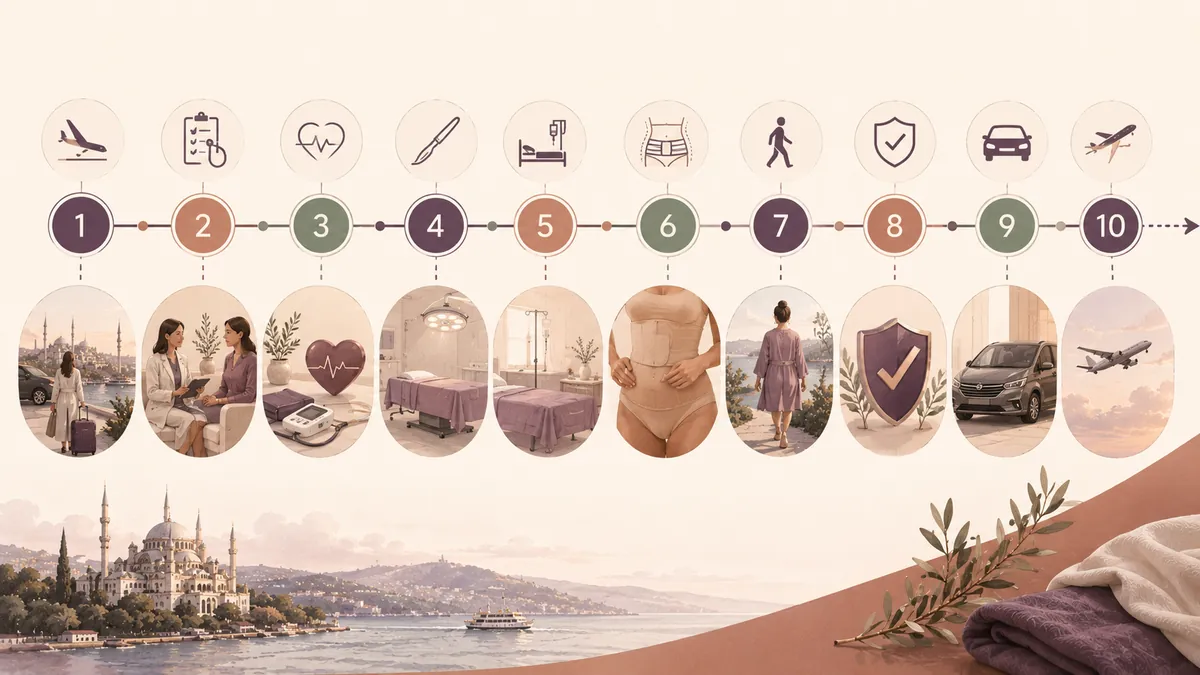
A standard full tummy tuck trip runs 7 to 10 days from arrival to safe-to-fly. This timeline is not arbitrary — it reflects the clinical requirement to keep the patient close to the operating surgeon through the highest-risk early recovery window and to avoid the DVT-risk-compounding effect of long-haul flying too soon after abdominal surgery.2
| Day | Activity |
|---|---|
| Day 0 | Arrival; airport pickup; transfer to hotel; check-in |
| Day 1 | In-person pre-op consultation with surgeon; blood work, ECG; consent signed; hospital admission planning |
| Day 2 | Operation; hospital stay begins |
| Day 3 | Hospital day 1 post-op; first ambulation; drain assessment; surgeon check |
| Day 4 | Discharge from hospital; transfer back to hotel; hotel-based recovery begins |
| Days 5–7 | Hotel recovery; walking increasing daily; garment worn; second follow-up |
| Day 8–9 | Final follow-up; drain removal if used and appropriate timing; safe-to-fly clearance |
| Day 10 | Return home; DVT precautions on flight |
For extended or fleur-de-lis operations, add 1–2 days. For mommy makeover (TT + breast), add 1 day. For any operation, the safe-to-fly clearance is a clinical decision by the surgeon — patients should not push for earlier flights to save hotel cost. The recovery arc is covered fully in the recovery timeline guide.
Istanbul vs Antalya (City Choice)
Two Turkish cities dominate the plastic surgery tourism market for international patients:
Istanbul
- Turkey's plastic-surgery capital; highest concentration of internationally-credentialed surgeons.
- Most JCI-accredited hospitals of any Turkish city.1
- Most direct international flight connections (both major airports, IST and SAW).
- Broadest range of after-hours support and specialist consultation if a complication surfaces.
- Higher price ceiling on premium packages (5-star hospitals, luxury hotels).
Antalya
- Mediterranean coastal city; smaller aesthetic destination.
- Fewer international specialists but a genuine plastic-surgery scene.
- More relaxed recovery environment (warmer climate, seafront hotels).
- Slightly lower prices in some cases; more sub-JCI facilities to check carefully.
- Direct EU flights are common; direct US flights are limited (usually via Istanbul).
For a straightforward tummy tuck with a well-vetted surgeon, either city can work. For larger operations (fleur-de-lis, mommy makeover, revision cases), Istanbul's depth of specialist infrastructure and larger hospital network is usually the safer choice. See our choosing a surgeon guide for how to verify individual surgeon and facility credentials in either city.
Companion Travel
Companion travel is strongly recommended for a Turkey tummy tuck trip, for both practical and safety reasons. Practically, a companion helps with mobility during the first 48–72 hours (the most uncomfortable phase), drain management if drains are used, and general moral support during a demanding recovery week. From a safety standpoint, having a companion present in the hospital and hotel means someone can identify early signs of complication (DVT symptoms, fever, unusual pain) and get the surgeon involved quickly.
Package logistics for companions are usually straightforward:
- Hotel — shared room, typically same rate (no companion supplement).
- Transfers — same vehicle, no additional cost.
- Hospital — most JCI hospitals have space for a companion to stay overnight; ask specifically.
- Meals — companion's meals are self-cost (typically $20–$40/day).
- Flight — companion's own booking; $600–$1,200 US roundtrip typical.
- Total added cost — usually $1,000–$1,500 all-in.
Solo trips are possible for patients with straightforward operations and prior surgical experience, but for a first-time abdominoplasty patient, a companion adds meaningful value. If a companion is not available, some providers offer a paid "recovery buddy" service (a coordinator who checks on you daily) — this is a partial substitute but not a full replacement for a family member or friend.
Aftercare Structure After You Return Home
Post-return-home aftercare is one of the biggest differentiators between packages, and it deserves specific attention because it is the area most vulnerable to shortcuts. A good aftercare structure includes:
- Scheduled video follow-up at 2 weeks post-return, with the surgeon (not a coordinator), reviewing photos and answering questions.
- Video follow-up at 6 weeks — the exercise-clearance decision point.
- Video follow-up at 3 months — early result assessment, scar-care review.
- Optional 6-month and 12-month check-ins for scar maturation and final result.
- WhatsApp or messaging access to the surgeon or their coordinator for any concern in between scheduled visits.
- Written protocol for complications — including who covers the cost of any needed evaluation at home, and how the surgeon coordinates with your home primary care physician (PCP) if required.
Packages that end their responsibility at the airport gate are meaningfully inferior. Ask the specific question: "What does your post-return-home follow-up look like, in detail?" — and get the answer in writing before deposit.
Red-Flag Package Patterns
- "All-inclusive" without a written breakdown of what is inside.
- Unnamed hospital ("we work with several accredited hospitals").
- Unnamed hotel ("appropriate hotel for post-op recovery").
- Package shorter than 7 days ("we can arrange for you to fly on day 5") — see recovery timeline.
- Only one hospital night (or day-case) for a full tummy tuck.
- No pre-op consultation with the actual operating surgeon.
- Post-return-home follow-up not specified.
- Complications-during-stay coverage unclear or absent.
- Discounts for booking without consultation, or "book today and save $500."
- Combining multiple large operations (tummy tuck + rhinoplasty + BBL) in one trip — combined-procedure safety is real,2 and packaging heavy combinations warrants surgeon-driven caution, not marketing enthusiasm.
The right process is: verify credentials (see choosing a surgeon guide), request an itemised package in writing, confirm named surgeon and named hospital, video-consult with the actual surgeon, sign contract, deposit, book flights — in that order. Never skip steps for speed.
FAQ
What is a Turkey tummy tuck package?
A Turkey tummy tuck package is a bundled fixed-price arrangement that includes the operation and the surrounding logistics — surgeon fee, anaesthesia, accredited hospital stay, hotel accommodation, in-country transfers, translator, garment, medications, and in-country follow-ups — under one contract at one total price. The packaging model dominates the Turkish medical tourism market because it lets international patients see the total cost upfront and lets providers deliver a coordinated stay. A legitimate package is transparent (itemised breakdown), specific (named hospital, named surgeon, named hotel tier), and structured around the actual clinical timeline (1–2 nights hospital + 5–6 nights hotel before flying).
Should I choose Istanbul or Antalya?
Istanbul is Turkey's plastic-surgery capital with the highest concentration of internationally-recognized plastic surgeons, most JCI-accredited hospitals,1 most direct international flights, and the broadest range of after-hours support if a complication surfaces. Antalya is a smaller aesthetic destination with fewer international specialists but has the advantage of Mediterranean climate, potentially more relaxed recovery environment, and slightly lower prices in some cases. For a straightforward tummy tuck with a well-vetted surgeon, either city can work; for larger operations (fleur-de-lis, mommy makeover, revision cases), Istanbul's depth of specialist infrastructure is usually the safer choice.
How long does the total trip take?
A standard tummy tuck trip is 7 to 10 days total, from arrival to safe-to-fly. Typical breakdown: Day 0 — arrival, transfer to hotel; Day 1 — in-person pre-op consultation, medical workup, admission; Day 2 — operation; Days 3–4 — hospital recovery (1–2 nights); Days 5–7 — hotel recovery, drain-removal or PTS check, mobilisation; Day 8–10 — final follow-up, safe-to-fly clearance, return home. Extended and fleur-de-lis operations may add 1–2 days. Flying before day 7 is generally discouraged by surgeon consensus, because prolonged sitting is a recognized DVT risk factor, and that risk compounds with recent abdominal surgery.3
What hotel do packages usually put me in?
Reputable packages typically place patients in 3–4 star hotels within walking distance or a short transfer from the hospital. The hotel tier matters less than three functional requirements: quiet neighbourhood conducive to recovery, ability to walk short distances (which supports early mobilisation and reduces DVT risk), and reasonable proximity to the hospital in case a same-day check is needed. Some higher-tier packages include 4–5 star hotels or aparthotels with better privacy and food service. Always ask the specific hotel name before agreeing to a package — packages that promise a "hotel appropriate for post-op recovery" without naming it should be pressed for specifics.
Can my partner or family member come with me?
Yes — companion travel is strongly recommended. Reputable Turkey packages accommodate a companion easily: shared hotel room is normally the same room-rate, transfers accommodate both people, and hospital rooms usually have space for a companion to stay overnight. The additional cost is typically only the companion's flight ($600–$1,200 US roundtrip). A companion provides practical support (help with mobility, drain management if used, moral support) and improves safety by ensuring you are not alone during the highest-risk first 24–48 hours post-op. Solo trips are possible but require extra planning.
What aftercare does the package include after I get home?
This varies significantly by provider and is one of the most important package details to clarify. A good package includes: a scheduled video follow-up at 2 weeks post-return, follow-up at 6 weeks, and 3 months (with additional visits as needed); a clear communication channel (WhatsApp with the surgeon or their coordinator) for any concern in between; and a written protocol for what to do if a complication emerges — including who covers the cost of any needed evaluation at home, and how the surgeon coordinates with your home primary care physician (PCP) if needed. Packages that end their responsibility at the airport gate are inferior to those that maintain post-return-home structure.