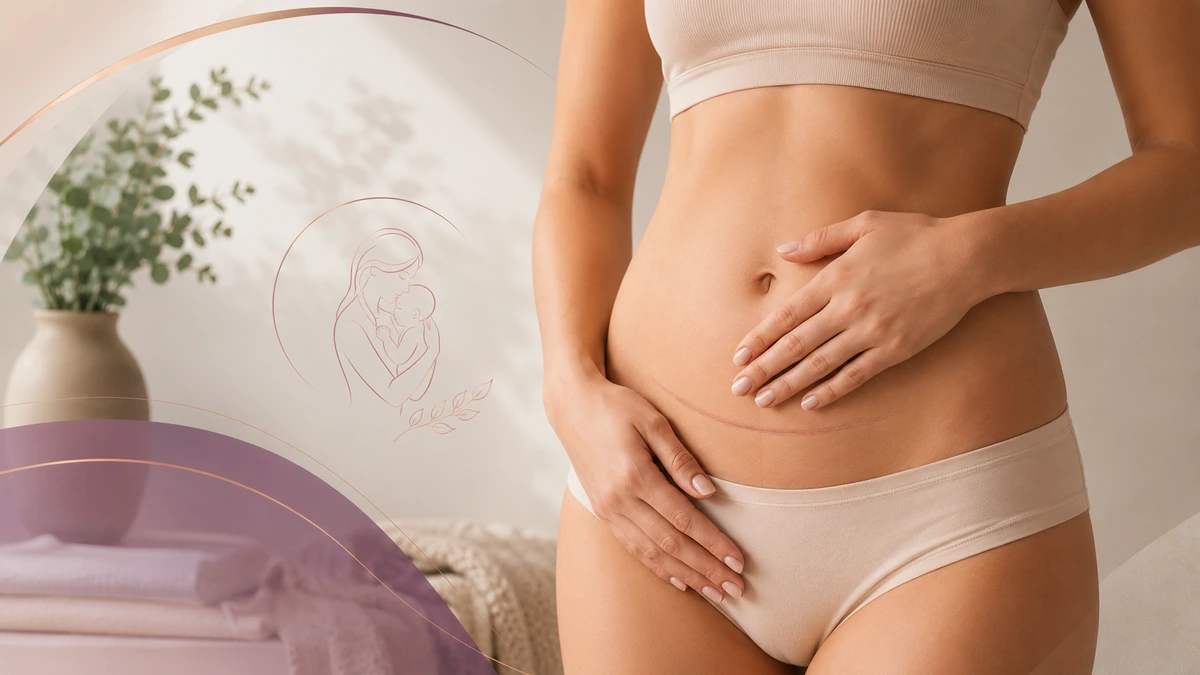
A large fraction — probably the majority — of tummy tuck patients have had one or more C-sections. The typical post-C-section abdomen has three problems that a well-performed tummy tuck can address together: loose overhanging skin (often above the C-section scar), diastasis recti from the pregnancy, and a persistent "pooch" that exercise doesn't fix. For the full context on tummy tuck muscle repair — what it is, who needs it, and how it fits into a tummy tuck — see our pillar guide. This page covers what to expect, timing, and the specific considerations for muscle repair around a C-section scar.
What Happens to the Abdomen After C-Section
C-section itself is a well-tolerated operation, but the abdominal wall goes through several changes:
- Pregnancy stretches the skin — often past its elastic recoil limit. Post-C-section, the skin does not retract fully.
- Pregnancy stretches the rectus muscles apart — this is diastasis recti, and it happens whether delivery is vaginal or C-section. Rates post-partum are 30–70% depending on how strictly assessed.2
- The C-section scar creates a fixed tether — the scar itself doesn't stretch, so the skin above it drapes over into the "shelf" that so many post-C-section women describe.
- Weight shift — most women retain some weight post-partum; distribution is often altered.
- Umbilicus deformation — pregnancy often stretches or distorts the belly button.
Exercise, diet, and time help — but they cannot restore skin that has been stretched past its recoil limit, cannot repair diastasis (that requires surgical plication), and cannot remove the shelf above a C-section scar. This is why so many post-C-section women who "do everything right" still can't get back to their pre-pregnancy abdomen.
The "C-Section Shelf"
The classic overhang above the C-section scar — often called the "shelf" or the "mummy tummy" — is the single most common presenting complaint. It happens because the C-section scar acts as a fixed tether at the level of the incision (typically at the pubic hairline in a Pfannenstiel scar). Skin above the scar stretched during pregnancy; skin at the scar level didn't. Post-delivery, the skin above hangs over the scar line, creating the "shelf."
The shelf usually cannot be fixed by exercise, diet, or non-surgical treatments — the loose skin is loose because it has been stretched past its elastic limit. A full tummy tuck removes the overhanging skin, repositions the umbilicus, and typically re-excises the old C-section scar as part of the new hip-to-hip incision. The result is one scar (the tummy tuck scar), not two, and the shelf is gone.
Mini tummy tuck can address a small shelf if the diastasis is minimal and the loose skin is only below the umbilicus — see Mini vs Full guide. Most post-C-section patients need a full tummy tuck.
Diastasis Recti After C-Section
C-section does not protect against diastasis. Pregnancy stretches the rectus muscles apart whether delivery is vaginal or C-section — the route of delivery is essentially irrelevant to whether diastasis develops. What surgeons see routinely is that post-C-section patients need muscle repair as often as post-vaginal-delivery patients.
Assessed clinically, 30–70% of post-partum women have persistent diastasis at 12 months.2 If you have a visible or palpable midline gap (see our diastasis recti guide for the self-check), the tummy tuck should include muscle repair. Without repair, the internal architecture that pregnancy disrupted remains disrupted, and you get a flatter appearance but not a restored waistline.
Randomized evidence at 1 year confirms muscle repair is durable, with or without mesh reinforcement.1 Technique detail in our muscle repair surgery guide.
Muscle Repair Around a C-Section Scar
Surgeons factor the C-section scar into the tummy tuck plan in three ways:
- New incision placement — the tummy tuck incision is typically placed at or just below the level of the C-section scar, so that the old scar tissue can be re-excised as part of the new incision. You get one scar, not two.
- Adhesion release — C-section can leave internal adhesions between the abdominal wall and underlying structures. When the tummy tuck skin flap is elevated, these adhesions are typically released, and the surgeon reconstructs a smooth abdominal wall.
- Blood supply preservation — a very old high C-section scar can affect blood supply to the skin flap. The surgeon evaluates this at consultation; occasionally it affects technique choice (e.g., mini vs full).
Occasionally a small remnant of C-section scar remains if the C-section was placed unusually high on the abdomen — the surgeon evaluates this at consultation. In the majority of cases, the tummy tuck completely replaces the C-section scar.
Timing — When to Have Tummy Tuck After C-Section
Three timing considerations govern when to have the tummy tuck:
Minimum wait: 6–12 months
Most plastic surgeons recommend at least 6 months, more commonly 12 months, between C-section and tummy tuck. Reasons: scar maturation, tissue healing, fluid balance normalisation, weight stabilisation, and hormonal recovery. Operating too early on tissue that is still edematous and hormonally variable gives an unpredictable result.
After breastfeeding
Wait 3–6 months after stopping breastfeeding. Breastfeeding hormones (particularly prolactin) affect fluid retention and connective tissue quality. Operating during breastfeeding gives less predictable tightening.
After last planned child
Ideally, complete childbearing before tummy tuck. A subsequent pregnancy can stretch the muscle repair — not dangerously, but potentially back to diastasis, requiring re-repair later. Pregnancy after tummy tuck is safe for the pregnancy but may compromise the aesthetic result.
Weight stability
Weight should be stable for at least 3 months pre-op. Post-partum weight loss should have plateaued. Ongoing weight changes affect skin excess and undermine the durability of the result.
Combined C-Section + Tummy Tuck at Delivery — the Honest Answer
Some clinics offer "C-section + tummy tuck" as a combined operation at delivery, sometimes marketed as "mommy makeover at birth" or "cesarean tummy tuck." Most reputable plastic surgery organizations do not recommend this. The reasons are worth understanding:
- The pregnant abdominal wall is a poor operating field — stretched, edematous, hormonally softened. Skin tightening and muscle repair on this tissue is unreliable.
- Complication rates are elevated post-partum — pregnancy and the immediate post-partum period are recognized hypercoagulable states, and recent pregnancy is a documented VTE risk factor in the Caprini risk-assessment model used to guide prophylaxis after abdominoplasty.3 Adding a major cosmetic operation compounds these risks.
- Aesthetic result is unpredictable — tissue continues changing (involution, fluid loss, hormonal shifts) for months post-partum. The tummy tuck done at delivery cannot account for changes that haven't happened yet.
- Recovery is compounded — recovering from a C-section is hard enough; recovering from a C-section + tummy tuck while caring for a newborn is much harder.
The safer and better-outcome path is: have the C-section, focus on baby, wait 6–12 months, then have the tummy tuck when your body has stabilized. The final aesthetic result is better and the safety profile is better. Cost may be marginally higher (two anaesthetics vs one) but the outcome trade-off strongly favours the staged approach.
Recovery Considerations for the Post-Partum Patient
Recovering from a tummy tuck while caring for a young child requires planning. Realistic expectations:
- You cannot lift, carry, or bend to a small child for at least 2 weeks — 4 to 6 weeks for anything heavier than a very light toddler.
- You need in-home help for at least the first 7–10 days — a partner, family member, hired help, or postpartum doula. Not optional.
- Sleep is disrupted — you cannot sleep flat for the first 1–2 weeks; sleeping in a slight bend to protect the muscle repair. Combining this with a young child's schedule requires planning.
- Emotional experience is intense — the combination of surgery recovery + hormonal shifts + reduced sleep + parenting can trigger low mood or postpartum-like symptoms even in patients well past traditional post-partum.
Full recovery arc in our recovery timeline guide; scar-specific detail in scars guide.
FAQ
How long after a C-section can I have a tummy tuck?
Most plastic surgeons recommend waiting at least 6 to 12 months after your C-section before having a tummy tuck. This gives time for the scar to fully mature, for your abdominal wall tissue to heal, for pregnancy weight to stabilise, for hormones and fluid retention to normalise, and for you to be finished with breastfeeding if applicable. Waiting also lets you complete childbearing if further pregnancies are planned — a subsequent pregnancy after tummy tuck can stretch the muscle repair and require re-repair later. The 12-month mark is a common recommendation because by then the C-section scar is mature enough to be re-excised as part of the tummy tuck, weight is typically stable, and the abdominal wall is in a predictable healed state.
Can a tummy tuck fix my C-section shelf or overhang?
Yes — the classic "C-section shelf" (an overhang of skin and fat above the C-section scar) is one of the most common reasons post-partum women seek a tummy tuck. It happens because the C-section scar acts as a fixed tether at the level of the incision, while the skin above stretches during pregnancy and doesn't retract fully. A full tummy tuck removes the loose skin, repositions the umbilicus, and typically re-excises the old C-section scar as part of the new hip-to-hip incision — you end up with one scar instead of two, and the shelf is gone. Muscle repair addresses the underlying diastasis that most post-partum women also have, giving a flat midline the shelf-only patient rarely has just from skin removal.
Should I have muscle repair if I've had a C-section?
Almost certainly yes if you have visible or palpable diastasis. C-section itself does not cause diastasis — pregnancy does, particularly larger babies, twins, or multiple pregnancies. The C-section route of delivery does not protect against diastasis. What surgeons see routinely is that post-C-section patients need muscle repair (plication) as much as post-vaginal-delivery patients do. The muscle repair restores midline anatomy and waist definition that pregnancy stretched out. Randomized evidence at 1 year confirms the repair is durable.1 If your diastasis is minimal (< 2 cm and no functional issues), a mini tummy tuck without muscle repair may be an option; if wider or symptomatic, full tummy tuck with muscle repair is the standard answer.
Can I have a tummy tuck at the same time as a C-section?
Some obstetricians and plastic surgeons offer "C-section + tummy tuck" as a combined operation at delivery, sometimes marketed as "mommy makeover at birth" or "cesarean tummy tuck." Most reputable plastic surgery organizations do not recommend this. The main reasons: the pregnant abdominal wall is stretched, edematous, and hormonally softened — a poor state for durable tummy tuck skin-tightening and muscle repair; complication rates (bleeding, infection, and particularly DVT, since recent pregnancy is a recognized VTE risk factor in standard Caprini-model risk assessment3) are elevated in the post-partum state; and the aesthetic result is unpredictable because tissue continues changing for months post-partum. The safer and better-outcome path is: have the C-section, wait 6 to 12 months, then have the tummy tuck when your body has stabilized.
Can I breastfeed if I plan to have a tummy tuck later?
Yes, absolutely — the tummy tuck should be delayed until after breastfeeding is complete, but breastfeeding itself is not affected by future tummy tuck plans. A tummy tuck does not involve the breasts, does not affect milk production, and doesn't preclude future breastfeeding of subsequent children. The recommendation to wait until after breastfeeding is because breastfeeding hormones affect fluid retention and healing, and because the abdominal wall tissue is more variable in the breastfeeding state. Most surgeons recommend waiting at least 3 to 6 months after stopping breastfeeding before tummy tuck for the most predictable result. If further children are planned, most surgeons recommend completing childbearing entirely before tummy tuck.
Will my C-section scar be visible after a tummy tuck?
In most cases, no — the old C-section scar is typically re-excised as part of the new tummy tuck incision. The tummy tuck scar runs hip-to-hip in a low-abdominal placement that overlaps with where the C-section scar was, so the surgeon can cut through and remove the old scar tissue, ending up with a single tummy tuck scar rather than two separate scars. Sometimes a small remnant of C-section scar remains if the C-section scar was placed unusually high — the surgeon evaluates this at consultation. The tummy tuck scar itself is longer than the C-section scar was (hip-to-hip versus the shorter Pfannenstiel), but it is placed low enough to be covered by swimwear and underwear for most patients.