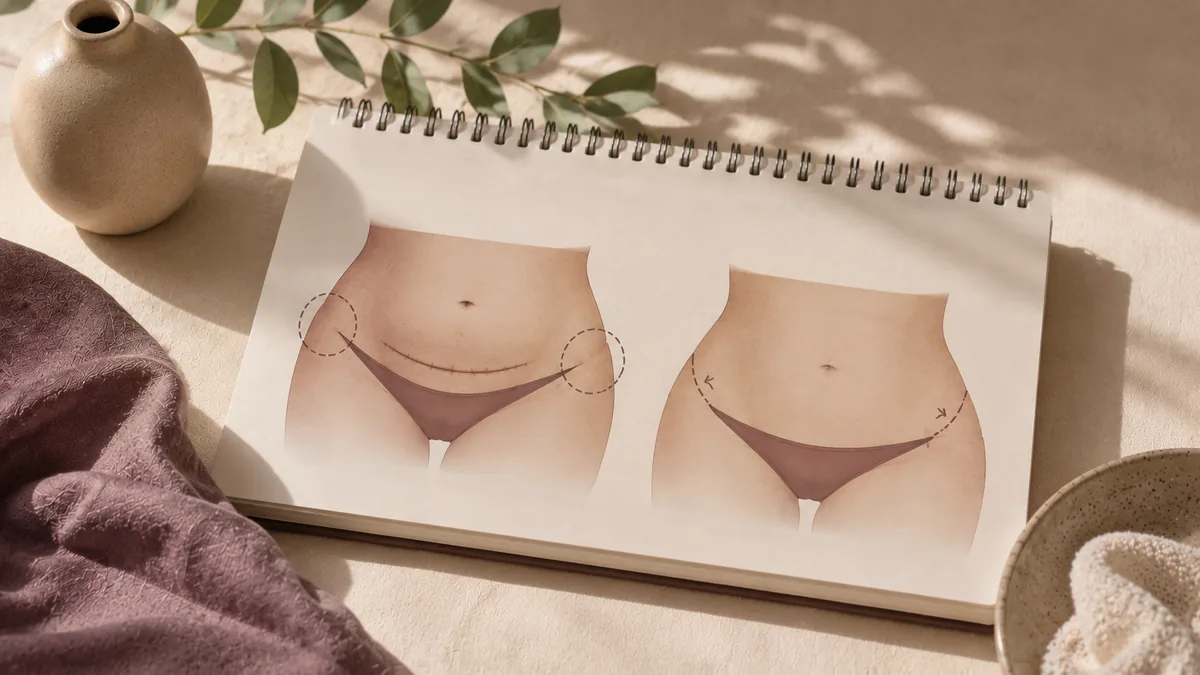
Dog ears are one of the most common minor tummy tuck outcomes people ask about — and one of the least serious. They are not a sign that anything has gone wrong. They are a technical result of the mismatch between how much skin was removed and how the tissue redistributes. Most patients don't get them; some do; a subset find them prominent enough to want revision. This guide is the honest picture.
What Dog Ears Actually Are
The medical term is standing cutaneous deformity. In plain language: at the outer ends of your tummy tuck scar — where the incision terminates near your hips — there is a small triangular pucker of skin and underlying fat. It can range from a barely perceptible small ridge to a prominent triangular protrusion that catches on clothing.
The mechanism: a tummy tuck incision is essentially an ellipse — wider in the middle and tapering at the ends. When the two edges of the ellipse are brought together, if the ellipse tapers too sharply the tissue at the ends can bunch up as it's compressed. Longer, more gradually tapered incisions eliminate this bunching but leave longer scars. Shorter, more sharply tapered incisions can produce prominent dog ears.
Dog ears are widely recognized in abdominoplasty practice as one of the more common minor complications, and revision for them is a routinely offered touch-up procedure.1
Why Dog Ears Form
Multiple factors contribute:
- Incision length trade-off. Shorter cosmetic-preferred incisions leave less room to redistribute skin at the ends. Some surgeons and patients prefer shorter scars; the trade-off can be dog ears in patients whose anatomy needed longer incisions.
- Flank / hip fullness. Patients with extra tissue at the flanks are at higher risk regardless of technique — an extended tummy tuck (which addresses flanks specifically) is often the answer for these patients.
- Higher BMI. More subcutaneous fat at the incision ends is harder to redistribute cleanly.
- Individual anatomy. Some body shapes are simply more prone to dog ear formation.
- Weight gain after surgery. Post-op weight gain can create secondary puckers that resemble dog ears.
Do They Go Away On Their Own?
Some do, meaningfully; some don't. The realistic pattern:
- Small dog ears often reduce noticeably in the first 3 to 6 months as swelling resolves and the skin remodels.
- Firmer, larger dog ears rarely resolve fully — they persist as visible puckers at 12+ months.
- The general rule: what you see at 6 months is close to your long-term result.
- If a dog ear has not improved substantially by 6 months, it typically won't improve significantly beyond that without intervention.
Many patients decide their dog ear is small enough to accept — particularly because revision requires another operation. This is a completely reasonable choice.
Revision Technique
When revision is chosen, the technique is straightforward:
- The existing horizontal scar is extended laterally (further toward the hip) by a small amount — typically 1 to 4 cm.
- The pucker is removed as a small elliptical or wedge-shaped excision.
- Underlying tissue is redistributed or trimmed as needed.
- The wound is closed with fine sutures in multiple layers.
- The scar is now longer horizontally, but flat and even.
Practical details:
| Detail | Typical |
|---|---|
| Timing | 6–12 months post-op (after full scar maturation) |
| Anaesthesia | Local, occasionally sedation for larger revisions |
| Operation time | 30–60 minutes per side |
| Setting | Office procedure room or ambulatory surgery center |
| Recovery | 1–2 weeks off strenuous activity |
| Scar length increase | 1–4 cm per side, extending onto hip |
| Cost per side | $1,000–$3,000 |
| Warranty coverage | Some surgeons include at no additional cost |
| Success rate | Generally very good; some patients need second minor touch-up |
When to Have Revision
Revision is typically done at 6 to 12 months post-op:
- Too early (before 6 months): risks operating on tissue that would have improved on its own; tissue is not fully mature.
- 6 months: minimum reasonable time for minor persistent dog ears.
- 12 months: preferred for larger revisions to ensure base result is fully mature.
- Beyond 12 months: no time limit — revision can be done years later if needed.
Discuss timing with your original surgeon (or a new surgeon if that relationship isn't workable).
A Note on Revision After Surgery Abroad
If your original tummy tuck was done abroad (Turkey, Mexico, other medical tourism destinations), revision creates a specific challenge: post-revision follow-up is important and difficult to arrange internationally. Practical options:
- Return to the original surgeon abroad for revision. Realistic if the relationship is good and travel is feasible; requires another trip.
- Have revision done locally with a US surgeon. Ensures continuity of care, but many US plastic surgeons are reluctant to revise other surgeons' work — call ahead to confirm the surgeon will accept the case, and expect standard revision fees (rather than warranty coverage).
- Wait and see if the dog ear reduces enough at 6 months to not require revision — often the best option for smaller dog ears.
Full context on surgery abroad in our Tummy Tuck in Turkey guide.
Can Dog Ears Be Prevented?
Partially, through surgical planning:
- Adequate incision length. A longer initial incision (extending further onto the hips) allows full skin redistribution and eliminates dog-ear risk in most cases.
- Progressive tension suture technique. Some surgeons use PTS to fine-tune skin distribution at the ends.
- Extended tummy tuck for high-risk anatomy. Patients with prominent flanks often do better with an extended abdominoplasty from the start rather than a standard TT with likely revision. See our extended tummy tuck guide.
- Adjunct liposuction. Liposuction of the flanks during the primary tummy tuck reduces lateral fat that contributes to dog ear formation.
Discuss incision length explicitly in your consultation — ask "will the incision be long enough to prevent dog ears in my anatomy?" A surgeon who is committed to a specific incision length regardless of your anatomy may be prioritising scar length over your final result.
FAQ
What are dog ears after a tummy tuck?
Dog ears — the technical term is "standing cutaneous deformity" — are small triangular puckers of excess skin and fat at the outer ends (lateral corners) of the tummy tuck incision, typically near the hip. They form when the skin removed from the abdomen was shorter horizontally than the base of the incision, leaving redundant tissue at the ends that folds into a small protruding pucker. Dog ears are one of the most common minor complications of abdominoplasty, and revision for them is a routinely offered touch-up procedure,1 typically noticed by patients in the first few weeks post-op as swelling reduces. They range from barely perceptible small puckers that fade with time to prominent triangular protrusions that require surgical revision. Dog ears are a technical outcome — not a sign that anything has gone wrong medically.
Do dog ears go away on their own?
Sometimes, but frequently not entirely. Small dog ears often reduce meaningfully in the first 3 to 6 months as post-op swelling resolves and the skin remodels. Firmer, larger dog ears rarely resolve fully and persist as visible puckers even at 12+ months post-op. The general rule: what you see at 6 months post-op is close to your long-term result. If a dog ear is still prominent at 6 months, it will typically remain prominent without intervention. Small dog ears that improve significantly by 3 months usually continue to improve. Not all dog ears need treatment — many patients decide their dog ear is small enough to accept, particularly since revision requires another operation.
How are dog ears fixed after a tummy tuck?
Dog ears are corrected with a minor in-office or ambulatory surgery revision, typically performed at 6 to 12 months post-op after full scar maturation. The technique: the surgeon extends the existing horizontal incision laterally by a small amount, removes the redundant tissue as a small ellipse or wedge, and closes with fine sutures. The revision typically takes 30 to 60 minutes per side under local anaesthesia (or occasionally sedation for larger revisions), with a recovery period of 1 to 2 weeks. The scar becomes slightly longer horizontally (extending further onto the hip) in exchange for eliminating the pucker (ASPS tummy tuck results / revision overview).1 Most patients find this trade-off acceptable. Cost is typically $1,000 to $3,000 per side; some surgeons include minor dog ear revision at no additional charge as part of their tummy tuck warranty.
Why did I get dog ears after my tummy tuck?
Dog ears are largely a technical outcome. The main causes: (1) insufficient horizontal skin removal — if the skin was excised in a way that took more from the middle than the sides, redundant tissue is left at the ends; (2) individual anatomy — patients with flanks or hip fullness are at higher risk regardless of surgical technique; (3) higher BMI — independently linked to higher overall complication rates after abdominal contouring, making clean tissue redistribution at the incision ends more technically difficult;2 (4) shorter incision than needed — some surgeons prefer shorter incisions for cosmetic reasons but this can leave dog ears in patients who needed a longer incision; (5) fluctuation in weight post-op. In some patients, dog ears are essentially unavoidable regardless of technique — the trade-off between longer incision (fewer dog ears) and shorter incision (more risk of dog ears) is a real one.
When can I get my dog ears fixed?
Revision is typically performed 6 to 12 months post-op after full scar maturation and post-op swelling has resolved. Doing revision too early risks operating on tissue that would have improved on its own, or on skin that has not fully settled into its final position. Some surgeons will address minor dog ears at 3 to 6 months if they are clearly not going to resolve; larger revisions typically wait until 12 months. The revision decision should be made in consultation with your original surgeon. Do not have revision done abroad if your original surgery was local — post-revision follow-up is important. If your tummy tuck was done abroad, arrange revision with a local surgeon or return to the original surgeon.
Can dog ears be prevented?
Partially, through good pre-operative planning and appropriate incision length. The surgeon-side prevention: proper preoperative marking that accounts for individual flank/hip anatomy; making the incision long enough to allow full skin redistribution (accepting a longer scar in exchange for no dog ears); using intraoperative techniques (progressive tension sutures, careful skin tailoring at the ends of the incision) that reduce dog ear risk. The patient-side prevention: choosing a surgeon with meaningful abdominoplasty volume; discussing incision length explicitly in the consultation; maintaining stable weight before and after surgery. Some patients are at high anatomic risk regardless of technique — for these patients, the honest conversation with the surgeon is about accepting either a longer initial incision or the likelihood of a minor revision procedure.