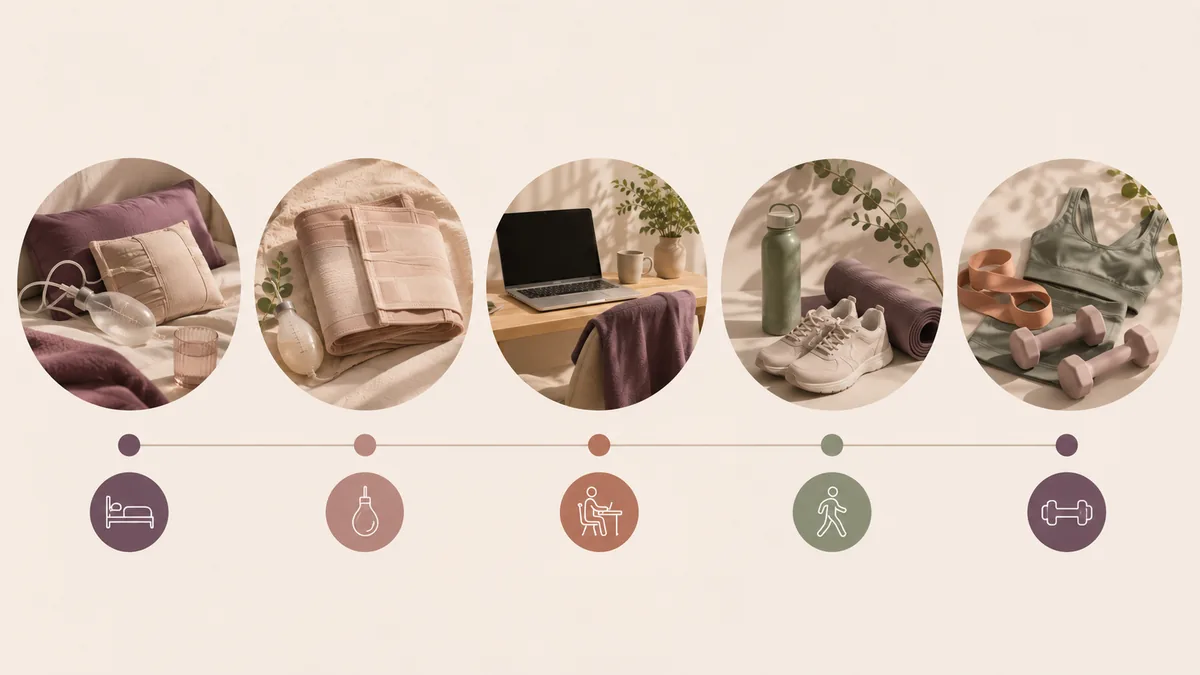
Recovery from a tummy tuck follows a fairly predictable arc, but the details — pain, drains, standing upright, when to move, when to worry — are the parts patients most want a clear read on. This is a realistic, week-by-week timeline based on the operation as it is typically performed, with what to expect at each stage and the specific warning signs that mean you should stop reading a timeline and call your surgeon.
A few things to know before diving in. First, individual recovery varies — age, health, smoking history, whether the operation was a mini or extended abdominoplasty, and whether combined procedures were done all matter (these same factors also shape your candidacy assessment). Second, the specific instructions your surgeon gives you always override a general timeline. Third, enhanced-recovery protocols now widely used in aesthetic surgery — multimodal (non-opioid-based) pain management, long-acting local anaesthetic, early ambulation, and structured pre-op counselling — measurably shorten early recovery and reduce opioid requirements.1 If your surgeon uses one, expect a smoother first week than the older narratives suggest.
The First Week
Day 0 — surgery day
Surgery under general anaesthesia takes 2 to 5 hours for a full abdominoplasty, longer with combined procedures. You wake up in a compression garment with, in many surgeons' practice, one or two soft closed-suction drains coming out of small incisions above the pubic hair line. Long-acting local anaesthetic (liposomal bupivacaine) infiltrated at the end of the operation often keeps the first 24–48 hours substantially less painful than older accounts suggest.
Most patients spend the first night in the hospital or an aftercare facility with nursing support. Some outpatient centres discharge home the same day with a caregiver — this is a case-by-case decision.
Days 1–3 — most uncomfortable
- Posture: you will walk bent forward at the hips ("beach chair" position) to keep tension off the closure. Standing straight is not possible or desirable yet.
- Walking: short, slow indoor laps every 1–2 hours from day 1. Walking reduces the risk of blood clots and speeds return of bowel function.
- Pain: managed with a combination the surgeon prescribes — typically a short course of prescription analgesia, scheduled non-opioid pain relievers, and long-acting local from the OR. Most patients describe soreness and tightness rather than sharp pain, worst when transitioning from lying to sitting to standing.
- Drains (if used): output measured and recorded 2–3 times per day. Output volume guides when they come out.
- Nausea is common the first 24–48 hours; managed with anti-nausea medication.
- Sleep: propped up on 2–3 pillows, knees bent (a wedge pillow under the knees reduces tension on the incision).
Days 4–7 — pain reducing
- Pain: noticeably better; most patients transitioning to over-the-counter pain relievers by day 5–7.
- Walking: longer indoor walks; some patients starting short outdoor walks. Still hunched forward.
- Drains: often come out toward end of week 1 or during week 2 when daily output falls below a set threshold (typically 25–30 mL/day for two consecutive days).
- Bruising: peaks around day 4–5, then starts fading.
- Bowel function: often slow to return after abdominal surgery and pain medication. A stool softener is usually prescribed prophylactically.
- Wound checks: first office visit typically day 5–7 for wound check and possibly drain removal.
Weeks 2–3
- Posture: standing straighter each day; most patients fully upright by end of week 3.
- Pain: usually manageable with over-the-counter pain relievers, if any needed at all.
- Return to work: desk-based work with the option to move around is often possible at 10–14 days.5 Many patients start on shortened schedules and build back up over week 3.
- Driving: usually not before day 10–14, and only when off narcotic pain medication and able to make an emergency stop without pain limiting the movement.
- Compression garment: continuous wear (removed only for showering) — this is critical for reducing swelling and supporting the closure.
- Wound care: incision line usually closed at the skin surface by end of week 2; sutures if used are typically dissolvable and out by this point. Silicone sheeting or gel usually starts once the incision is fully sealed (around week 2–3) — evidence supports silicone as first-line scar management.3
- Activity restrictions: no lifting more than 5–10 lb, no core exercise, no bending/twisting through the waist, no prolonged standing.
- Sleep: still propped up on pillows through week 2; often able to sleep flatter by end of week 3.
Weeks 4–6
- Function: most patients feel more like themselves during this window. Walking freely, working close to normal hours, sleeping normally.
- Exercise reintroduction: light cardio (walking, stationary bike, elliptical at low resistance) is often reintroduced from week 4 with surgeon clearance. No core work, no heavy lifting yet.
- Compression garment: usually continuous through week 6 in most surgeons' protocols.
- Return to physical work: typically week 4–6, sometimes with initial modifications.
- Sexual activity: usually resumed at week 4–6 depending on comfort and surgeon guidance.
- Scars: raised, pink, and firm — this is normal and continues through months 3–6 before starting to soften and pale; see our scar healing guide for the full maturation timeline.
- Numbness: skin numbness across the lower abdomen, including around the repositioned belly button, is common and can persist for months. Sensation gradually returns from the sides inward.
Months 2–12
Months 2–3
- Unrestricted exercise: at 6 weeks with clearance, progressive return to full exercise including core work over the following 2–4 weeks.
- Swelling: substantially resolved by month 3 but ongoing subtle change continues.
- Scar: still firm and pink; peak scar activity is typically month 3.
Months 3–6
- Result is close to final but not final. Swelling continues to soften, particularly at the flanks and lower abdomen.
- Scar starts to flatten, pinkness gradually fading.
- Sensation returning progressively — some patients notice small "zings" as nerves regenerate.
- Most patients seeing their "6-month photos" already close to the final result but still improving.
Months 6–12
- Scar continues to soften and flatten; typically pale by 12 months, mature by 12–18 months.4
- Subtle contour refinement continues as the residual swelling fully resolves.
- Sensation typically largely returned, with some persistent numbness possible at the lower abdomen for some patients.
- This is when "final result" comparison photos are taken.
Swelling & "Swell Hell"
"Swell hell" is a patient term for the surprising persistence of lower-abdominal swelling after a tummy tuck — our dedicated swelling guide covers it in depth. The clinical reality: swelling peaks around days 3–7, improves substantially by week 4, then continues to gradually resolve for months. Patients who expect swelling to be completely gone at 6 weeks are consistently surprised.
What helps:
- Continuous compression garment (typically 6 weeks minimum, sometimes extended to 8–12 in some protocols).
- Reduced salt intake — sodium drives fluid retention, which sits on top of surgical swelling.
- Adequate hydration — counterintuitive, but low fluid intake makes the body retain what it has.
- Manual lymphatic drainage massage in some protocols — evidence is mixed, but many patients report it helps subjectively.
- Time — the most important variable. Patience is genuinely part of the treatment.
Late fluid accumulation weeks after the operation — soft, fluctuant swelling that develops after the initial swelling had been settling — may be a seroma (a fluid collection). Seromas are the most common late complication of abdominoplasty; they are easily managed if caught early (drained in office) but can become chronic if ignored. This is one of the specific warning signs to bring up with your surgeon.
Warning Signs — When to Call Your Surgeon
These are the specific presentations that warrant contact, escalating from "call the office today" to "go to the emergency department now." Serious postoperative complications after abdominoplasty are well-characterised in the largest safety databases; the biggest early risks are venous thromboembolism, hematoma, seroma, and wound complications.2 Our warning signs guide covers each complication and when to escalate.
| Sign | Possible cause | Action |
|---|---|---|
| Chest pain, shortness of breath, sudden anxiety | Pulmonary embolism | Emergency — go to ER / call 911 |
| Calf pain, swelling, warmth (usually one side) | Deep vein thrombosis | Emergency — go to ER same day |
| Fever >101.5°F (38.6°C) persistent | Wound or systemic infection | Call surgeon immediately |
| Pain increasing after day 4 | Haematoma, infection, or other complication | Call surgeon immediately |
| Rapidly expanding hard swelling | Haematoma | Call surgeon immediately |
| Wound edges pulling apart | Dehiscence | Call surgeon same day |
| Thick, cloudy, or foul-smelling drainage | Wound infection | Call surgeon same day |
| New soft, fluctuant swelling weeks after surgery | Seroma | Call surgeon within a few days |
| Persistent nausea/vomiting unable to keep fluids down | Ileus, medication side effect | Call surgeon same day |
| Any concern that "feels wrong" | — | Call surgeon; you are the sensor |
Most established plastic surgery practices have an out-of-hours contact for their operative patients. Use it. Serious complications are much easier to manage when reported early — patients who wait "to see if it settles" are the ones who end up with the worst outcomes.
FAQ
-
How long does it take to fully recover from a tummy tuck?
Most patients feel functional at 4 to 6 weeks and are back to unrestricted normal activity at 6 to 8 weeks. Full internal healing takes longer: the abdominal wall remodels for months, and scar maturation continues for 12 to 18 months. Swelling settles substantially by month 3 and continues to improve to about month 6. Return to work depends on job type — desk work often 2 weeks, physical work 4 to 6 weeks. Return to unrestricted exercise is typically 6 weeks.
-
How painful is the first week after a tummy tuck?
The first 48 to 72 hours are the most uncomfortable — most patients describe it as significant soreness and tightness rather than sharp pain, especially when moving from a lying to standing position. Pain is managed with a combination the surgeon prescribes, typically a short course of prescription analgesia, scheduled non-opioid pain relievers, and sometimes long-acting local anaesthetic infiltrated into the wound at surgery (ERAS protocol).1 Pain reduces substantially by day 4 to 5 and most patients transition to over-the-counter medication by end of week 1.
-
When can I stand up straight after a tummy tuck?
You will not be able to stand fully upright for the first 5 to 10 days because the abdominal skin has been tightened downward and standing straight puts tension on the closure. Patients walk in a slightly bent, protective posture during this period. Most patients stand straighter by end of week 2 and are fully upright by end of week 3. Forcing full upright posture too early risks wound dehiscence, so follow your surgeon's specific instructions.
-
When can I go back to work after a tummy tuck?
Return to work depends on your job type. Desk-based work with the option to move around is often possible at 10 to 14 days, though many patients are still on modified schedules and short days at this point. Physically demanding work (lifting, prolonged standing, manual labor) usually requires 4 to 6 weeks off. Return to full physical exercise, including core work, is typically 6 weeks minimum, with progressive return over the following month. Talk to your surgeon about a written return-to-work note if your employer requires one.
-
What is "swell hell" and how long does it last?
"Swell hell" is a patient term for the surprisingly long persistent swelling of the lower abdomen after a tummy tuck. Swelling peaks around days 3 to 7, improves substantially by week 4, and continues to gradually resolve for months — many patients are still seeing subtle changes at 6 months. Compression garment use (typically 6 weeks continuous), lymphatic massage in some protocols, adequate hydration, and reduced salt intake all help. What matters most is knowing it is normal and prolonged — patients who expect swelling to be gone at 6 weeks are frequently surprised.
-
What warning signs mean I should call my surgeon?
Call your surgeon promptly for: chest pain or shortness of breath (possible pulmonary embolism — emergency); calf pain, swelling, or warmth (possible deep vein thrombosis — emergency); fever above 101.5°F (38.6°C) that persists; increasing rather than decreasing pain after the first few days; wound drainage that is thick, cloudy, foul-smelling, or increasing rather than decreasing; wound edges pulling apart (dehiscence); expanding hard swelling under the wound (possible hematoma) or soft fluctuant swelling weeks after the operation (possible seroma).2 Any of the first two warrants emergency care rather than calling the office.