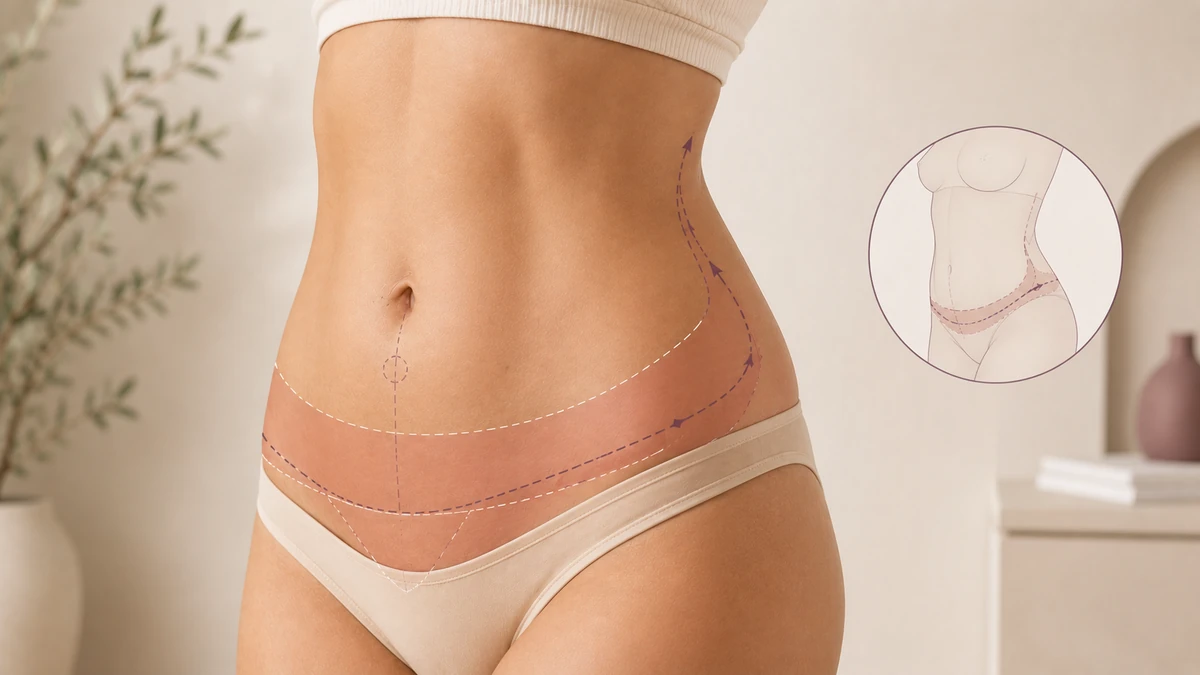
The extended tummy tuck sits in the middle of the abdominoplasty family — larger than a full but smaller than a lower body lift. It exists for a specific problem: skin excess that continues from the abdomen around onto the flanks. A standard full abdominoplasty is limited to the front — it cannot address the "wrap-around" fold that some patients develop after significant weight loss, weight fluctuation, or (occasionally) pregnancy. For patients deciding between smaller procedures, our mini vs full comparison covers that decision. The extended variant solves this by lengthening the incision laterally past the hips.
What follows: what specifically makes it "extended," candidacy (including the key distinction from lower body lift), scar and recovery, safety, and cost.
What Makes a Tummy Tuck "Extended"?
The extended tummy tuck is defined by where the incision goes, not by any change to the core operation. Everything a full abdominoplasty does — skin removal above and below the belly button, full-length muscle repair (rectus diastasis plication), umbilicus repositioning — an extended does identically. The difference is the incision: instead of stopping at the hips, it continues laterally onto each flank.
Anatomically, this lets the surgeon reach and remove excess skin and fat in the flank zone — the area between the lower ribs and the top of the pelvis, wrapping onto the sides. This is the same zone patients often call the "love handle" area or the "muffin top." When this tissue is loose or excess, a standard full leaves it untouched; the extended addresses it.
The extension does not continue around the back — that is a different operation (a lower body lift). The extended stops partway around the flanks. This partial-wrap character is what makes it the right operation for patients whose excess ends before the back, and the wrong operation for patients whose excess is truly circumferential.
Who Is a Candidate
The extended candidate profile is defined by the location and extent of skin excess:
- Loose skin or a horizontal fold that continues past the hips onto the flanks — visible when the patient stands and viewed from the side or the back.
- Flank fullness that persists after weight loss — sometimes with skin quality changes indicating this is redundant tissue rather than just localized fat.
- Post-massive-weight-loss patients who did not require the vertical component of a fleur-de-lis tummy tuck but still have flank redundancy after bariatric-surgery-related weight loss.
- Significant weight-fluctuation history with resulting flank changes.
- Some post-partum patients whose changes extended beyond the abdomen — less common than in the weight-loss populations.
The candidacy question that most often needs clarification: do you need an extended, or is a standard full enough? A physical exam answers this in seconds — the surgeon pinches and lifts the tissue at the flanks; if there is meaningful excess that wraps, it is extended territory. If the excess stops at the hips, a full is enough.
Higher-BMI patients face the same BMI-related complication considerations as any abdominoplasty. An ACS-NSQIP analysis of 18,891 patients showed obesity is independently associated with elevated wound complications and reoperation across abdominoplasty and panniculectomy.3 Most surgeons prefer BMI < 32 for extended cases. See our candidacy guide.
Extended tummy tuck vs lower body lift
The key distinction:
| Feature | Extended Tummy Tuck | Lower Body Lift |
|---|---|---|
| Scope | Abdomen + flanks (partway around) | Circumferential (all the way around) |
| Back / buttock lift | No | Yes — buttock and outer thigh lift included |
| Scar | ~24–32 in, stops mid-flank | Full circumference, continues around back |
| Typical patient | Wrap onto flanks, back OK | Substantial back/buttock skin excess, usually post-massive-weight-loss |
| Operative time | 3–5 hours | 4–7 hours |
| Hospital stay | 1–2 nights | 2–4 nights |
| US cost (all-in) | $12,000 – $20,000 | $18,000 – $30,000+ |
The Scar
The extended scar is the same low horizontal scar as a full tummy tuck, extended laterally onto each flank. Total scar length is typically 24–32 inches versus 18–24 for a standard full. The lateral extensions continue in the same anatomical plane — sitting within the underwear line for many patients when boyshort-style underwear is worn, but potentially exposed by higher-cut swimwear at the lateral ends.
Scar maturation follows the standard 12-to-18-month trajectory documented in the systematic-review literature — raised-and-pink through months 0–6, flattening and paling through months 6–12, mature at 12–18 months.4 Silicone (sheets or gel) and sun protection for the first year are the two evidence-based scar-care basics. The lateral extensions receive the same care as the central scar. See the tummy tuck scars guide for detailed scar-care protocols.
The Operation
Extended abdominoplasty under general anaesthesia typically takes 3–5 hours. Sequence:
- The low horizontal incision with lateral extensions is marked pre-op, standing.
- The incision is made and the abdominal skin flap is elevated from the underlying muscle.
- Full-length rectus diastasis repair is performed with permanent sutures.
- Flank tissue is undermined, elevated, and the excess trimmed at the lateral incision line.
- The skin flap is drawn downward, excess trimmed at the central incision.
- Umbilicus is repositioned at correct anatomical level.
- Multi-layer closure with attention to lateral tension zones.
- Drains typically placed (or progressive tension suture technique if drainless — see drainless guide).
- Compression garment applied covering abdomen and flanks.
Many extended operations combine with lipoabdominoplasty for a more refined contour — particularly of the flank region, where residual fat often benefits from liposuction beyond what skin excision alone can achieve. Combined-procedure evidence supports appropriately selected combinations.2
Recovery
Recovery from an extended is broadly the same as a full but slightly longer at each milestone because of the larger operation, additional tissue trauma, and longer closure:
| Milestone | Extended | Full (for comparison) |
|---|---|---|
| Most uncomfortable phase | Days 1–3 | Days 1–3 |
| Hospital stay | 1–2 nights (often 2) | 1–2 nights |
| Drains removed (if used) | End week 1 – 2 | End week 1 – 2 |
| Standing fully upright | ~Week 3 | ~Week 3 |
| Return to desk work | ~14 days | 10–14 days |
| Unrestricted exercise | 6 weeks (surgeon clearance) | 6 weeks |
| Swelling substantially settled | Months 3–4 | Month 3 |
| Scar mature | 12–18 months | 12–18 months |
The compression garment for an extended operation covers both abdomen and flanks — worn 4–6 weeks per the surgeon's protocol. Full week-by-week detail in our recovery timeline guide.
Safety & Complications
The extended tummy tuck sits within the abdominoplasty family and has a broadly comparable safety profile to a full — the ~4% major complication rate reported in the largest US safety database applies as a reasonable ballpark, with the caveat that the larger operation and more extensive tissue undermining raise the absolute rates of wound complications and seroma somewhat.2
The specific risks that matter for the extended variant:
- Lateral wound tension — the flank extensions typically heal under more tension than the central scar; wound-healing complications tend to concentrate there.
- Seroma — more tissue undermining means more raw surface area; the total volume of drainage tends to be higher than with a full.
- Dog-ears — bunching of skin at the lateral scar ends is more common with extended; surgeon planning and technique reduce but do not eliminate the risk.
- DVT/PE risk — longer operations raise DVT risk; VTE prophylaxis is particularly important for extended cases.
General abdominoplasty risk profile and mitigation strategies are covered in our safety hub. Choosing a board-certified plastic surgeon operating in an accredited facility, stopping smoking pre-op, and following VTE prophylaxis are the highest-leverage risk-reduction steps for any abdominoplasty variant.
Cost
| Location | Range | Typical |
|---|---|---|
| US — average metro | $12,000 – $16,000 | ~$14,000 |
| US — coastal / premium | $16,000 – $20,000 | ~$18,000 |
| Turkey — package | $4,000 – $6,500 | ~$5,000 |
| Add: Lipoabdominoplasty (US) | +$2,000 – $4,000 | — |
| Add: Lipoabdominoplasty (Turkey) | +$800 – $1,500 | — |
Extended tummy tuck is 15–25% more than a standard full because of the longer operation, additional tissue removal, and typically longer facility time. Turkey saving is proportional to a full — roughly 60–65%. Detailed pricing structure in our cost guide. Insurance does not cover extended abdominoplasty when performed for cosmetic reasons — only medically-necessary panniculectomy may qualify; see our insurance guide.
FAQ
-
What is an extended tummy tuck?
An extended tummy tuck is a full abdominoplasty with lateral extensions of the incision that continue past the hips onto the flanks (sides) and, in some cases, partway around toward the lower back. It addresses excess skin and fat that continues from the abdomen around onto the flanks — the "love handle" zone — which a standard full abdominoplasty cannot reach. The core operation is the same as a full tummy tuck (skin removal above and below the belly button, full-length muscle repair, umbilicus repositioning); the extension is added laterally as needed based on where the excess tissue continues.
-
Who is a candidate for an extended tummy tuck?
The extended variant is for patients whose loose skin, fat, or "love handles" continue from the abdomen around onto the flanks — visible as a horizontal fold that wraps beyond the hips, or as flank fullness that persists after weight loss. Common candidates include post-massive-weight-loss patients who did not need a fleur-de-lis, significant weight-fluctuation patients, and some post-partum patients with flank changes. A standard full is sufficient when the skin excess stops at the hips; the extended is needed when it wraps around.
-
How much longer is the extended tummy tuck scar?
The extended scar is roughly 4 to 8 inches longer than a standard full abdominoplasty scar, with the additional length wrapping laterally onto each flank. Total scar length is typically 24 to 32 inches versus 18 to 24 for a full. In many patients the extension still sits within the underwear/bikini line, particularly for boyshort-style underwear, but higher-cut swimwear may partially expose the lateral ends of the scar (scar maturation reference).4 This is a specific trade-off patients should discuss at consultation.
-
How is recovery different from a full tummy tuck?
Recovery from an extended tummy tuck is broadly the same as a full but slightly longer at each milestone because of the larger operation. Operative time is 3–5 hours versus 2–4 for a full. Hospital stay is often 2 nights versus 1–2. Return to desk work is typically 14 days versus 10–14 for a full. Return to unrestricted exercise remains 6 weeks with surgeon clearance. Swelling settles over months 3–6, and the scar matures over 12–18 months as with any abdominoplasty.
-
How much does an extended tummy tuck cost?
In the US, an extended tummy tuck typically costs $12,000 to $20,000 all-in — roughly 15–25% more than a standard full because of the longer operation, more tissue removal, and higher facility fee. In Turkey, the extended typically runs $4,000 to $6,500 all-in through package providers, a similar ratio to the full. Insurance does not cover extended abdominoplasty when performed for cosmetic reasons; only medically necessary panniculectomy may qualify.
-
Extended tummy tuck vs lower body lift — which do I need?
An extended tummy tuck addresses the abdomen and flanks (partway around); a lower body lift is a circumferential operation that continues the incision all the way around the back and lifts the buttocks and outer thighs as well. The extended is right when excess skin wraps onto the flanks but stops before the back; the lower body lift is right when the excess is truly circumferential — most commonly seen after massive weight loss. Most patients fall into extended territory; lower body lift is reserved for the post-bariatric population with substantial back and buttock skin excess.