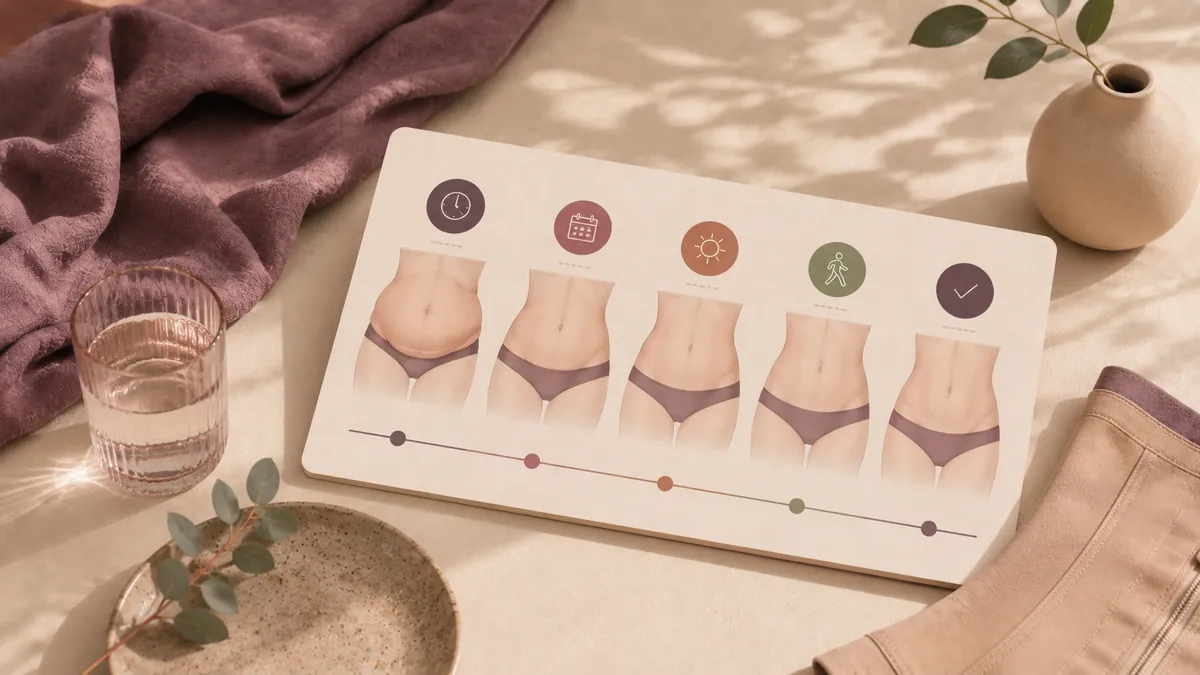
Swelling is the single most emotionally-draining part of tummy tuck recovery, and it is also the part most poorly prepared for. Patients arrive at surgery expecting to look like the before-and-after photos within weeks; what they actually see is a swollen, distorted-looking abdomen that improves in fits and starts over the following year. Understanding that this is normal — and knowing what "normal" looks like at each stage — is the difference between a manageable recovery and a demoralising one. For the broader picture, see our complete recovery guide.
This page is the honest month-by-month timeline, an explanation of what patients call "swell hell," the specific warning signs that mean call-your-surgeon, and the evidence-informed management levers that make swelling resolve as fast as it is going to.
The Honest Swelling Timeline
What actually happens, week by week:
| Timeframe | What swelling looks like |
|---|---|
| Days 0–3 | Rapid onset. Abdomen swollen, tight, hard-feeling. Bruising apparent. Patient walking hunched forward. |
| Days 3–7 (peak) | Maximum swelling. Tissue feels firm and full. Skin may look shiny. This is when patients often panic — this is normal. |
| Weeks 2–4 | Rapid early improvement. Bruising fading. Tightness reducing. First real sense that "this is getting better." |
| Weeks 4–6 | Roughly half of the swelling gone. Abdomen still swollen, but much softer. Standing fully upright by end of week 3–4. |
| Weeks 6–12 ("swell hell") | Improvement slows. Daily fluctuations (morning-to-evening puffiness) more noticeable. Patients often feel worse subjectively even though objectively better. |
| Months 3–4 | Most residual swelling settling. Abdomen looking close to final shape. Scar still active. |
| Months 4–6 | The last of the deep tissue swelling melts. Skin envelope contours onto the new abdominal wall. |
| Months 6–12 | Slow finishing changes. Result you see at 12 months is what you have long-term. |
Two things patients don't expect: (1) the abdomen at week 6 looks nothing like the final result; (2) between month 3 and month 12 there is still meaningful visible change even though most patients think they are "done" at 3 months.
What "Swell Hell" Really Is
"Swell hell" is a patient-community term for the phase — usually weeks 6 to 12 — when swelling stops improving in a satisfying way and instead seems to fluctuate. Patients report puffiness that is worse in the evening than the morning, worse after long walks or standing, worse after salty meals, and often worse after they think they are past the recovery period.
Objectively, swell hell is rarely a worsening. The total swelling volume is almost always continuing to decrease. What changes at this phase is:
- Baseline is lower, so daily fluctuations that were invisible under the acute swelling are now visible.
- Patients are more active, so end-of-day swelling from standing/walking becomes noticeable in a way it wasn't when they were mostly resting.
- Expectations are higher — the patient has been told 6 weeks is the "return to normal exercise" milestone, so they expect to look normal, and the residual swelling reads as failure rather than progress.
- The compression garment is often being worn less, so the mechanical fluid limit is loosened.
The right frame: swell hell is a plateau perception, not a plateau of actual improvement. Weekly photos taken from the same angle and lighting almost always show ongoing progress that the daily-mirror view misses.
What Actually Helps
The evidence-informed levers, in order of impact:
Compression garment, consistently
The compression garment is standard of care after abdominoplasty. It supports the healing tissue, distributes tension away from the incision, helps the skin flap adhere to the underlying muscle wall (reducing seroma risk), and mechanically limits how much fluid accumulates. Standard protocol is 4 to 6 weeks of continuous wear (24 hours except for showering) followed by 2 to 4 weeks of daytime-only wear.1
The single most common recovery mistake at this stage is patients stopping the garment early because it feels restrictive or because "I don't need it anymore." Consistent garment wear is the highest-leverage single choice a patient can make. If the garment feels loose (from swelling reduction), have it re-fitted rather than abandoning it.
Walk daily, from day 1
Walking is the biggest single lever for both swelling reduction and DVT risk reduction. Even 5-minute walks starting the day of surgery help lymphatic drainage; by week 2, patients should be walking 10–20 minutes multiple times daily. What matters is consistency, not intensity — a series of short walks is better than one long walk, particularly in the first two weeks. This is one of the specific behavioural protocols formally recommended in enhanced-recovery-after-surgery pathways for abdominoplasty and other body-contouring operations.
Sodium moderation
Dietary sodium drives fluid retention system-wide. Most patients see visible reduction in evening swelling within days of reducing salt intake to moderate levels (typically < 2,000 mg/day). This is not a strict diet — it is avoiding obvious high-sodium sources (processed food, restaurant food, salty snacks) during the swelling-reduction phase.
Hydration, paradoxically
Dehydration worsens swelling because the body responds by retaining more fluid. Consistent water intake (roughly 2 L/day for most adults) throughout recovery supports lymphatic clearance and reduces the fluid-retention response.
Elevation when resting
Sleeping and resting with the upper body slightly elevated (a wedge pillow or a couple of pillows under the shoulders) reduces overnight abdominal pooling. This matters most in the first 3–4 weeks.
Manual lymphatic drainage (if surgeon recommends)
After the acute healing phase (typically week 2–3), some surgeons recommend manual lymphatic drainage massage — a gentle, specific technique performed by a trained therapist. Published evidence is mixed but many patients report subjective improvement, and the intervention is low-risk when performed by a trained therapist familiar with post-surgical patients. This is a surgeon-guided decision.
When Swelling Is Not Normal
Steady, gradually-improving overall swelling is expected. The specific patterns that mean call-your-surgeon:
- Sudden increase in swelling on one side or one area — may indicate seroma (fluid collection) or hematoma (blood collection). Seroma is the most common late complication and is treatable with drainage.2
- Swelling with fever above 38°C / 100.4°F — may indicate infection.
- Sudden calf swelling or calf pain — DVT concern, this is an emergency — go to ER.
- Sudden shortness of breath or chest pain — pulmonary embolism concern, emergency — call 911/999/112.
- Swelling with skin color change to red, purple, or grey — may indicate skin compromise, seroma with skin thinning, or infection.
- New persistent unilateral swelling weeks after most swelling has resolved — may indicate delayed seroma; ultrasound can confirm and aspiration can treat.
- Foul-smelling discharge from the incision — infection concern.
- Increasing rather than decreasing pain after the first week — flag to surgeon.
For the full list of warning signs after a tummy tuck, see our dedicated guide. For the full complication overview, see our complications guide. For DVT/PE specifically, see the DVT and PE guide.
Factors That Affect Your Swelling Timeline
Several patient-specific factors influence how fast swelling resolves:
- BMI — Higher-BMI patients typically swell more and take longer to resolve. Higher BMI is also independently associated with elevated complication rates including wound issues.3
- Operation size — Extended, fleur-de-lis, and combined mommy-makeover operations swell more than a mini or standard full.
- Muscle repair extent — Full-length rectus repair (durable at 1 year per randomized evidence) creates more early swelling than partial repair.4
- Liposuction added — Lipoabdominoplasty adds fluid mobilisation and often more visible early swelling; it also refines the final contour.
- Post-op adherence — Garment wear, walking, salt intake, and hydration all measurably affect the trajectory.
- Individual biology — Some patients simply resolve faster than others. Both extremes are within normal.
FAQ
How long does tummy tuck swelling last?
Most of the visible swelling resolves in the first 3 months, but complete resolution takes 6 to 12 months. The pattern: peak swelling around days 3–7 post-op, substantial reduction over weeks 2–6 (typically 50–60% of the swelling gone by week 6), continued gradual reduction through month 3, and slow finish over months 3–12. The abdomen looks close to its final shape at month 3, then continues to refine and "melt" for another 6–9 months. This is normal.
What is "swell hell" and when does it happen?
"Swell hell" is a patient-community term for the phase around weeks 6 to 12 when patients often feel that swelling gets worse rather than better. In reality, it usually isn't worse than earlier weeks — it feels worse because patients are more active by then, expectations are higher, and daily fluctuations (better in morning, worse by evening) become more noticeable when the baseline swelling is lower. Compression garment protocols, gradual return to activity, salt/sodium moderation, and patience are the honest management levers. It is a real phenomenon and not a complication in itself; if swelling suddenly worsens with pain, fever, or asymmetry, contact your surgeon to rule out seroma.
When should I worry about swelling after a tummy tuck?
Contact your surgeon promptly if any of these occur: sudden increase in swelling on one side or one area (may indicate seroma or hematoma), swelling accompanied by fever above 38°C/100.4°F (may indicate infection), sudden calf swelling or pain (may indicate DVT — this is an emergency), sudden shortness of breath (may indicate pulmonary embolism — emergency), swelling with skin color change to red, purple, or grey (may indicate seroma with skin compromise or infection), or new persistent unilateral swelling weeks after most swelling has resolved (delayed seroma).2 Steady, gradually improving overall swelling is normal; sudden changes are not.
Does compression garment really help with swelling?
Yes — compression garment is a standard-of-care part of abdominoplasty recovery for a reason.1 It supports the healing tissue, distributes tension away from the incision, encourages the skin flap to adhere to the underlying muscle wall (reducing seroma risk), and mechanically limits how much fluid accumulates. Standard protocol is 4 to 6 weeks of continuous wear (24 hours except for showering) followed by 2 to 4 weeks of daytime-only wear. Some patients benefit from continuing daytime wear longer, particularly for prolonged activity. Consistent garment use is one of the highest-leverage recovery choices a patient can make.
Can I do anything to reduce swelling faster?
There are several evidence-informed levers: consistent compression garment wear per the surgeon's protocol; walking daily starting from day 1 (short walks — even 5 minutes helps lymphatic drainage and reduces DVT risk); moderating dietary sodium (which drives fluid retention); staying well hydrated (paradoxically, dehydration worsens swelling); elevating the upper body when resting (a slight incline reduces abdominal pooling); avoiding prolonged sitting or standing in weeks 2–4; and — if the surgeon recommends it — manual lymphatic drainage massage after week 2–3. Salt reduction and consistent garment wear are the two biggest single-lever changes.
How long until my abdomen looks "finished"?
The abdomen looks close to final at month 3 for most patients, but continues to refine for a full year. Month 3 to month 6 is when the last of the deep tissue swelling settles and the skin envelope "melts" onto the new abdominal contour. Scar maturation continues on its own separate 12-to-18-month trajectory.5 The result you see at your 12-month follow-up is what you'll have long-term (assuming stable weight); the result at 3 months is close but still evolving. This long-tail timeline is one of the most important expectations to set before surgery.