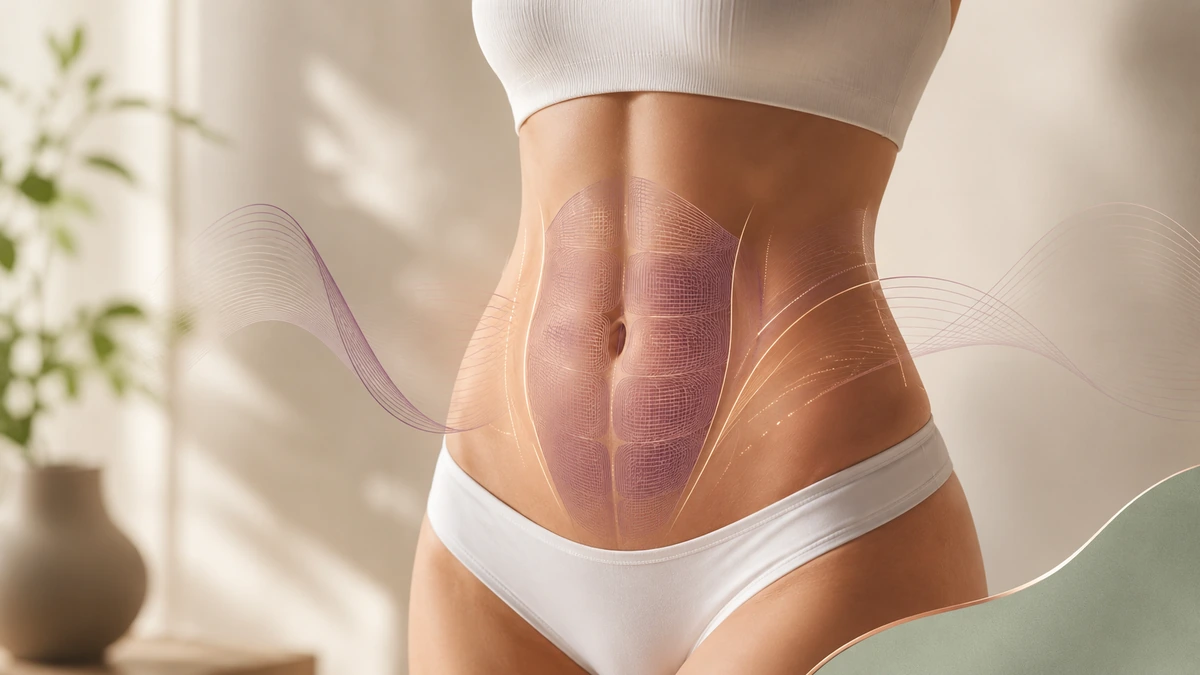
Muscle repair is the step that distinguishes a real tummy tuck from a "skin-only" abdominoplasty — see our tummy tuck with muscle repair overview for the full picture. It is also the step patients understand least — most know their surgeon is going to "tighten the muscles," but few understand what that actually means at the operating table. This guide walks through exactly what happens during rectus plication, the technique variations, the mesh question, and what the repair means for recovery and long-term result.
The Anatomy the Repair Addresses
The two rectus abdominis muscles (the "six-pack" muscles) run vertically from the ribs down to the pubis. They are held together at the midline by a fibrous connective-tissue sheet called the linea alba. In pregnancy, weight gain, or ageing, this midline sheet can stretch and thin, allowing the two muscles to separate — this is rectus diastasis (or diastasis recti).
When separated, the midline of the abdomen bulges forward under strain (because there is no strong muscle wall to hold it in), the abdominal wall lacks integrity, and the waist loses definition. Post-pregnancy patients describe this as a "pooch" that persists no matter how much they exercise. Full detail on the condition itself in our diastasis recti guide.
Muscle repair (plication) surgically brings the two rectus muscles back together at the midline by tightening the fascia between them — restoring the abdominal wall's integrity and the waist's definition.
How the Repair Is Performed
Plication is performed during the tummy tuck operation, after the skin flap has been elevated from the underlying muscle wall. The sequence:
- Exposure. The skin flap is lifted from just below the sternum down to the pubis, exposing the entire rectus fascia — the fibrous sheath overlying the two rectus muscles.
- Assessment. The surgeon assesses the width and length of the diastasis by asking the (anaesthetised) patient's diaphragm to relax and observing the natural midline. Sometimes the surgeon marks the intended repair line with a marking pen.
- First layer. A series of interrupted "figure-of-eight" sutures are placed in the rectus fascia on each side, bringing the two sides together at the midline. Sutures are typically placed at 1–2 cm intervals from just below the sternum down to the pubis.
- Second layer. A running suture is placed over the top of the interrupted sutures for reinforcement — sometimes called an "imbricating" second layer that overlaps the first.
- Assessment. The surgeon confirms the midline is tight, that there is no bunching or unevenness, and that the plication reaches from sternum to pubis.
- Skin closure. The tummy tuck proceeds with skin removal, umbilicus repositioning, and skin closure.
The muscle itself is not cut or removed — the muscles are simply brought back to their correct midline position. This is a common patient misconception. The sutures anchor into the strong fibrous sheath overlying the muscle, not into the muscle fibres themselves.
Suture Choice
Surgeon preference varies. Two main categories of suture are used:
Permanent (non-absorbable) sutures
Materials: polypropylene (Prolene), Nurolon, Ethibond, silk (rarely used now). The rationale is durability — a permanent suture continues to hold the repair together indefinitely. Downsides: the suture is a permanent foreign body in the tissue, occasionally becomes palpable through thin skin, and rarely causes a stitch abscess or sinus tract requiring later removal.
Long-acting slow-absorbing sutures
Materials: PDS (polydioxanone), Maxon. These slowly break down over 6+ months, giving the healing tissue time to consolidate around them before losing tensile strength. Rationale: no permanent foreign body. Downsides: theoretically less durable than permanent, though the published outcomes are broadly similar.
Both approaches have long track records and comparable outcomes in the aesthetic surgery literature. What matters more than the exact suture material is consistent, meticulous placement of the sutures — this is what makes the repair durable.
The Mesh Question
Mesh reinforcement is not routinely used in cosmetic tummy tuck muscle repair — the standard is suture-only plication. Mesh is added in a subset of cases:
- Very wide diastasis (particularly > 5 cm) where sutures alone create high tension on the repair.
- Prior failed repair (revision cases).
- Co-existing ventral or umbilical hernia that warrants a formal hernia repair.
- Patients with connective-tissue disorders (Ehlers-Danlos, etc.) where tissue quality is poor.
- Post-massive-weight-loss patients with poor fascial quality.
A 2025 randomized clinical trial published in the British Journal of Surgery specifically compared rectus diastasis repair with and without mesh at 1-year follow-up, and reported the repair was durable in both groups.1 This provides high-quality evidence that suture-only repair is not inferior to mesh-augmented repair at that time point — supporting the standard practice of reserving mesh for specific indications.
Adding mesh introduces additional cost, mesh-specific potential complications (infection, chronic pain, palpability), and should be a surgeon-driven decision based on individual anatomy.
Functional Benefits Beyond Aesthetics
Muscle repair produces aesthetic benefits (flatter midline, defined waist) but also has functional benefits that patients often notice:
- Improved core function. The re-approximated abdominal wall provides the mechanical basis for core strength that diastasis had disrupted.
- Reduced lower back pain. Some patients with pre-op back pain related to diastasis report improvement post-repair. A systematic review of nearly 500 patients across 7 studies found diastasis repair improved SF-36 physical-function scores and abdominal strength measures.2
- Improved posture. Anterior pelvic tilt often associated with abdominal wall weakness can improve after repair.
- Improved abdominal support during activity. Patients often describe a sense of "core support" that they lacked pre-op.
- Improved cosmetic response to exercise — abdominal exercise creates visible muscle definition rather than paradoxical bulging.
Functional benefits are not uniform — not every patient with diastasis has back pain or functional complaints, and not every repair produces functional improvement. But for patients whose diastasis was affecting core function, the repair is often as important functionally as aesthetically.
Recovery Specifics for Muscle Repair
Recovery from a tummy tuck with muscle repair follows the same broad arc as tummy tuck recovery generally (see our full recovery guide and the detailed recovery timeline). The specifics that apply to the muscle repair component:
| Activity | Timeline |
|---|---|
| Walking | From day 1 — encouraged |
| Bending / twisting | Restricted first 2–3 weeks |
| Lifting > 5 kg / 10 lb | Avoid for 4–6 weeks |
| Light cardio (stationary bike, walking) | 4 weeks |
| Running | 6 weeks |
| Core exercise (crunches, planks, sit-ups) | 6 weeks minimum (some surgeons 8) |
| Heavy weight training | 6–8 weeks |
| Contact sports | 8+ weeks |
The most important restriction is the 6-week core-exercise wait. Doing crunches or planks too early can stress the repair before the tissue has consolidated around the sutures, potentially compromising durability. The 4–6 week lifting restriction has the same rationale — heavy lifting generates intra-abdominal pressure that stresses the midline repair.
Pregnancy After Muscle Repair
Pregnancy after tummy tuck with muscle repair is possible and not dangerous, but it can stretch the repair — sometimes back to diastasis, sometimes only partially. Most surgeons recommend completing childbearing before tummy tuck when possible. Patients who become pregnant after repair may need re-repair after their final childbearing is complete. The repair does not restrict pregnancy — it just means the aesthetic result may need refreshing later.
Muscle Repair Complications
Muscle-repair-specific complications are a small subset of the overall tummy tuck complication rate (~4% major per the CosmetAssure database).3 Specific to the muscle repair component:
- Repair failure — recurrence of diastasis, most often from excessive early strain, wide starting diastasis, or poor tissue quality. Rare in the first year per the 2025 RCT evidence.1
- Suture-related issues — palpable sutures, occasional stitch abscess or sinus, rarely requiring removal.
- Increased early post-op pain — muscle repair produces more early discomfort than skin-only tummy tuck because the plication itself creates tension across the abdominal wall.
- Rarely: seroma formation over the repair — treated with aspiration.
Choosing a board-certified plastic surgeon experienced with abdominoplasty is the single biggest safety factor for the muscle repair specifically — the technique is judgement-dependent and rewards experience. See our choosing a surgeon guide for the full vetting framework.
FAQ
How does muscle repair surgery work in a tummy tuck?
Muscle repair — technically called rectus plication or diastasis recti repair — is performed during the tummy tuck operation after the skin flap is elevated. The surgeon identifies the two separated rectus abdominis muscles in the midline and re-approximates them with permanent sutures placed in the fibrous sheath (rectus fascia) that overlies the muscles. The sutures are typically placed in two layers for durability, running from just below the sternum down to the pubis in a full tummy tuck. This "re-corsets" the abdominal wall, restoring midline anatomy and waist definition. The muscle itself is not cut or removed — the muscles are simply brought back together.
How long does the muscle repair last?
A 2025 randomized clinical trial published in the British Journal of Surgery examined 1-year outcomes of rectus diastasis repair with and without mesh reinforcement. The repair was durable at 1-year follow-up in both groups.1 Longer-term follow-up beyond 1 year is more limited in the published evidence, but clinical experience with millions of tummy tucks worldwide indicates the repair is generally durable long-term when performed with permanent (or long-acting absorbable) sutures. Factors that can compromise durability include subsequent pregnancy, significant weight gain, chronic straining (heavy lifting, chronic cough), and connective-tissue disorders.
What sutures are used for muscle repair?
Surgeon preference varies, but most modern practice uses either permanent sutures (such as polypropylene / Prolene, Nurolon, or Ethibond) or long-acting slow-absorbing sutures (such as PDS — polydioxanone — which takes 6+ months to absorb). The rationale for permanent sutures is durability; the rationale for slow-absorbing is avoiding a foreign body permanently in the tissue. Both approaches have long track records. The suture is typically placed in a two-layer configuration: a first row of interrupted "figure-of-eight" sutures for the primary repair, and a running suture over the top for reinforcement.
Is mesh used in tummy tuck muscle repair?
Mesh reinforcement is not routinely used in cosmetic tummy tuck muscle repair — the standard is suture-only plication. Mesh is used in a subset of cases: patients with wide diastasis, prior failed repair, connective-tissue disorders, or a co-existing hernia that warrants formal hernia repair. The 2025 BJS randomized trial specifically compared repair with and without mesh at 1 year and found the repair durable in both approaches.1 Adding mesh introduces additional cost, potential complications specific to mesh (infection, pain, palpability), and is a decision that should be surgeon-driven based on individual anatomy — not a routine addition.
Does muscle repair change how I look and feel?
Yes, in both aesthetic and functional ways. Aesthetically, muscle repair restores the flat midline contour and defined waist that pregnancy-related diastasis often obscures — it is why post-partum patients say their tummy tuck "gave them back a waist," not just a flatter tummy. Functionally, a systematic review of diastasis repair outcomes found measurable improvements in abdominal strength and physical function — the muscle repair provides the abdominal wall integrity that diastasis had disrupted.2 Bowel function is not affected. Feeding and pregnancy after repair are possible; a subsequent pregnancy can stretch the repair and may require re-repair after childbearing is complete.
How long is recovery from muscle repair?
Recovery from a tummy tuck with muscle repair follows the same broad arc as tummy tuck recovery generally: most uncomfortable days 1–3, standing fully upright by week 3, return to desk work at 10–14 days, return to unrestricted exercise at 6 weeks with surgeon clearance. The muscle repair specifically means: core exercises (crunches, planks, sit-ups, heavy weight training) are restricted for at least 6 weeks (some surgeons 8 weeks) to allow the repair to consolidate. Walking, gentle cardio, and normal daily activity are allowed on the standard timeline. Lifting restrictions are typically stricter than for tummy tuck without muscle repair — commonly nothing over 5 kg / 10 lbs for the first 4–6 weeks.