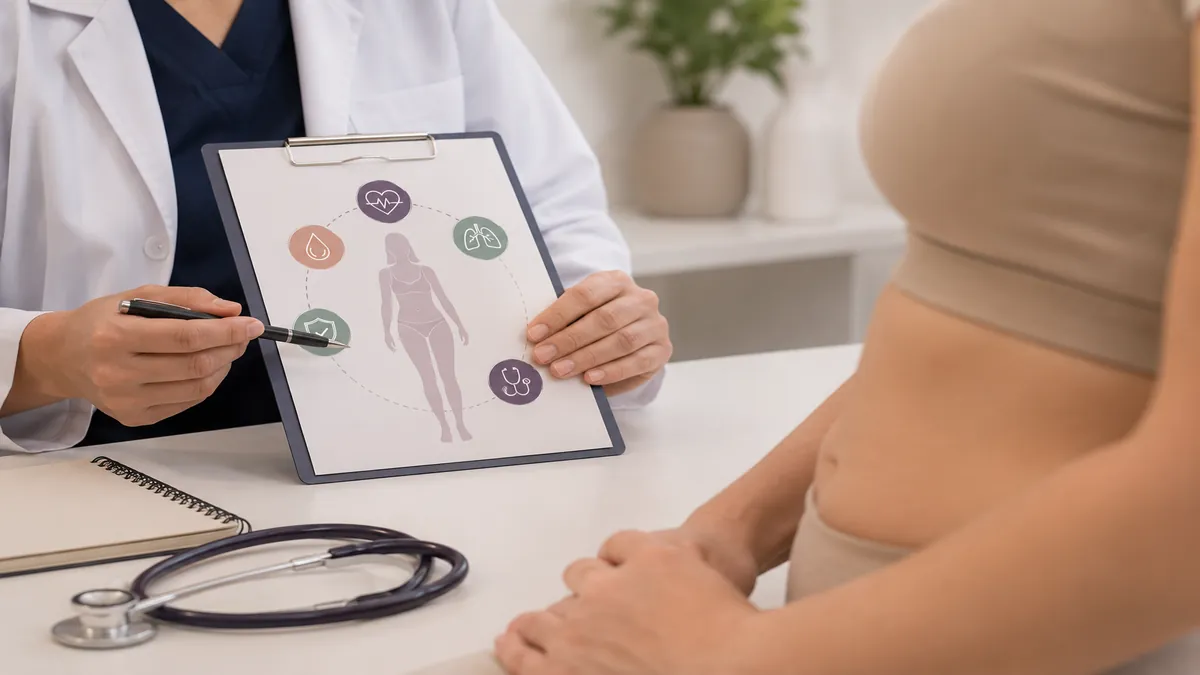
"Is a tummy tuck safe?" is the wrong question — our safety guide covers the full picture. The right question is: "What makes a tummy tuck safe, and what makes it dangerous?" The answer is not the operation itself — it is the patient, the surgeon, the facility, and the specific decisions around DVT prophylaxis and combined operations. The largest US abdominoplasty safety review (25,478 cases)2 and the ACS-NSQIP analysis of 18,891 patients3 provide the data this page is built on.
Mortality: How Rare Is Death After a Tummy Tuck?
The mortality rate for abdominoplasty in published large-database studies is approximately 1 in 10,000 to 1 in 15,000 — or 0.007% to 0.01%. This is comparable to other elective cosmetic operations under general anaesthesia. The primary cause of death after tummy tuck is pulmonary embolism (PE) — a blood clot that forms in the leg veins and travels to the lungs.1 PE risk is meaningfully reduced by early mobilisation after surgery, appropriate DVT prophylaxis, and not combining large operations. Detail on DVT/PE is on our dedicated DVT/PE page.
Complication Rates: What the Databases Show
The overall complication rate for abdominoplasty in the CosmetAssure database of 25,478 cases is 4.0%.2 When including minor complications that resolve without intervention, rates of 5–7% are typical. The most common:
| Complication | Rate | Severity |
|---|---|---|
| Seroma (fluid collection) | 10–15% (with drains); 5–10% (drainless) | Minor — aspiration in office |
| Wound infection | 2–4% | Minor-moderate — antibiotics |
| Wound-healing issues | 3–5% | Minor-moderate — dressings, rarely debridement |
| Haematoma | 1–2% | Moderate — may need drainage |
| DVT (deep vein thrombosis) | 0.3–0.5% | Serious — anticoagulation |
| PE (pulmonary embolism) | 0.1–0.3% | Life-threatening — emergency |
| Dog ears (revision needed) | 5–10% | Minor — elective revision at 6–12mo |
What Makes a Tummy Tuck More Dangerous
The ACS-NSQIP analysis of 18,891 patients identifies these independent risk factors for complications:3
High BMI
BMI above 30 is the single strongest independent risk factor. Wound complications, infections, and overall morbidity are all significantly higher. Most surgeons require BMI below 30 — ideally below 28 — before proceeding.
Combined Operations
Combining tummy tuck with another large operation (e.g., breast surgery, extensive liposuction) roughly doubles the complication rate in the CosmetAssure database.2 Combining is common and often appropriate, but patients should understand the increased risk.
Smoking
Active smoking impairs wound healing and increases infection rates. The evidence-based requirement is to stop smoking at least 4 weeks before surgery and remain smoke-free through recovery. This is not a preference; nicotine directly compromises the blood supply to the skin flap.
Facility Quality
Operations performed in non-accredited facilities have higher complication rates in published data. Accreditation (AAAASF in the US, JCI internationally) verifies that the facility meets specific safety standards for anaesthesia, equipment, and emergency protocols.4 For readers evaluating a specific overseas destination, our country-specific analysis of tummy tuck safety in Turkey walks through how to verify Ministry of Health licensing, JCI accreditation, and surgeon credentials in practice.
No DVT Prophylaxis
Skipping DVT prophylaxis (compression stockings, early ambulation, chemical prophylaxis when indicated) increases the risk of the most dangerous tummy tuck complication — pulmonary embolism. See our DVT/PE guide.
What Makes a Tummy Tuck Safe
The controllable safety factors, supported by the published evidence:
- Board-certified plastic surgeon with meaningful abdominoplasty volume (not occasional).
- Accredited facility — AAAASF, JCI, or hospital-based.
- BMI below 30 at time of surgery.
- Non-smoker for 4+ weeks pre-op.
- DVT prophylaxis protocol — early walking, compression, chemical prophylaxis when indicated.
- Stable weight for 3+ months — no active weight loss.
- Avoid unnecessary combined operations — do what is needed, not everything at once.
- Honest medical history — disclose all conditions and medications.
How Painful Is a Tummy Tuck?
Moderate to significant pain for the first 3–5 days, manageable with prescribed medication. Most patients describe deep tightness rather than sharp pain. The muscle repair (rectus plication) is the primary source of discomfort. Pain reduces meaningfully by Day 5–7, is typically manageable with over-the-counter medication by Day 10–14, and most patients are pain-free in daily activities by Week 6. Full detail on our recovery timeline page.
FAQ
What is the mortality rate for a tummy tuck?
Approximately 1 in 10,000 to 1 in 15,000 (~0.01%). Primary cause: pulmonary embolism.
Is a tummy tuck dangerous?
Not inherently. Overall complication rate is 4–7%, mostly minor. It becomes more dangerous with high BMI, combined operations, non-accredited facilities, or skipped DVT prophylaxis.
What makes a tummy tuck safer?
Board-certified surgeon, accredited facility, BMI below 30, non-smoker, DVT prophylaxis, stable weight, no unnecessary combined operations.
How painful is a tummy tuck?
Moderate pain for 3–5 days, deep tightness rather than sharp. Manageable with OTC medication by Day 10–14. Pain-free in daily activities by Week 6.
What is the complication rate?
4–7% overall. Most common: seroma (10–15%), wound infection (2–4%), wound-healing issues (3–5%). Serious: DVT/PE (0.3–0.5%).
Is a tummy tuck safe for someone with high BMI?
Higher BMI is the strongest independent risk factor. Most surgeons require BMI below 30 before proceeding — this is safety-driven, not cosmetic.