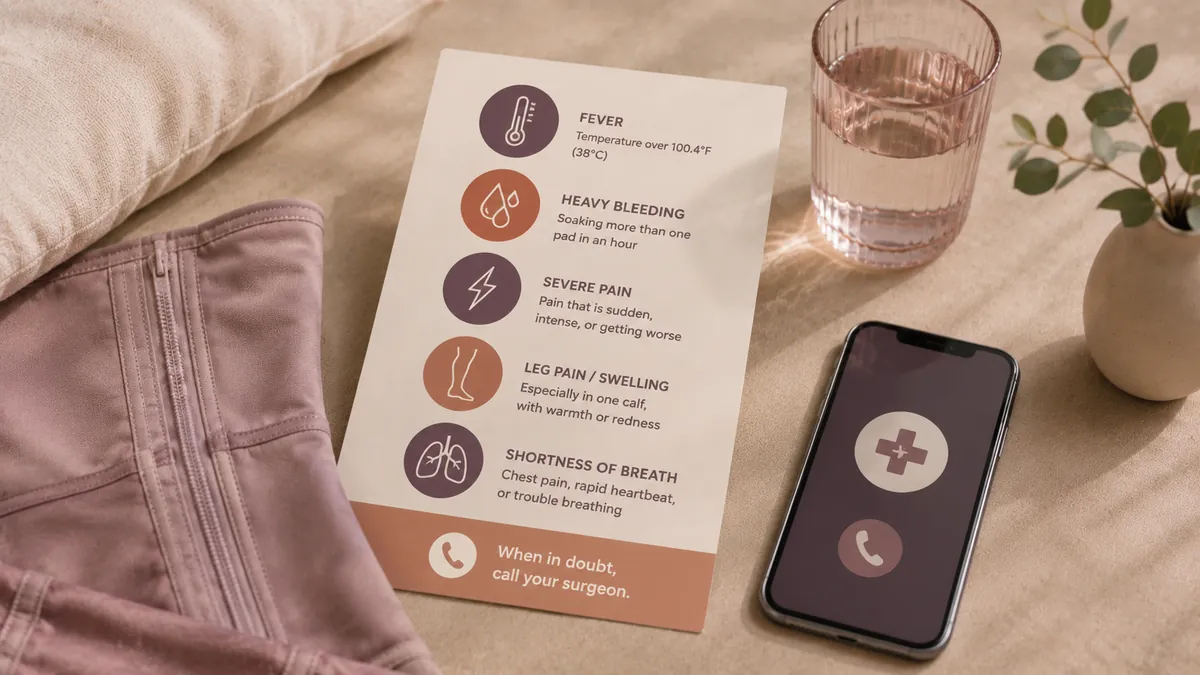
This is the guide you want on hand during the first 6 weeks post-op. Most tummy tuck recoveries go smoothly, but some complications are life-threatening if not recognized. The single most important thing this page can do for you is give you a clear three-level triage: emergency, same-day call, or soon. Print it, bookmark it, or keep it on your phone.
Level 1: Emergency — Call 911 or Go to the ER
These signs may indicate pulmonary embolism (PE) — a clot that has traveled to the lungs — which is one of the leading causes of death after cosmetic surgery. PE requires immediate emergency treatment.
| Sign | What it might mean |
|---|---|
| Sudden shortness of breath (unexplained) | Pulmonary embolism |
| Chest pain, especially with deep breaths | Pulmonary embolism |
| Coughing blood | Pulmonary embolism |
| Rapid heart rate at rest (over 100–110 bpm) | Pulmonary embolism |
| Fainting or near-fainting | PE, severe bleeding, cardiac event |
| Sudden severe leg swelling with pain (usually one leg) | DVT with possible PE risk |
| Sudden severe abdominal pain with weakness/dizziness | Post-op bleeding (hematoma) |
| Sudden dramatic swelling with worsening pain | Bleeding under skin flap |
Do not: wait to see if it passes, drive yourself, wait for your surgeon to call back, take extra painkillers to "handle it." Call 911 or have someone drive you to the nearest emergency room. Tell them you had a tummy tuck (date and location) so the ER team can immediately consider VTE workup. Full DVT/PE detail in our DVT/PE guide.
Level 2: Same-Day — Call Your Surgeon Today
These signs are not immediate emergencies but require urgent evaluation. Call your surgeon's office same day — most have on-call coverage 24/7.
Fever
- Any fever over 101.5°F (38.6°C) at any point post-op.
- Any temperature over 100°F (37.8°C) persisting beyond 48 hours post-op.
- Fever accompanied by shaking chills.
- Fever + redness at incision + increasing pain (infection pattern).
Low-grade fever (up to ~100°F) in the first 24–48 hours after anaesthesia is common and usually not concerning. The concerning pattern is fever that develops later or persists.
Infection signs
- Spreading redness around the incision — beyond the immediate wound edge.
- Warmth of the skin around the incision.
- Foul-smelling drainage from the wound.
- Pus or thick yellow-green discharge.
- Increasing pain (rather than gradual improvement).
DVT signs (call surgeon, but if PE signs develop → 911)
- Swelling in one leg (often the calf) that is different from normal post-op swelling.
- Pain or tenderness in the calf that is different from normal soreness.
- Warmth in the affected leg.
- Redness or discoloration in the leg.
- Pain that worsens when standing or walking.
Skin flap concerns
- Dark, dusky, or purplish color of skin around the incision (skin necrosis warning).
- Skin that feels cold or firm compared with surrounding skin.
- Loss of sensation that is worse than expected numbness.
Level 3: Soon — Call Your Surgeon Within 24 Hours
These signs are important but not urgent. Contact your surgeon's office within 24 hours for evaluation.
Suspected seroma
A seroma is a collection of clear or straw-coloured fluid under the skin, most commonly developing 2 to 4 weeks post-op (often after drains have been removed). Signs:
- A swelling that feels fluid-filled and moves when you press on it — sometimes described as feeling like a water balloon.
- Firm, tender area on the abdomen that develops or worsens after drain removal.
- Fluctuant swelling that is visibly asymmetric.
Seromas are typically not painful but can feel uncomfortable. Untreated they can persist or become infected. Managed with in-office aspiration — the surgeon uses a needle to drain the fluid, sometimes repeated over several visits.
Drainage changes
- Sudden increase in drain output after previous decline.
- Change in drainage color (from serosanguineous to bright red or cloudy).
- Wound drainage after apparent healing.
Swelling that worsens after improvement
Normal swelling improves gradually. Sudden re-worsening after a period of improvement often indicates seroma or a small hematoma. Full swelling timeline detail in our swelling guide.
What's Normal and Doesn't Require a Call
These findings are typical and don't require contacting your surgeon:
- Bruising around the incision, extending down toward the pubic area and thighs — normal, resolves over 2–3 weeks.
- Swelling that varies with time of day (worse evening than morning) — normal for months.
- Numbness in the abdominal skin — normal, gradually improves over 6–12 months.
- Sharp shooting sensations as nerves regenerate — normal from week 6 onwards.
- Tightness / "pulling" sensation across the abdomen — normal, improves as swelling reduces.
- Small clear scab formation along the incision — normal healing.
- Small amount of pink or clear drainage from the incision in the first 2 weeks — normal.
- Mild redness right at the incision edge — normal healing pinkness.
- Constipation — very common post-op from anaesthesia and pain medications; managed with stool softeners and hydration.
What to Have Ready Before You Call
When you call your surgeon's office, having the following information ready helps them triage quickly:
- Your surgery date and type of tummy tuck (mini, full, extended, combined).
- Your current temperature.
- Description of the specific symptom — location, timing, severity.
- Photograph of the incision or affected area if visible.
- Current medications you are taking (including any recent changes).
- List of medications you are allergic to.
- Location of your nearest emergency room.
When Can You Stop Worrying?
| Complication | Peak risk window | Risk after this |
|---|---|---|
| DVT / PE | Week 1–2 | Low but not zero through week 6 |
| Wound infection | Week 1–3 | Uncommon after week 4 |
| Bleeding (hematoma) | First 48 hours | Rare after week 1 |
| Seroma | Weeks 2–4 | Occasional in weeks 4–8 |
| Skin necrosis | Week 1–2 (evident) | Manifest by week 3 |
| Wound dehiscence (separation) | Week 2–4 | Uncommon after week 6 |
| Late scar / asymmetry issues | Months 3–12 | Long-term concern |
By week 6 post-op, the acute complication risk has largely passed. Continued healing takes 6–12 months; late issues (persistent asymmetry, scar concerns, ongoing numbness) can still emerge but rarely require urgent action.
How to Reduce Your Risk
Recovery-side actions that reduce complication risk:
- Walk from day 1 — even 5–10 minutes hourly during waking hours. Reduces DVT risk substantially per ASPS VTE guidance.2
- Wear your compression garment as prescribed — reduces swelling and seroma risk.
- Take all prescribed medications including any anticoagulants; do not stop early.
- Stay well-hydrated — helps circulation, prevents constipation.
- Do not smoke — a 2026 multivariate analysis of 150 abdominoplasties found active smoking an independent predictor of complications (p<0.05), alongside high BMI.3
- Do not miss follow-up appointments — they exist to catch problems early.
- Follow lifting/activity restrictions — early strain increases hematoma and dehiscence risk.
- Watch temperature daily for the first week.
FAQ
What are the warning signs after a tummy tuck?
The warning signs that require contacting your surgeon promptly fall into several categories. Emergency (call 911 or go to ER): sudden shortness of breath, chest pain, coughing blood, sudden severe leg swelling with pain — these can be signs of pulmonary embolism or deep vein thrombosis.2 Same-day surgeon call: fever over 101.5°F (38.6°C), spreading redness around the incision, foul-smelling drainage, sudden severe pain, one-sided leg swelling or calf pain. Next-day surgeon call: swelling that suddenly worsens after initial improvement, small increases in drainage volume, questions about medications or activity restrictions. Recognising the difference is critical — some tummy tuck complications are truly life-threatening and require immediate emergency care, while others are important but not emergencies.
How do I know if I have a seroma after a tummy tuck?
A seroma is a collection of clear or straw-coloured fluid under the skin that most commonly develops 2 to 4 weeks after tummy tuck — often after drains have been removed. Signs include: a swelling that feels fluid-filled and moves when you press on it (sometimes described as feeling like a water balloon); a firm, tender area on the abdomen that develops or worsens after drain removal; occasionally a fluctuant swelling that is visibly asymmetric. Seromas are typically not painful in themselves but can feel uncomfortable, and left untreated can persist or become infected. They are managed with in-office aspiration — the surgeon uses a needle to drain the fluid, sometimes repeated over several visits. Very rarely, a persistent seroma requires re-insertion of a drain or surgical revision. Report suspected seroma to your surgeon promptly; while not an emergency, it needs treatment.
What are the signs of a blood clot after a tummy tuck?
DVT (deep vein thrombosis) signs to watch for: swelling in one leg (often the calf), pain or tenderness in the calf that is different from normal post-surgical soreness, warmth in the affected leg, redness or discoloration in the leg, pain that worsens when standing or walking. PE (pulmonary embolism — a DVT that has traveled to the lungs) is a medical emergency: sudden shortness of breath, chest pain especially with deep breaths, coughing (sometimes with blood), rapid heart rate, feeling faint or dizzy. PE is one of the leading causes of death after cosmetic surgery. If you have any suspected DVT sign call your surgeon immediately; if you have any suspected PE sign call 911 or go to the nearest emergency room. Do not wait to see if it passes.
What temperature is a warning sign after tummy tuck?
A low-grade fever (up to about 100°F / 37.8°C) in the first 24 to 48 hours after surgery is common and usually not concerning. Higher temperatures require attention: any temperature over 101.5°F (38.6°C), any temperature over 100°F (37.8°C) that persists beyond 48 hours, or any fever accompanied by redness at the incision, foul-smelling drainage, or worsening pain should prompt a same-day call to your surgeon. Fever after the first few days is more concerning than fever on day 1 because it more often reflects infection rather than the normal post-anaesthesia response. Have a thermometer at home; check temperature twice daily for the first week and any time you feel unwell.
What does a tummy tuck infection look like?
Signs of a wound infection: increasing redness around the incision that spreads beyond the immediate wound edges; warmth of the skin around the incision; increasing pain rather than gradual improvement; foul-smelling drainage from the wound; fever (especially over 101.5°F / 38.6°C); pus or thick yellow-green discharge. Some pinkness around the incision in the first week is normal healing; the concerning finding is redness that expands, spreads, or is accompanied by warmth and increasing pain. Infection is more common in the first 2 weeks post-op but can develop later. If you suspect infection, call your surgeon the same day for evaluation. Infections are usually treated with antibiotics, sometimes with wound care or drainage. Rarely they require re-operation.
When can I stop worrying about complications after a tummy tuck?
Most serious complications occur in the first 30 days. DVT/PE risk is highest in the first 2 weeks but persists at lower levels through week 4 to 6. Wound complications (infection, dehiscence) are most common in the first 2 to 3 weeks. Seroma most commonly develops between weeks 2 and 4. By week 6 post-op, the risk of any acute complication is much lower — but healing continues for 6 to 12 months and late issues (asymmetries, scar concerns, persistent numbness) can still emerge. The realistic answer: be vigilant about warning signs for the first 6 weeks; contact your surgeon for anything unexpected in the first 3 months; long-term concerns can typically wait for a scheduled follow-up. Attend all scheduled post-op visits — they exist to catch issues early.