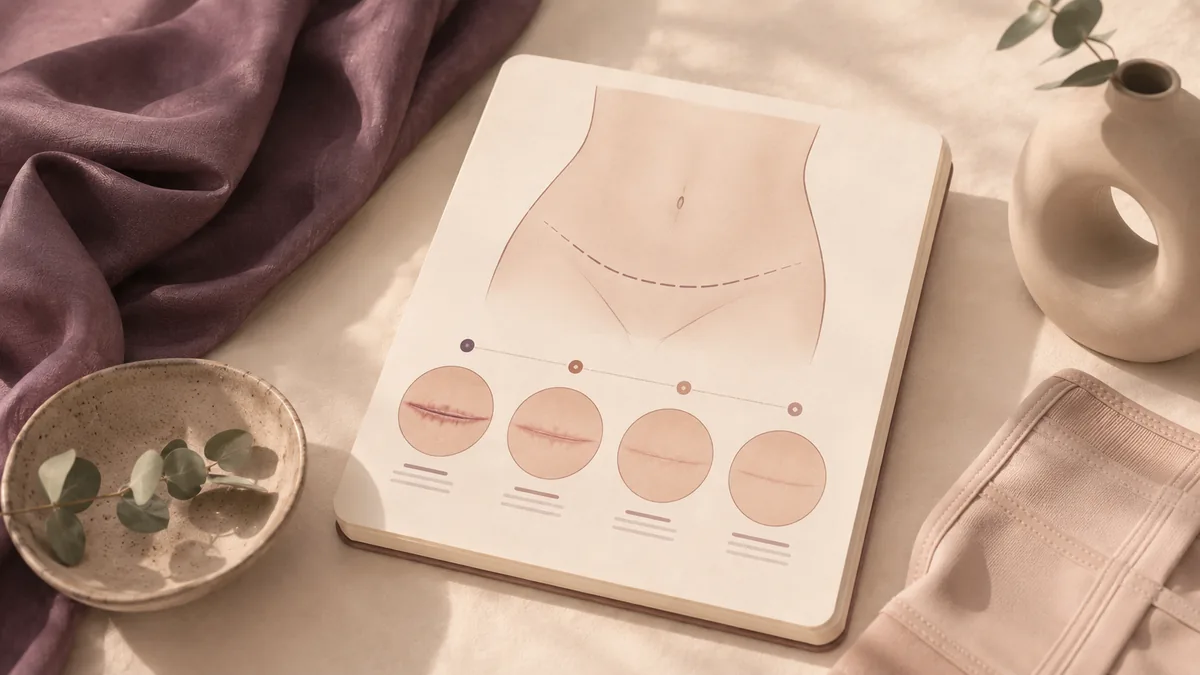
A tummy tuck is a permanent-scar operation. That is the trade-off: significant improvement in contour and loose skin in exchange for a scar that never disappears completely. The realistic question is not "will there be a scar" but "where will it be, what will it look like as it heals, and what can I do to make sure it heals as well as it can."
The two variables the surgeon controls are placement and closure technique. The variables you control are early scar care (particularly sun protection and silicone), compression garment adherence (which also manages post-op swelling), and avoiding excess tension in the healing period. Biology handles the rest, on its own timetable of roughly a year to a year and a half.
Where the Scar Is Placed
The main tummy tuck scar is a horizontal line placed low across the lower abdomen. Its length depends on the variant of the operation:
- Mini abdominoplasty: shortest scar, often 4–8 inches, similar in length to a low C-section scar.
- Full abdominoplasty: longer horizontal scar, typically hip-to-hip, plus a small circular scar around a repositioned belly button.
- Extended abdominoplasty: full scar plus lateral extensions wrapping onto the flanks.
- Fleur-de-lis abdominoplasty: full horizontal scar plus a vertical scar up the midline — the classic "T" shape. Used when significant skin needs to be removed both vertically (up and down) and horizontally.
Pre-op scar planning
A skilled surgeon plans the scar placement before the operation, in the office, with the patient wearing typical underwear or swimwear. The scar is marked to sit inside the garment line, low enough that everyday clothing hides it. If you routinely wear high-cut swimwear or specific underwear styles, bring them to the pre-op appointment — the placement can be adjusted.
One anatomical constraint: the scar has to sit where the tension of the closure allows it to sit. Placing the scar unrealistically low means either the wound will heal under too much tension (predisposing to widening or hypertrophy) or the surgeon has to leave more skin behind. This is a conversation to have at consultation.
The belly-button scar
A full abdominoplasty repositions the belly button because the skin above it is pulled down to the horizontal incision. The umbilical stalk stays attached to the abdominal wall, and a new opening is made in the skin at the correct anatomical level for the belly button to sit through. The result is a small circular scar around the umbilicus, typically well-hidden in the natural crease of the belly button when planned well — our belly-button recovery guide covers healing and reshaping in detail. A mini abdominoplasty usually does not require umbilicus repositioning and therefore avoids this scar.
Scar Timeline: 6 Months, 1 Year, 5 Years
Scar maturation is a well-characterised biological process. A systematic review of surgical wound maturation documented the typical trajectory across large numbers of patients: an initial active phase, followed by a maturation phase, followed by final scar remodeling.1
| Time point | Typical scar appearance | What is happening biologically |
|---|---|---|
| Days 0–14 | Fresh incision line, closed with sutures or tissue glue; some crusting | Epithelial closure and initial inflammatory phase |
| Weeks 2–6 | Pink to red, slightly raised, firm to touch | Active fibroblast proliferation, collagen deposition |
| Months 2–3 | Still raised and pink; scar activity peaks around month 3 | Peak of remodeling phase |
| Months 3–6 | Starting to flatten and soften; pinkness beginning to fade | Type III collagen being replaced by more organized Type I |
| Months 6–12 | Substantially flatter, paler, softer | Continued collagen remodeling; scar architecture maturing |
| Months 12–18 | Final flat, pale scar for most patients | Scar considered "mature" |
| Years 2–5 | Stable; typically the appearance the patient lives with long-term | Fully remodeled tissue |
Two practical points from that timeline. First, the scar looks worst around month 3 — this is expected and not a sign anything is wrong. Second, the "final" scar you will have long-term is not the scar you have at 6 months; there is still substantial improvement to come through months 6 to 18 — for what to expect at the five-year mark and beyond, see our scars after 5 years guide.
Scar Care — What Actually Helps
Not all scar treatments are equally supported by evidence. The below is ordered by strength of evidence for surgical wounds.
Silicone — first-line
Silicone sheets and silicone gel are the best-supported first-line scar treatments for surgical wounds. A Cochrane systematic review specifically evaluated silicone gel sheeting for prevention and treatment of hypertrophic and keloid scarring and found reduced incidence and improved appearance compared with no treatment.2
Practical use for abdominoplasty:
- Start once the incision is fully sealed (usually week 2–3 per the recovery timeline), not before.
- Apply for a minimum of 12 hours per day; 22–23 hours if using sheets and tolerated.
- Continue for at least 2 to 3 months, ideally 4 to 6.
- Sheets are cheaper long-term; gel is more convenient and works under clothing.
Sun protection
UV exposure on fresh scars causes permanent hyperpigmentation — the scar becomes darker than surrounding skin, sometimes permanently. This is preventable: cover the scar or use SPF 30+ on it whenever it will be sun-exposed, for at least the first 12 months. This is one of the highest-leverage things you can do and one of the most commonly missed.
Tension-offloading devices
A randomized controlled trial specifically looking at abdominoplasty scars compared a tension-offloading device (Embrace Active Scar Defense) with standard silicone taping and found improved scar appearance at 12 months in the tension-device group.4 These are more expensive than basic silicone and typically prescribed by a plastic surgery office for select patients (particularly those at higher risk of hypertrophic scarring or with visible scar tension).
Wound antisepsis in the perioperative period
A randomized controlled trial in abdominoplasty found that using octenidine dihydrochloride for wound antisepsis reduced short-term wound complications, which indirectly benefits the eventual scar (well-healed wounds scar better than complicated ones).5 This is your surgeon's choice, not yours, but it is part of the reason surgeon and technique matter for scar outcome.
Other treatments — mixed evidence
- Onion extract creams (e.g. Mederma): evidence is mixed; probably not harmful but not a strong first-line choice on their own.
- Vitamin E: no clear evidence of benefit; some patients develop contact dermatitis.
- Massage: often recommended anecdotally; some biological rationale for helping collagen alignment. Not harmful once the wound is fully healed (typically week 3+), and many patients find it subjectively helpful.
- Micro-needling: possible role in refining mature scars (6+ months) but should be done by a professional experienced with surgical scars.
Factors That Affect Scarring
Two patients having the same operation with the same surgeon can end up with quite different scars, because scar biology is highly individual. Key factors:
- Skin type / ethnicity: darker skin types (Fitzpatrick IV–VI) have higher rates of hypertrophic and keloid scarring. This does not mean the operation is not appropriate, but scar care and monitoring should be more intensive.
- Genetics: a family or personal history of keloid scarring elsewhere is a risk factor. Discuss at consultation.
- Age: younger patients tend to produce more aggressive scar tissue; older patients often heal with less prominent scars.
- Smoking: strongly associated with worse wound healing and worse scarring — smoking cessation for 4+ weeks pre-op is a standard recommendation.
- Weight fluctuation post-op: significant weight change after surgery can stretch the scar; maintaining a stable weight helps.
- Tension at the closure: scars healing under high tension widen and thicken. Surgeon's technique — and the patient not forcing early upright posture — both matter.
- Sun exposure: covered above; the single most preventable cause of a permanently darker scar.
- Compliance with post-op instructions: including the compression garment, activity restrictions, and scar care regimen.
A validated patient-reported outcome measure for scarring, SCAR-Q, is used in some plastic surgery practices to track patient perception of scars over time and identify patients who would benefit from additional intervention.3 Ask your surgeon about it if scar concerns are a priority for you.
Scar Revision, Removal & Tattooing Options
Tummy tuck scars cannot be fully removed — the surgery leaves a permanent scar. But unsatisfactory scars can often be significantly improved. Options, roughly in order of intervention level:
Conservative interventions (mature but suboptimal scars)
- Corticosteroid injection for raised, itchy, or hypertrophic scars — usually multiple injections spaced 4–6 weeks apart.
- Laser treatment: fractional non-ablative or ablative lasers can soften, blend, and refine mature scars. Series of treatments usually needed.
- Microneedling with or without PRP for scar texture refinement.
- Medical tattooing / camouflage: color-matched pigment can blend the scar line into surrounding skin. A dedicated specialty; results depend heavily on the practitioner.
Surgical scar revision
Formal surgical revision — re-excising the scar and re-closing under better conditions — is an option when the scar is widened, hypertrophic, or asymmetric, or when dog ears form at the ends of the incision. Considerations:
- Almost always delayed until scar is fully mature (12–18 months). Revising an immature scar produces another immature scar with unpredictable results.
- Improvement is usually meaningful but not perfect; the new scar goes through its own maturation timeline.
- Typically done as an office or day-surgery procedure under local anaesthesia with sedation.
- Some surgeons include one scar revision in the original fee for the operation if the initial scar is unusually problematic; others charge separately.
Managing expectations honestly
Revision improves scars; it does not eliminate them. Patients whose expectation is that revision will make the scar invisible are usually disappointed. Patients whose expectation is that revision will make the scar significantly less noticeable are usually satisfied. Discuss the realistic goal specifically with your surgeon before proceeding.
FAQ
-
Where is the tummy tuck scar located?
The main tummy tuck scar is a horizontal line placed low across the lower abdomen, positioned to sit within the bikini/underwear line. A skilled surgeon plans the scar location before the operation with the patient wearing typical underwear or swimwear so the final scar is hidden. A full abdominoplasty also creates a small circular scar around a repositioned belly button. Extended and fleur-de-lis variants add lateral or vertical extensions to the scar, which is a trade-off for more skin removal in patients who need it.
-
What does a tummy tuck scar look like at 6 months?
At 6 months a tummy tuck scar is typically still visible — flatter than it was at 3 months, but still with some pinkness or redness and a firm feel. This is normal. Scar maturation is a well-documented process that continues for 12 to 18 months:1 the scar flattens, softens, and pales gradually over that period. The 6-month mark is often when patients think "is it going to stay this pink?" — for the vast majority the answer is no; the pinkness continues to fade for another 6 to 12 months.
-
How long does a tummy tuck scar take to fully mature?
Scar maturation is a biological process that takes 12 to 18 months for the majority of patients, and up to 2 years for some. A systematic review of surgical scar maturation documented the typical trajectory: an active remodeling phase over the first 3 to 6 months (scar is raised, red, firm), a maturation phase through months 6 to 12 (scar flattens, softens, pinkness fades), and final maturation through 18 to 24 months (scar reaches its final pale, flat state).1 Ethnicity, skin type, and individual healing biology influence the timeline.
-
What is the best scar treatment after a tummy tuck?
The best-supported first-line scar treatment is silicone — either sheets or gel — applied once the incision is fully sealed (usually around week 2–3). A Cochrane systematic review found silicone gel sheeting reduced the incidence and appearance of hypertrophic and keloid scars in surgical wounds.2 Sun protection over the scar for the first 12 months is essential to prevent hyperpigmentation. Randomized trials have found taping and silicone-based approaches consistently more useful than most over-the-counter creams. Newer options include tension-offloading devices for select patients.4
-
Can tummy tuck scars be removed?
Tummy tuck scars cannot be fully removed — the surgery leaves a permanent scar. However, unsatisfactory scars can be improved through several approaches: scar revision surgery (re-excising the scar and re-closing under better tension conditions), laser treatments (fractional non-ablative or ablative lasers to soften and refine the scar), corticosteroid injection for raised or itchy hypertrophic scars, and medical tattooing to camouflage color differences. Revision is usually considered no earlier than 12 to 18 months post-op when the scar has fully matured.
-
Why is my tummy tuck scar raised and red?
In the first 3 to 6 months after surgery, all healing scars go through an active phase where they are raised, red or pink, and firm — this is normal collagen remodeling, not a complication. However, if the scar continues to grow beyond the wound edges, becomes progressively thicker and darker, or is persistently itchy or painful, it may be a hypertrophic or keloid scar, which are more common in darker skin types and in scars under tension. These are treatable: silicone sheeting, corticosteroid injections, and pressure therapy are the standard first-line options. Discuss any concerning scar with your surgeon rather than waiting.