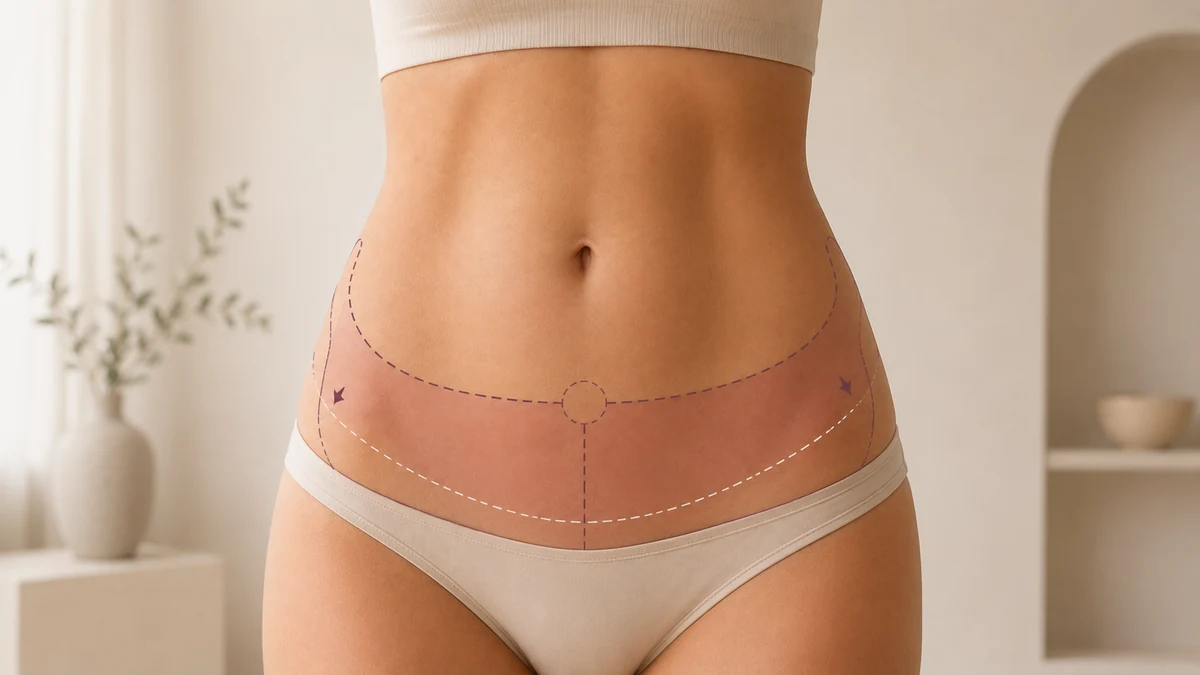
When patients search for "full tummy tuck," they usually mean one of two things: they either know they need the whole operation — not the shortened mini — and want to understand what that entails, or they are trying to figure out which variant they actually need. This page addresses both. The short answer is that a full tummy tuck is the standard abdominoplasty — the version that addresses the entire abdomen, above and below the belly button, and includes both muscle repair and umbilicus repositioning. It is also the version most post-pregnancy patients need, because the changes pregnancy makes to the abdominal wall — particularly diastasis recti — usually cannot be reached by a mini.
What follows is a structured, patient-focused walkthrough — part of our tummy tuck types series — covering what specifically makes a tummy tuck "full," how it differs from the other variants side-by-side, the six components that make up the standard operation, who is actually a full candidate (and who is better suited to a mini or extended), what recovery looks like, and what it costs.
What Makes a Tummy Tuck "Full"?
A "full" tummy tuck is defined by anatomical scope more than any single technique. Three specific things distinguish a full abdominoplasty from a mini:
- Skin removal reaches above the belly button. The skin from ribs downward is undermined (lifted from the underlying muscle), pulled down, and the excess is removed. A mini only addresses skin below the umbilicus.
- Muscle repair (rectus diastasis plication) is performed across the full length of the abdomen. The two rectus muscles that have separated — typically from pregnancy or weight gain — are re-approximated in the midline with permanent sutures. A mini cannot repair muscle separation above the umbilicus because it does not have surgical access to that area.
- The belly button is repositioned. Because the abdominal skin above the umbilicus is pulled down, a new opening has to be made in the skin at the correct anatomical level. The umbilical stalk stays attached to the abdominal wall; the skin around it is repositioned. This creates the small circular scar around the belly button that is characteristic of a full abdominoplasty.
These three elements are what "full" means clinically. The scar length, the recovery time, and the cost all follow from that anatomical scope — not the other way around.
Full vs Mini vs Extended vs Fleur-de-Lis
The abdominoplasty family is often confusing because the variant names describe different things — some are about scar length, some about anatomical scope, some about specific patient populations. Here is the practical comparison:
| Variant | Skin scope | Muscle repair | Umbilicus | Scar | Typical patient |
|---|---|---|---|---|---|
| Mini | Below umbilicus only | Below umbilicus if any | Not repositioned | Short horizontal (~4–8 in) | Mild lower-abdominal laxity, no upper diastasis |
| Full (this guide) | Full abdomen (ribs → pubis) | Full length | Repositioned | Hip-to-hip + umbilicus circle | Post-pregnancy, moderate–significant laxity |
| Extended | Full abdomen + flanks | Full length | Repositioned | Full + lateral extensions onto flanks | Skin excess wrapping onto hips/back |
| Fleur-de-Lis | Full abdomen + vertical midline | Full length | Repositioned | Horizontal + vertical (T-shape) | Post-bariatric with substantial excess in both dimensions |
| Drainless | Any of the above | Any | Depends on variant | Same as variant | Technique choice (progressive tension sutures), not a separate variant |
A published classification study proposed a functional and clinical framework for choosing between these variants based on measurable tissue findings — the amount and location of excess skin, degree and location of diastasis, and quality of remaining tissue.3 In practice, most patients fit clearly into one variant at physical exam; the ambiguous cases are usually mini-vs-full and full-vs-extended.
The Six Components of a Full Abdominoplasty
A well-performed full abdominoplasty is not one action — it is a coordinated set of six components. Understanding them helps you understand what your surgeon means at consultation and what you are paying for.
1. Low horizontal incision, individually planned
The scar is marked pre-operatively with the patient wearing typical underwear or swimwear, so that the final scar sits within the garment line. The incision usually runs hip-to-hip, curving slightly upward at the ends. Extended variants lengthen the ends; mini keeps them short.
2. Skin elevation from ribs down
The entire skin flap between the incision and the ribs is lifted from the underlying muscle wall. This is what gives the surgeon access to the muscle layer above the umbilicus — which the mini does not allow.
3. Rectus diastasis repair (plication)
The two rectus abdominis muscles that have separated in the midline are re-approximated with permanent sutures from just below the sternum down to the pubis. This is the internal "corset" tightening that restores waist definition — it is what allows the abdominal wall to hold in what dieting alone cannot. A randomized trial with 1-year follow-up demonstrated the repair is durable at that time point.1
4. Umbilicus (belly button) repositioning
The umbilical stalk stays attached to the underlying muscle. As the skin above is pulled down, a new opening is made in the skin at the correct anatomical level, and the umbilicus is sutured to the surrounding skin. The result — when planned well — is a natural-looking belly button that sits in the right place, with a small, well-hidden circular scar.
5. Skin removal and closure
The excess skin below the incision line (and any excess from the flap above) is removed. The remaining skin is pulled down and closed to the incision under measured tension — too much tension widens the scar, too little leaves loose skin. Modern closures often use multi-layer techniques with dissolvable deep sutures and skin adhesive or fine skin sutures.
6. Optional flank contouring / liposuction
Many full abdominoplasty operations now combine with lipoabdominoplasty (liposuction of the flanks and upper abdomen) for a more refined contour. Systematic review evidence indicates the combined operation has a broadly comparable safety profile to standalone abdominoplasty in appropriately selected patients — see the liposuction vs tummy tuck guide for detail.
Who Needs a Full (Not a Mini)
The single most common candidacy mistake is a patient wanting a mini because "the scar is smaller and recovery is easier" when their physical exam findings actually call for a full. A mini in a patient who needs a full leaves upper-abdominal skin laxity, unrepaired diastasis above the umbilicus, and an unbalanced appearance.
You are most likely a full candidate if any of the following apply:
- You have had one or more pregnancies and have visible skin laxity or a "pouch" above the belly button.
- You can feel or see rectus diastasis (muscle separation) that extends above the umbilicus. A physical exam confirms this — many patients have more diastasis than they realize.
- Your umbilicus itself has been distorted (stretched, elongated, herniated) by pregnancy or weight change.
- You have significant weight-fluctuation history (not massive, which points to fleur-de-lis) that has left skin laxity across the whole abdomen.
- You have loose skin that continues onto the lower ribs.
You may be a mini candidate instead if all of the following are true: loose skin is limited to below the belly button; there is no muscle separation above the umbilicus; the umbilicus itself is well-positioned and not distorted; and upper-abdominal skin quality is good. That is a specific and relatively uncommon profile. For a detailed side-by-side, see mini vs full — which fits you.
Higher-BMI patients need particular candidacy attention. An ACS-NSQIP analysis of 18,891 patients showed obesity is independently associated with elevated wound complications, DVT, and reoperation after abdominoplasty and panniculectomy.4 Most surgeons prefer a BMI under 30 for routine full tummy tucks and require weight loss above 35 — see the candidacy guide.
Recovery from a Full Tummy Tuck
Recovery from a full is longer than a mini because the operation is larger — the flap is elevated further, muscle repair is longer, and total tissue trauma is greater. The full timeline is in our recovery timeline guide; the key milestones for a full specifically:
| Timeline | Expected milestone |
|---|---|
| Days 1–3 | Most uncomfortable phase; walking in bent-forward posture from day 1 |
| Days 4–7 | Pain reducing; first office visit; drains often removed toward end week 1 |
| Weeks 2–3 | Return to desk work; standing straighter each day; fully upright by end of week 3 |
| Weeks 4–6 | Feeling functional; light cardio reintroduced with clearance |
| Week 6 | Unrestricted exercise (including core) with surgeon clearance |
| Months 2–3 | Swelling substantially settled; scar most active |
| Months 6–12 | Scar flattening and paling; contour close to final |
| Months 12–18 | Scar fully mature; final result |
Enhanced-recovery-after-surgery (ERAS) protocols — multimodal (non-opioid-based) pain management, long-acting local anaesthetic, early ambulation, structured pre-op counselling — have measurably shortened both early recovery and opioid requirements in aesthetic abdominoplasty over the past decade. If your surgeon uses one, expect a smoother first week than older accounts suggest.
The other recovery variable to know: scars go through a well-characterised 12-to-18-month maturation, moving from raised-and-pink through months 3–6 to flat-and-pale by 12–18 months.5 Silicone (sheets or gel) starting once the incision is fully sealed and sun protection through the first year are the two evidence-based basics.
Full Tummy Tuck Cost
Cost varies significantly by geography and by what the quote actually includes. Professional-society (ASPS) published averages give a similar picture to the geographical ranges below.6 Full breakdown in our cost guide; here is the summary for the full variant specifically:
| Location | Range | Typical | What is included |
|---|---|---|---|
| US — average metro | $10,000 – $14,000 | ~$12,000 | Surgeon fee, anaesthesia, facility, garment |
| US — coastal / premium | $14,000 – $18,000 | ~$16,000 | Same |
| Turkey — package | $3,500 – $5,500 | ~$4,500 | Above + accredited hospital, hotel 5–7 nights, transfers, follow-ups during stay |
| Add: Lipoabdominoplasty (US) | +$2,000 – $4,000 | — | Additional OR time + garment |
| Add: Lipoabdominoplasty (Turkey) | +$800 – $1,500 | — | Same |
The full variant is not covered by US insurance when performed for cosmetic reasons. Only medically-necessary panniculectomy — a different operation that only removes the pannus without muscle repair — may qualify for coverage in specific circumstances, most commonly after massive weight loss. Full detail in our insurance coverage guide.
For a comprehensive comparison of the Turkey option (savings, safety, package inclusions, red flags), see the tummy tuck in Turkey guide.
FAQ
-
What is a full tummy tuck?
A full tummy tuck — also called a standard or complete abdominoplasty — addresses the entire abdomen from the ribs to the pubis. It removes excess skin above and below the belly button, repairs separated abdominal muscles (rectus diastasis) across the full length of the abdomen, repositions the belly button to its correct anatomical location, and tightens the remaining skin for a flatter contour. The scar is a horizontal line placed low across the lower abdomen (usually hip-to-hip) plus a small circular scar around the repositioned umbilicus. It is the version most post-pregnancy patients need.
-
How is a full tummy tuck different from a mini?
A mini tummy tuck addresses only the lower abdomen below the belly button — it does not include muscle repair above the umbilicus or umbilicus repositioning. A full tummy tuck addresses the entire abdomen and includes both. The mini has a shorter scar and slightly quicker recovery but is only appropriate for a specific candidate profile: mild lower-abdominal skin laxity with no muscle separation above the belly button. Most post-partum patients need a full because pregnancy-related diastasis recti almost always extends above the umbilicus and cannot be addressed by a mini.
-
How long does a full tummy tuck take?
A full tummy tuck typically takes 2 to 4 hours under general anaesthesia. Combined procedures (lipoabdominoplasty, mommy makeover with breast surgery) can extend this to 4 to 6 hours. Most surgeons perform the operation as an inpatient stay of one to two nights, though some outpatient centres discharge the same day with a caregiver. Enhanced-recovery-after-surgery protocols with multimodal pain management and long-acting local anaesthetic have measurably shortened both operative and recovery times over the past decade.
-
How much does a full tummy tuck cost?
In the US, a full tummy tuck typically costs $10,000 to $18,000 all-in, covering surgeon fee, anaesthesia, facility fee, garment, medications, and follow-ups. Geography drives the range — coastal metros are usually higher, mid-size cities lower. In Turkey, the same operation typically runs $3,500 to $5,500 all-in through package providers, a saving of roughly 60–70%. Cost is not covered by US insurance when the operation is cosmetic; only medically necessary panniculectomy may qualify — see our insurance guide.
-
What is recovery like from a full tummy tuck?
The first 48–72 hours are the most uncomfortable — patients walk hunched forward to protect the closure. Drains, if used, come out during week 1–2. Most patients return to desk work at 10–14 days and stand fully upright by end of week 3. Return to unrestricted exercise, including core work, is typically 6 weeks with surgeon clearance. Swelling settles substantially by month 3 and continues to improve for another 3–6 months. Scars mature over 12 to 18 months. Full recovery timeline in our recovery guide.
-
What are the risks of a full tummy tuck?
The largest US safety review of over 25,000 abdominoplasty patients reported an overall major complication rate of about 4.0%.2 The most common events are seroma (fluid collection), hematoma, wound infection, and wound-healing complications. The most serious but less common risks are venous thromboembolism (DVT/PE) and skin flap necrosis. Obesity, smoking, and combined procedures raise complication rates in a dose-dependent way.4 Choosing a board-certified plastic surgeon operating in an accredited facility, stopping smoking pre-op, and following VTE prophylaxis protocols are the highest-leverage risk-reduction steps.