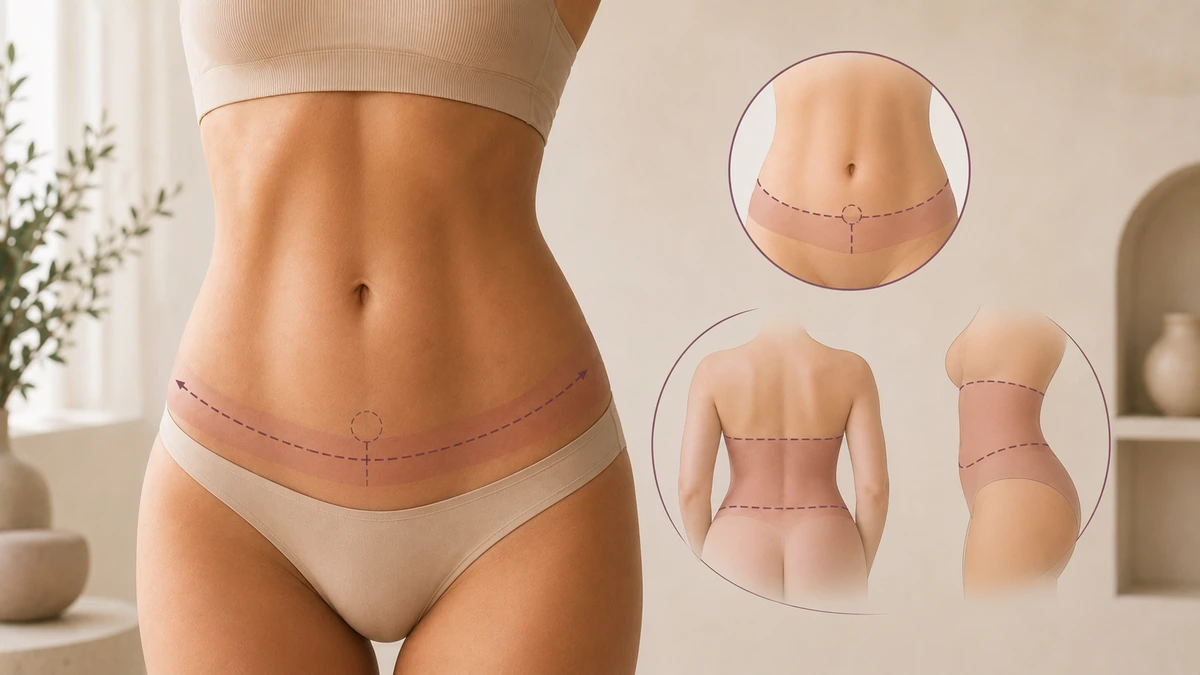
Most patients who research a "tummy tuck" mean a full abdominoplasty — the standard operation that removes lower-abdominal skin excess through a low horizontal incision. Our tummy tuck types overview covers the full range of variants. Two much less common variants come up when the anatomy does not fit that mould: the reverse tummy tuck (when laxity is concentrated above the belly button) and the 360 tummy tuck (when laxity is truly circumferential, typically after massive weight loss). This guide covers both, when each is indicated, honest trade-offs, and how they compare with the standard variants.
The Reverse Tummy Tuck
A reverse abdominoplasty removes excess skin and tightens the upper abdomen by working from an incision hidden in the inframammary fold (the natural crease under each breast) rather than the low horizontal incision of a standard tummy tuck. The skin flap is elevated downward from that incision, pulled upward, and the excess trimmed and closed along the under-breast fold — the reverse direction of the standard operation.
It is a niche operation. Most patients with abdominal skin laxity have laxity distributed both above and below the belly button, and a full abdominoplasty addresses both zones because the skin above the umbilicus is redistributed downward during the operation. The reverse variant is reserved for specific anatomies:
- Patients with upper-abdominal laxity but a tight lower abdomen — an unusual pattern, sometimes seen after a prior full tummy tuck that tightened the lower half but revealed or created upper laxity.
- Patients undergoing combined breast surgery in whom the inframammary incision is being made anyway (breast lift, augmentation) — the reverse abdominoplasty can extend that same incision to address the upper abdomen without adding a low horizontal scar.
- Rare cases where a low horizontal incision is contraindicated (previous complex abdominal surgery with existing scars, specific anatomical concerns).
The published classification framework for abdominoplasty variants treats reverse as a specific-indication operation rather than a general alternative to standard abdominoplasty.1 If a surgeon offers a reverse to a patient with the typical postpartum lower-abdominal skin excess pattern, that is a candidacy mismatch.
Reverse recovery
Recovery is broadly similar to a standard tummy tuck: 10–14 days for desk work, 6 weeks for unrestricted exercise, 12–18 months for full scar maturation. The scar is hidden in the under-breast fold rather than under the underwear line, which many patients prefer for aesthetic reasons but which is more visible when the breasts are lifted (in certain garments, in intimate settings). Compression garment protocols follow the standard abdominoplasty pattern.
The 360 Tummy Tuck (Lower Body Lift)
A "360 tummy tuck" — properly called a lower body lift or circumferential abdominoplasty — takes the horizontal incision all the way around the torso, removing a belt of excess skin and fat from the front, sides (flanks), and back (lower back, upper buttocks). It is a much larger operation than a standard abdominoplasty and is used almost exclusively in patients who have lost a large amount of weight (typically 100+ pounds, often after bariatric surgery) and who have circumferential skin excess that a front-only operation cannot address.
The distinction from an extended tummy tuck matters. An extended tummy tuck lengthens the incision onto the flanks but stops before wrapping around to the back — it addresses the front and sides. A true 360 completes the belt, taking the incision all the way across the lower back and lifting the buttocks in the process.
Technique and hospital stay
The operation is performed in two positions during the same anaesthetic: the front portion (standard abdominoplasty with muscle repair) is done supine, then the patient is turned prone (or lateral, depending on surgeon preference) for the back portion. Total operative time is typically 5–7 hours. Hospital admission of at least 1 to 2 nights is standard because of the operative length, larger fluid shifts, and higher complication risk. Full recovery to unrestricted activity is typically 6–8 weeks — meaningfully longer than a standard tummy tuck.
Safety and candidacy
A circumferential body lift is a legitimate operation with a reasonable safety profile when performed by an experienced plastic surgeon on an appropriately selected patient in an accredited facility. But absolute risk is higher than a standard abdominoplasty for three reasons: the operative length, the greater area of tissue undermining, and the patient population (post-massive-weight-loss patients typically have elevated BMI and more comorbidities).
The largest US abdominoplasty safety database reports a ~4% major complication rate for standard abdominoplasty;2 complication rates for lower body lift published series are meaningfully higher (wound complications, seroma, dehiscence at the T-junctions). Higher-BMI patients — the typical 360 candidate population — have independently elevated complication rates across abdominoplasty and panniculectomy per the ACS-NSQIP analysis of 18,891 patients.3
Practical candidacy requirements: weight-stable for at least 12–18 months after bariatric surgery, non-smoker (or 4+ weeks pre-op cessation), controlled comorbidities, adequate nutrition, realistic expectations about the scar (a full 360 scar). See our candidacy guide.
How These Compare With Standard Tummy Tucks
| Aspect | Reverse | 360 / Lower body lift | Full (reference) | Extended (reference) |
|---|---|---|---|---|
| Incision location | Under-breast fold | Full circumference | Low horizontal (hip-to-hip) | Low horizontal + flanks |
| Primary target zone | Upper abdomen | Front + sides + back | Lower abdomen (and upper via redistribution) | Lower + flanks |
| Muscle repair | Not usually included | Yes (front portion) | Yes | Yes |
| Operative time | 2–3 hours | 5–7 hours | 2–4 hours | 3–5 hours |
| Hospital stay | Often day-case | 1–2 nights | Often day-case | 0–1 night |
| Return to work | 10–14 days | 3–6 weeks | 10–14 days | 2–3 weeks |
| Baseline complication risk | Similar to standard | Higher than standard | ~4% major (ref) | Slightly higher than full |
| Typical candidate | Isolated upper-ab laxity | Post-massive-weight-loss | Postpartum, mixed laxity | Postpartum with flank fullness |
Cost
Cost varies significantly by geography and by whether procedures are combined (reverse abdominoplasty is often combined with breast surgery; 360 body lift is sometimes combined with thigh lift or arm lift in staged operations).
| Operation | US all-in | Turkey all-in |
|---|---|---|
| Reverse abdominoplasty (isolated) | $8,000 – $14,000 | $3,500 – $5,500 |
| Reverse + breast lift/augmentation combined | $15,000 – $25,000 | $6,500 – $10,000 |
| 360 / lower body lift (isolated) | $15,000 – $28,000 | $6,000 – $10,000 |
Full pricing structure in our cost guide; the specifics for Turkey are in the Turkey cost guide. For any of these larger operations, choosing a board-certified plastic surgeon operating in an accredited facility is the single highest-leverage safety decision.4
FAQ
-
What is a reverse tummy tuck?
A reverse abdominoplasty is a body-contouring operation that removes excess skin and tightens the upper abdomen through an incision hidden in the inframammary (under-breast) fold, rather than the low horizontal incision used in a standard tummy tuck. It is used when the primary skin excess and laxity are above the belly button, most often in patients whose lower abdomen is already tight (from a prior tummy tuck, or from anatomy that concentrates laxity in the upper abdomen).
-
What is a 360 tummy tuck?
A "360 tummy tuck" — clinically a lower body lift or circumferential abdominoplasty — extends the horizontal incision all the way around the body, removing a belt of excess skin and fat from the front, sides (flanks), and back (lower back / upper buttocks). It is used almost exclusively in massive-weight-loss patients who have circumferential skin excess that a standard front-only tummy tuck cannot address. It is a much larger operation than a standard abdominoplasty with proportionally higher risk and longer recovery.
-
Who needs a reverse tummy tuck instead of a standard one?
Reverse abdominoplasty is a niche operation. The primary candidates are patients whose skin excess and laxity are concentrated above the belly button rather than below, patients with a prior standard tummy tuck who developed upper-abdominal laxity that a repeat lower operation would not reach, and patients undergoing combined breast surgery in whom the inframammary incision can serve both operations. Most patients with abdominal skin laxity are better served by a standard full or extended tummy tuck.1
-
How is a 360 lower body lift different from an extended tummy tuck?
An extended tummy tuck extends the horizontal incision onto the flanks but stops before wrapping to the back — it addresses the front and sides. A 360 / lower body lift takes the incision all the way around, adding removal of excess skin from the lower back and the ability to lift the buttocks. It is a larger operation, done under longer anaesthesia, with meaningfully higher complication rates than a standard abdominoplasty. It is appropriate for massive-weight-loss patients with true circumferential excess; it is not appropriate for standard cosmetic candidates with only front-and-flank laxity.
-
Is a 360 body lift safe?
A circumferential body lift performed by an experienced plastic surgeon in an accredited facility on an appropriately selected massive-weight-loss patient is a legitimate operation with a reasonable safety profile, but the absolute risk is higher than a standard abdominoplasty because of the operative length, the greater tissue undermining, and the higher-BMI patient population. The largest US abdominoplasty safety database reports a ~4% major complication rate for standard abdominoplasty;2 complication rates for lower body lift are meaningfully higher — patient selection and facility choice matter more here than for any other abdominal contouring operation.
-
How much do reverse and 360 tummy tucks cost?
Reverse abdominoplasty in the US typically runs $8,000 to $14,000 all-in for the isolated operation, more when combined with breast surgery. A 360 / lower body lift is a substantially larger operation and typically runs $15,000 to $28,000 in the US and $6,000 to $10,000 in Turkey through legitimate accredited providers. These are meaningfully more than standard abdominoplasty because of the additional operative time, larger area of tissue removal, and (for 360) the longer hospital stay.