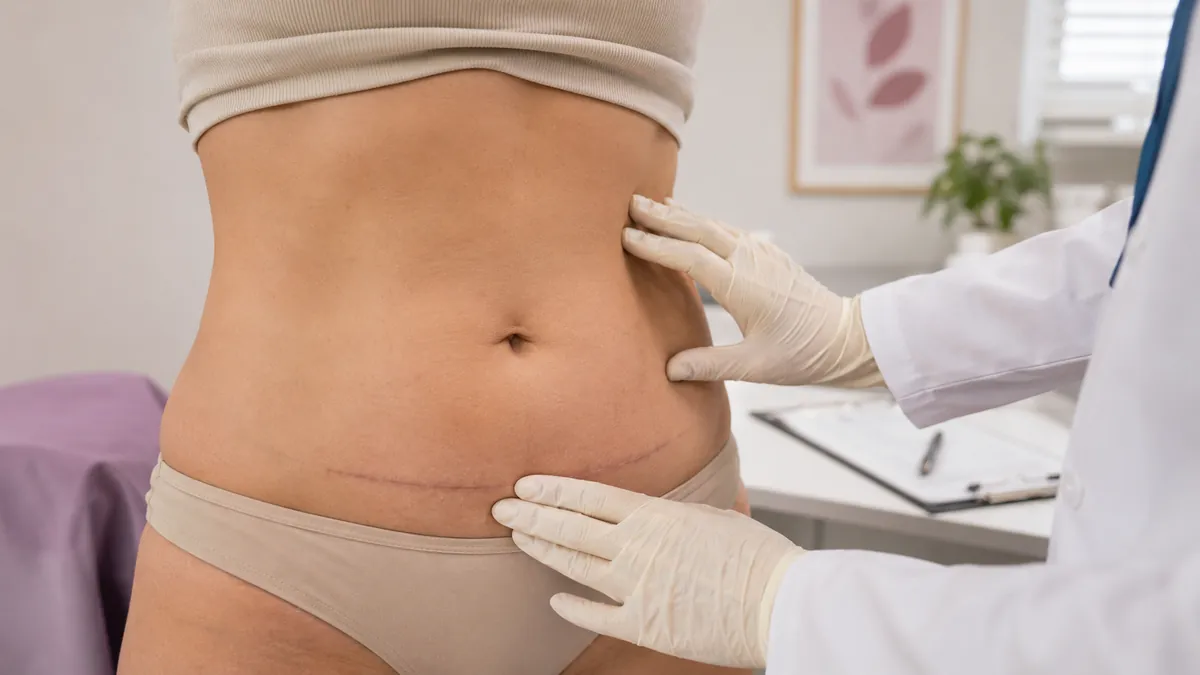
Any honest tummy tuck conversation has to include the complication numbers — see our safety overview for the full framework. Not because they are alarming — the ~4% major complication rate from the largest US safety database is actually reassuring in the context of a major elective operation — but because most patients arrive at consultation either overestimating risk (from anecdotal horror stories) or underestimating it (from marketing that skips the numbers). This page presents the real data from the largest published safety analyses, what each complication actually is, what raises and lowers individual risk, and the specific things patients can control.
Because the decisions this page informs are consequential, every rate cited below is linked to the specific published study behind it — the CosmetAssure database analysis of 25,478 abdominoplasty patients, the 2025 ACS-NSQIP obesity analysis, and peer-reviewed meta-analyses of surgical technique. Where the literature disagrees or the range is wide, we say so.
The Headline Number
The most-cited number in the abdominoplasty safety literature comes from the CosmetAssure database analysis published by Winocour et al. in Plastic and Reconstructive Surgery in 2015. This analysis examined 25,478 abdominoplasty patients from the CosmetAssure database (a US aesthetic surgery insurance program), and found an overall major complication rate of 4.0%.1
"Major" in this context specifically means: hematoma, infection, or venous thromboembolism (DVT/PE) requiring hospitalisation, emergency room visit, or reoperation within 30 days of surgery. It does not count minor wound-healing delays, small seromas treated in-office, or non-consequential recovery events.
This 4% baseline is a starting point for individual risk estimation, not a fixed number. Patient factors and setting factors move it up or down meaningfully.
The Specific Complications
Seroma
A seroma is a collection of clear or amber fluid (mostly lymphatic) that accumulates in the space between the abdominal skin flap and the underlying muscle wall. It is the single most common late complication after abdominoplasty. Rates in the drain-based literature range widely — commonly quoted as 5–15%. Progressive tension suture (drainless) technique reduces reported seroma rates in the modern literature, with meta-analytic evidence supporting rates in the low single digits.3
Most seromas are treated with in-office aspiration (drawing off the fluid with a needle), sometimes multiple times. Larger or recurrent seromas may need a small drain reinserted. Full detail is in our drainless guide. Seroma-related warning signs are covered in our swelling guide.
Haematoma
A hematoma is a collection of blood, usually occurring in the first 24–48 hours post-op. Reported rates in CosmetAssure and similar databases are typically 1–2%. Small haematomas may resolve on their own with observation; larger or expanding haematomas require operative drainage, sometimes urgently. Risk factors include anticoagulant use, uncontrolled hypertension, and specific surgical technique factors.
Wound-healing complications
Delayed healing, superficial dehiscence (small wound separation), and delayed epithelialisation are the most common minor wound issues. They occur most often along the low horizontal scar and — in fleur-de-lis operations — at the T-junction where horizontal and vertical scars meet. Rates vary widely by patient factors (BMI, smoking, diabetes) and by surgeon closure technique. Most heal with local wound care over a few weeks.
Infection
Most tummy tuck infections are superficial (skin-level, treated with oral antibiotics). Deep infection — involving the underlying tissue or muscle repair — is rare but potentially serious. Major infection rates in CosmetAssure are approximately 0.5–1%. Pre-op antibiotic prophylaxis is standard.
Venous thromboembolism (DVT / PE)
Deep vein thrombosis (blood clot in the leg) and pulmonary embolism (clot that travels to the lung) are the most consequential potential complications of abdominoplasty. Reported rates are approximately 0.3–1% depending on the population and prophylaxis protocol. VTE is also historically the dominant single cause of tummy tuck-related mortality — which is why VTE prophylaxis (early ambulation, mechanical compression devices, chemical prophylaxis where indicated) is heavily emphasized. Full detail in our DVT and PE guide.
Skin flap necrosis
Loss of viability of part of the abdominal skin flap — usually a small area along the incision line — from inadequate blood supply. Rare in non-smokers; substantially more common in smokers. Treatment ranges from local wound care to debridement and skin grafting. Prevention is smoking cessation and careful surgical technique.
Umbilical necrosis
Partial or complete loss of the umbilicus from inadequate blood supply. Very rare in non-smokers; more common in smokers. Detailed in our belly button guide.
Scar-related complications
Hypertrophic scarring (raised, thick scars), keloid formation (rare), and widened or dark scars are longer-term aesthetic complications. Silicone-based topical treatment is the evidence-based first-line intervention; the full scar-care protocol is in our scars guide.
Mortality
Death from an isolated aesthetic tummy tuck in an accredited facility with a board-certified plastic surgeon is very rare. Reported mortality in large safety databases is in the range of 1 in 10,000 or lower for isolated abdominoplasty. The dominant single historical cause has been pulmonary embolism from DVT — which is precisely why VTE prophylaxis is now standard.
Mortality risk rises meaningfully for:
- Combined procedures — particularly abdominoplasty combined with large-volume liposuction or BBL (Brazilian Butt Lift).
- Older age (particularly > 65).
- Higher BMI (particularly > 35).
- Non-accredited or under-equipped facilities.
- Multiple comorbidities.
Modifiable Risk Factors (What You Can Control)
Several patient-controlled factors have measurable effects on complication rates. In descending order of impact:
Smoking / nicotine
Nicotine (from smoking, vaping, or nicotine replacement therapy) constricts small blood vessels, reducing blood flow to the healing tissue. This raises rates of wound-healing complications, skin flap necrosis, umbilical necrosis, delayed healing, and infection — all dose-dependently. Most surgeons require cessation of all nicotine ≥ 4 weeks before and 4 weeks after surgery. Some surgeons test cotinine (nicotine metabolite) at pre-op to verify.
BMI
The 2025 ACS-NSQIP analysis of 18,891 patients found obesity is independently associated with elevated wound complications, DVT, and reoperation after abdominoplasty and panniculectomy.2 The effect is dose-dependent — BMI 30–35 higher rates than under 30, BMI over 35 higher still. Most surgeons prefer BMI under 30 for routine cases; some decline over 35. Losing weight pre-op is high-leverage.
Combined procedures
Combining tummy tuck with other operations (breast surgery in a "mommy makeover," extensive liposuction) is a valid clinical choice in appropriate patients but has additive risk. The Winocour analysis specifically examined combined-procedure safety and found manageable risk profiles in appropriately selected patients but elevated absolute rates compared with isolated abdominoplasty.1 Combination should be a surgeon-driven decision, not a marketing bundle.
Comorbidities
Diabetes (particularly with elevated HbA1c), hypertension, and sleep apnoea all measurably raise risk when uncontrolled. Optimising these conditions pre-op is standard.
Surgeon and facility choice
The single biggest safety decision. A board-certified plastic surgeon operating in an accredited facility with proper anaesthesia, VTE prophylaxis, and complication protocols is meaningfully safer than the alternative. This holds equally in the US, Turkey, or anywhere else — see the vetting checklist in our choosing a surgeon guide.
Practical Risk-Reduction Checklist
- Choose a board-certified plastic surgeon in an accredited facility. The single biggest lever.
- Stop all nicotine ≥ 4 weeks pre- and post-op. Include vaping and NRT.
- Get BMI under 30 if possible before surgery.
- Optimise diabetes, hypertension, and sleep apnoea pre-op.
- Follow VTE prophylaxis — early ambulation from day 1, mechanical compression, chemical prophylaxis where prescribed.
- Wear the compression garment as prescribed for the full duration.
- Walk daily from day 1 — short walks multiple times daily.
- Avoid bundled multi-operation packages unless the surgeon (not marketing) supports the combination.
- Attend all follow-ups.
- Know the emergency warning signs — sudden calf pain/swelling (DVT), shortness of breath (PE), fever, sudden asymmetric swelling.
For full candidacy assessment see the candidacy guide. For VTE / DVT specifics see the DVT and PE guide.
FAQ
How common are tummy tuck complications?
In the largest US aesthetic surgery safety database — the CosmetAssure analysis of over 25,000 abdominoplasty patients — the overall major complication rate was approximately 4.0%.1 The most common events were hematoma (fluid/blood collections), venous thromboembolism (DVT/PE), and infection. Minor complications (seroma treated with aspiration, minor wound-healing issues, delayed drain removal) are more common but generally less consequential. Complication rates rise significantly with obesity, smoking, older age, and combined procedures — meaning individual risk can be meaningfully lower or higher than the 4% baseline depending on patient factors and setting.
What are the most common tummy tuck complications?
By frequency: (1) seroma (fluid collection under the skin flap) — the single most common late complication, usually treatable with aspiration in the office; (2) hematoma (blood collection) — usually early, sometimes requires operative drainage; (3) wound-healing complications (delayed healing, superficial dehiscence) — most common along the low horizontal scar and at the vertical/T-junctions in fleur-de-lis; (4) infection — usually superficial, treated with antibiotics; (5) venous thromboembolism (DVT/PE) — less common but potentially serious; (6) skin flap necrosis — rare, more common in smokers; (7) umbilical necrosis — rare, smoking-related. Progressive tension suture (drainless) technique reduces seroma rates in published meta-analyses.3
What is the risk of dying from a tummy tuck?
Death from an isolated aesthetic tummy tuck in an accredited facility with a board-certified plastic surgeon is very rare — reported mortality in large safety databases is in the range of 1 in 10,000 or lower for isolated abdominoplasty. Risk rises with combined procedures (particularly with BBL/liposuction of substantial volume), older age, higher BMI, and non-accredited facilities. The dominant single cause of tummy tuck-related mortality historically has been pulmonary embolism (PE) from DVT — which is why VTE prophylaxis protocols and early ambulation are heavily emphasized in modern practice. Isolated tummy tuck in a properly selected patient in an accredited setting is a safe elective operation.
Does BMI or obesity affect tummy tuck complication rates?
Yes — significantly. A 2025 ACS-NSQIP analysis of 18,891 patients found obesity is independently associated with elevated wound complications, DVT, and reoperation after abdominoplasty and panniculectomy.2 The effect is dose-dependent: patients with BMI 30–35 have higher rates than BMI under 30, and BMI over 35 has higher rates still. Most surgeons prefer BMI under 30 for routine cosmetic tummy tuck and may decline patients above 35 as inappropriate candidates. Losing weight before surgery is one of the highest-leverage single things a patient can do to reduce their complication risk.
Does smoking really affect tummy tuck complications?
Yes, substantially. Nicotine constricts small blood vessels, reducing blood flow to the abdominal skin flap and umbilicus. This raises rates of wound-healing complications, skin flap necrosis, umbilical necrosis, delayed healing, and infection — all in a dose-dependent way. Most surgeons require patients to stop smoking (including vaping and nicotine replacement therapy — nicotine is the problem, not smoke) at least 4 weeks before and 4 weeks after surgery. Some surgeons test cotinine (a nicotine metabolite) at pre-op to verify compliance. Continued smoking through the perioperative period is the single largest modifiable risk factor for tummy tuck wound complications.
How can I reduce my tummy tuck complication risk?
The evidence-based, patient-controlled levers: (1) Choose a board-certified plastic surgeon operating in an accredited facility — the single biggest safety decision; (2) stop smoking (including vaping) at least 4 weeks pre- and post-op; (3) achieve a BMI under 30 before surgery if possible; (4) optimise diabetes, hypertension, and other comorbidities pre-op; (5) follow VTE prophylaxis protocols (early ambulation, mechanical compression, chemical prophylaxis where indicated); (6) wear the compression garment as prescribed; (7) walk from day 1; (8) avoid combining multiple large operations in one setting unless surgeon-driven; (9) attend all follow-up appointments. Individual risk can be reduced meaningfully by controlling these variables.