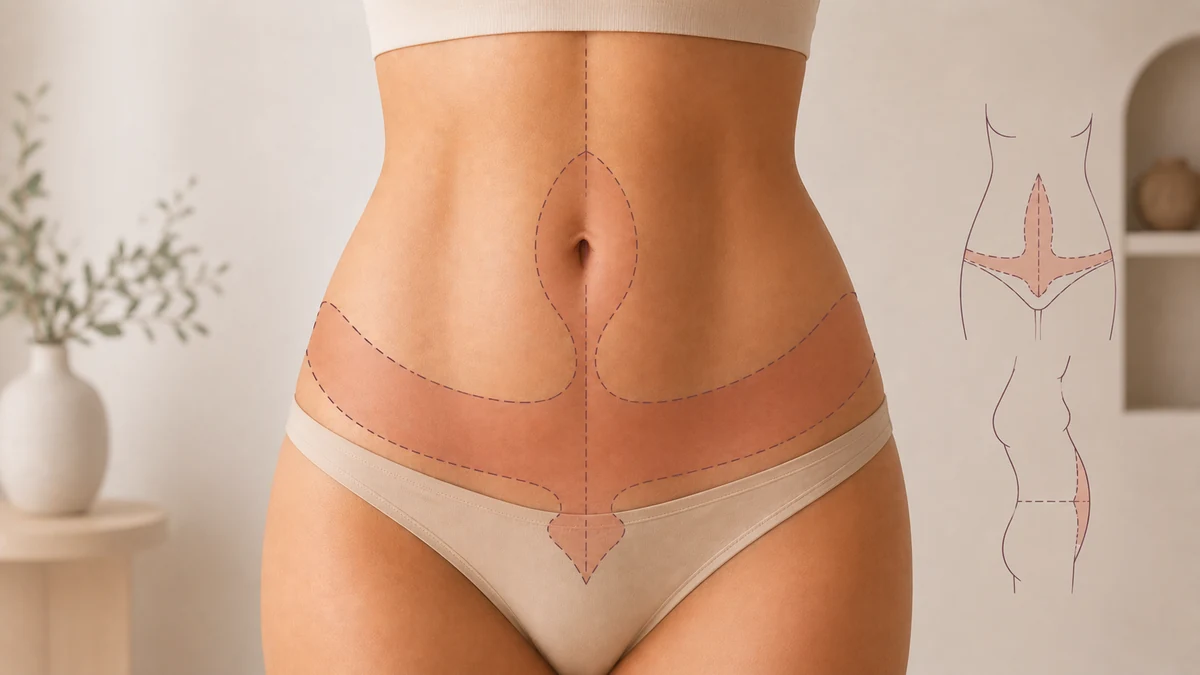
The fleur-de-lis tummy tuck is one of the more specialized tummy tuck types and one of the most commonly misunderstood. Patients who have researched it typically fall into two camps: post-bariatric patients whose surgeon has recommended it, and prospective patients who have seen the T-shaped scar online and are trying to figure out whether it applies to them. This guide is written for both — with the honest bottom line up front: the fleur-de-lis exists for a specific population with a specific problem (substantial two-dimensional skin excess after massive weight loss), and outside that population the vertical scar is a permanent cost with no proportionate benefit.
What follows is a structured walkthrough — what the operation actually is, what the T-scar looks like and why it is used, who qualifies, how the operation is performed, safety data, and how cost and insurance work.
What Is a Fleur-de-Lis Tummy Tuck?
A fleur-de-lis tummy tuck (also called a fleur-de-lis abdominoplasty or T-abdominoplasty) is a variant of the standard operation that removes excess skin in both dimensions. A standard full abdominoplasty removes excess skin horizontally — the flap between the ribs and the lower incision is pulled down and the excess trimmed off at the bottom, resulting in a single horizontal scar. It cannot address excess skin that runs vertically (side-to-side redundancy), because a horizontal-only closure would leave visible standing folds at the edges.
The fleur-de-lis addresses this by adding a vertical midline component. In addition to the standard low horizontal excision, a wedge of skin running up the midline is removed and closed together, pulling the abdominal skin toward the center from both sides. The result is a scar in the shape of an inverted T or a fleur-de-lis symbol — the horizontal component along the underwear line and the vertical component running up the midline of the abdomen.
The muscle repair and umbilicus repositioning are still part of the operation — the fleur-de-lis includes everything a full abdominoplasty does, plus the vertical skin excision. It is the standard full's more extensive relative, not a different operation category.
The T-Shaped Scar
The T-scar is the fleur-de-lis's most visible feature and its most-discussed trade-off. Understanding what it looks like and where it goes is important for candidacy conversation:
- Horizontal component: low across the lower abdomen, hip-to-hip, placed within the underwear/bikini line — the same as a standard full abdominoplasty scar.
- Vertical component: runs up the midline of the abdomen from the horizontal scar toward the sternum, sometimes only partway up (depending on how much excess skin is present).
- Umbilicus: sits within the vertical scar line — a repositioned belly button with its own small circular scar, along the vertical incision.
The vertical scar is not hidden by underwear or most swimwear. That is the specific trade-off patients need to understand: the fleur-de-lis produces a visible vertical scar in exchange for being able to remove significantly more skin than a horizontal-only closure can address. For patients with a lot of two-dimensional excess, this is often a clearly better outcome than the alternative — being left with visible skin folds, standing-cone deformity at the incision edges, or an incompletely-contoured abdomen. For patients without a lot of excess, the trade-off is not worth making.
Scars follow the standard 12-to-18-month maturation trajectory documented in the systematic review literature: raised-and-pink through months 0–6, flattening and paling through 6–12, mature at 12–18 months.4 Silicone (sheets or gel) and sun protection for the first year are the evidence-based scar-care basics — the vertical scar deserves particular attention because it is more visible and tends to heal under more tension than the horizontal. For a complete walkthrough, see our long-term scar care guide.
Who Is a Candidate
The primary fleur-de-lis candidate is a post-massive-weight-loss patient — someone who has lost a large amount of weight, usually after bariatric surgery (gastric bypass or sleeve gastrectomy), and is left with substantial excess skin in both horizontal and vertical dimensions.
Anatomical criteria
- Substantial horizontal excess: loose skin extending well beyond the anterior abdominal wall onto the flanks — patients with flank-dominant excess may instead need an extended tummy tuck.
- Substantial vertical excess: loose, redundant skin from ribs to pubis that cannot be adequately removed by horizontal-only closure.
- Two-dimensional skin quality issues: often thin, stretched, sometimes with striae (stretch marks), reduced elasticity.
- Often a large hanging pannus (apron of skin) extending to or below the pubis.
Clinical criteria
- Weight stable for 12 to 18 months after bariatric surgery — bariatric weight loss is not fully complete before then and operating on unstable weight produces poor durability of result.
- Nutritional status addressed: post-bariatric patients commonly have protein, iron, or vitamin deficiencies that impair wound healing; these need to be corrected pre-op.
- BMI ideally below the surgeon's threshold: an ACS-NSQIP analysis of 18,891 patients confirmed obesity is independently associated with higher wound complication, DVT, and reoperation rates in abdominoplasty and panniculectomy;2 most surgeons prefer BMI < 32–35 for a fleur-de-lis.
- Non-smoker (mandatory cessation ≥ 4 weeks pre- and post-op) — smoking substantially raises wound complications in T-scar closures particularly.
- Comorbidities controlled: diabetes, hypertension, sleep apnoea (common in post-bariatric patients) need to be optimised.
- Realistic understanding of the scar trade-off: the vertical scar is permanent and visible.
A published 499-patient series specifically examined outcomes in the post-bariatric fleur-de-lis population and concluded the operation is a safe alternative to standard abdominoplasty for this group.1 That is a meaningful evidence base for the specific population — but it is a population-specific finding, not a general endorsement for use outside the post-bariatric context.
Who is not a candidate
- Standard post-pregnancy patients — a full abdominoplasty is almost always adequate.
- Patients with mild-to-moderate abdominal changes — the vertical scar is not proportionate to the benefit.
- Patients still actively losing weight or with unstable weight after bariatric surgery.
- Patients with unaddressed nutritional deficiencies (correct first, then operate).
- Patients unable to stop smoking for the required period.
- Patients with unrealistic expectations about the vertical scar.
For general candidacy criteria that apply to all abdominoplasty variants, see the candidacy guide.
How the Operation Is Performed
Fleur-de-lis abdominoplasty follows the same general sequence as a full abdominoplasty with the addition of the vertical excision. Operative time is typically 3 to 5 hours — longer than a standard full because of the added tissue removal, more closure work, and typically more precise flap planning.
Pre-op planning
The horizontal and vertical excision zones are marked before the operation with the patient standing. The horizontal marking is the same as a standard full abdominoplasty (low, within the underwear line). The vertical marking is centred on the midline, tapered so that closure produces a natural contour rather than a straight line. Amount of vertical skin removed is estimated from the amount of side-to-side redundancy present.
The operation
Under general anaesthesia:
- The low horizontal incision is made and the abdominal skin flap is elevated from the underlying muscle wall, extending up to the ribs.
- Rectus diastasis (muscle separation) is repaired across the full length of the abdomen with permanent sutures — the same as a full abdominoplasty.
- The vertical excision is made along the midline, removing the wedge of excess skin.
- The skin from each side is drawn toward the midline and closed vertically.
- The skin flap is drawn downward and the excess trimmed at the horizontal incision line, which is then closed.
- The umbilicus is repositioned along the vertical scar line at the correct anatomical level.
- Drains may be placed (some surgeons use progressive tension suture techniques to reduce or eliminate drains).
- The patient is placed in a compression garment.
Hospital stay and recovery
Hospital stay is typically 1–3 nights, longer than a standard full because of the more extensive operation and the post-bariatric population's typically higher medical complexity. Recovery follows the standard recovery timeline with an additional consideration: the vertical scar closure often heals with slightly more tension than the horizontal, so scar care and early wound support are particularly important.
Safety & Complications
Fleur-de-lis abdominoplasty in the post-bariatric population has a safety profile broadly comparable to standard abdominoplasty in cosmetic patients, according to the 499-patient series that specifically examined the operation.1 That said, several factors intrinsic to the post-bariatric population raise absolute risk:
- Higher BMI even after weight loss — post-bariatric patients often remain in the overweight or class-I obesity range at their new stable weight, and the ACS-NSQIP data shows the effect on complications.2
- Nutritional deficiencies — untreated protein, vitamin, or iron deficiencies impair wound healing.
- Tissue quality — stretched skin has reduced vascularity and elasticity, raising risk of dehiscence and delayed healing.
- Comorbidity burden — sleep apnoea, diabetes, cardiovascular disease are all more common in this population.
- T-junction wound risk — the point where the horizontal and vertical scars meet is under particular tension and has a somewhat higher rate of wound complications; surgeon experience matters here.
For general abdominoplasty complication rates and the largest safety database context, see the safety hub. The overall major-complication rate for abdominoplasty in the CosmetAssure database was around 4%; post-bariatric fleur-de-lis in appropriate candidates is broadly comparable but with the population-specific caveats above. Choosing a plastic surgeon experienced with post-bariatric body contouring is more important for this operation than for standard abdominoplasty.
Cost & Insurance
| Location | Range | Typical |
|---|---|---|
| US — average metro | $15,000 – $19,000 | ~$17,000 |
| US — coastal / premium | $19,000 – $24,000 | ~$21,000 |
| Turkey — package | $5,500 – $8,000 | ~$6,500 |
Fleur-de-lis is typically 40–50% more expensive than a standard full abdominoplasty because of the extra complexity, longer OR time, and often longer stay. The Turkey saving is proportional — around 60–65%. See our cost guide for detail on what US totals include, and our Turkey guide for what package pricing typically covers.
Insurance coverage — the panniculectomy angle
Post-bariatric patients often qualify for at least partial insurance coverage through the panniculectomy angle. A panniculectomy — removal of the overhanging apron of skin and fat for documented functional/medical reasons — is a separate procedure that some US insurers cover when medical necessity is established. When a post-bariatric patient qualifies for panniculectomy coverage, the panniculectomy portion of the operation may be billed to insurance, and the additional aesthetic elements (muscle repair, contour tightening, the vertical fleur-de-lis component if primarily aesthetic) are paid out of pocket.
Common documentation requirements: photographs showing pannus extending to or below the pubis, documented recurrent skin infections under the pannus, at least 3–6 months of failed conservative treatment, 12 to 18 months of stable weight after bariatric surgery, BMI below the insurer's threshold. A published review of US insurance policies for post-bariatric abdominal contouring found the specific criteria vary considerably by insurer.3 Full detail in our insurance coverage guide.
FAQ
-
What is a fleur-de-lis tummy tuck?
A fleur-de-lis tummy tuck (fleur-de-lis abdominoplasty) is a variant of the standard operation that removes excess skin in both dimensions — horizontal and vertical. The result is a scar in the shape of an inverted T or fleur-de-lis symbol: a low horizontal scar hip-to-hip plus a vertical scar running up the midline of the abdomen. The vertical component allows removal of skin that a standard horizontal-only closure cannot reach, which is why it is used almost exclusively in patients with substantial excess skin in both dimensions — typically after massive weight loss (bariatric surgery).
-
Who is a candidate for a fleur-de-lis tummy tuck?
The primary candidate is a post-massive-weight-loss patient — typically after bariatric surgery (gastric bypass or sleeve gastrectomy) with substantial weight loss and 12 to 18 months of stable weight — who has significant excess skin both above and below the belly button and around the flanks. A published 499-patient series confirmed the fleur-de-lis is a safe alternative to standard abdominoplasty specifically in this population.1 Candidates should be non-smokers (or willing to stop 4+ weeks pre-op), have nutritional deficiencies addressed, and understand the vertical scar trade-off. Non-bariatric patients rarely need it.
-
How is the fleur-de-lis scar different?
The fleur-de-lis has a T-shaped scar rather than a horizontal-only scar. There is a low horizontal scar (hip-to-hip, in the underwear line, same as a standard full abdominoplasty) plus a vertical scar running up the midline of the abdomen from the horizontal scar toward the sternum, or partway up. The vertical scar is the trade-off for being able to remove significantly more skin than a horizontal-only closure allows. In appropriate candidates (with a lot of excess skin), the scar is a much better trade than being left with residual redundant skin; in inappropriate candidates, the vertical scar is a permanent cost with no proportionate benefit.
-
Is a fleur-de-lis tummy tuck safe?
In the correct patient population — massive weight loss patients with substantial two-dimensional skin excess — a fleur-de-lis has a safety profile broadly comparable to standard abdominoplasty. A published 499-patient series specifically examined outcomes in a post-bariatric population and concluded the fleur-de-lis is a safe alternative.1 That said, post-bariatric surgery of any type carries elevated risk compared with cosmetic abdominoplasty because of factors intrinsic to the patient population — nutritional deficiencies, comorbidities, tissue quality. An ACS-NSQIP analysis of 18,891 patients confirmed higher-BMI status raises complication rates.2 Choosing a surgeon experienced with post-bariatric body contouring is particularly important for this operation.
-
How much does a fleur-de-lis tummy tuck cost?
A fleur-de-lis tummy tuck typically costs $15,000 to $24,000 in the US and $5,500 to $8,000 all-in through Turkey package providers — roughly 40–50% more than a standard full abdominoplasty because of the extra complexity. If the operation is performed for medically necessary reasons in a post-bariatric patient — most often as a panniculectomy with a fleur-de-lis component for functional reasons — parts of it may be covered by US insurance. This requires documentation of functional problems (recurrent infections, hygiene issues, mobility) and pre-authorization. See our insurance guide for detail.
-
Can insurance cover a fleur-de-lis tummy tuck?
The panniculectomy portion — removing the overhanging pannus for medically necessary reasons — may be covered when documentation supports it. Common requirements include photographs showing a pannus extending to or below the pubis, documented recurrent skin infections under the pannus, at least 3–6 months of failed conservative treatment, 12 to 18 months of stable weight after bariatric surgery, and BMI below the insurer's threshold. When insurance covers the panniculectomy portion, the aesthetic elements added (muscle repair, contour tightening, and the fleur-de-lis vertical component if primarily aesthetic) are usually paid out of pocket. A published review of US insurance policies found the specific criteria vary considerably by insurer.3