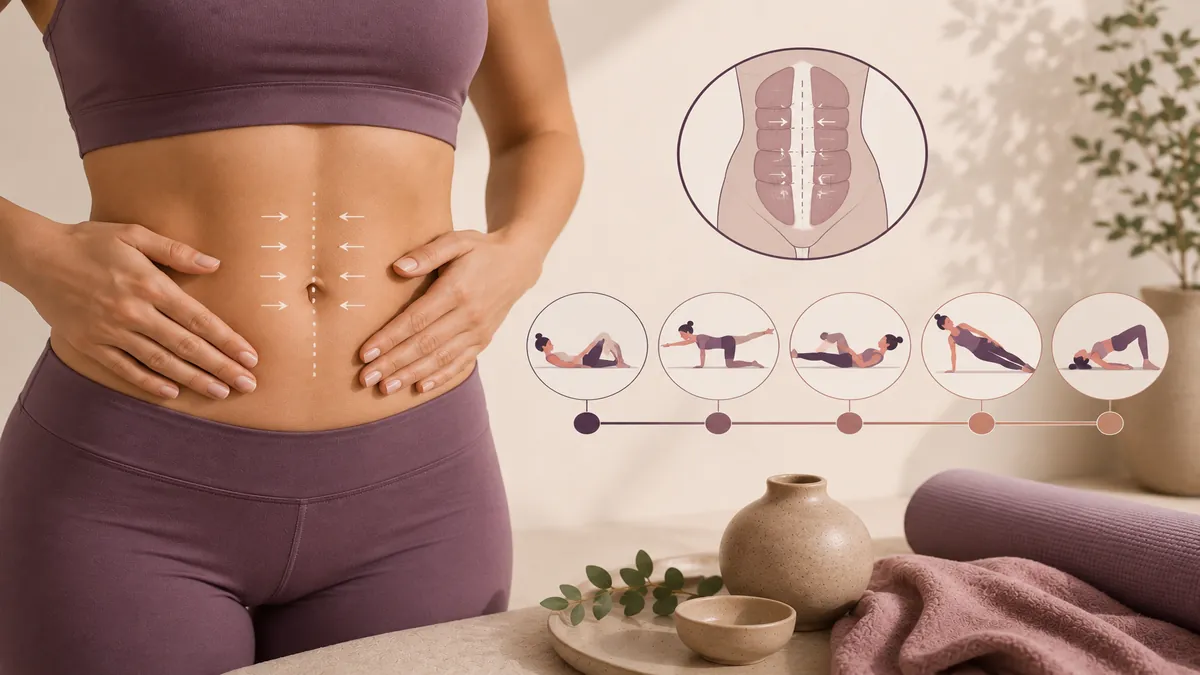
Diastasis recti — the separation of the two rectus abdominis muscles at the midline — affects 30 to 70 percent of women in the immediate postpartum period, with a significant proportion persisting past 12 months.4 "Diastasis recti exercises" is one of the highest-volume Google queries in women's health, driven mostly by postpartum women looking for a non-surgical way to close the gap. For broader context on understanding diastasis recti and muscle repair, see our pillar guide. This page is the honest answer to what works, what doesn't, and where the limit of exercise lies.
Two things to know up front. First: for mild to moderate diastasis, exercise genuinely helps — the evidence supports it and thousands of postpartum women narrow their gap this way. Second: for severe or long-standing diastasis, no amount of exercise closes the gap fully, and pretending otherwise leads to years of frustration before the eventual decision to have surgery. Knowing which category you fall into is the most important thing this page can do for you.
Can Exercise Actually Fix Diastasis Recti?
A 2019 systematic review published in the British Journal of Sports Medicine examined the evidence for exercise as treatment for postpartum diastasis recti and concluded that structured exercise programs — particularly those emphasizing transversus abdominis activation and pelvic floor engagement — produce measurable narrowing of the inter-rectus distance in a significant proportion of women.1 The effect size varies, and not every study shows benefit, but the direction of evidence is consistent.
What the evidence does not support: (1) that any single exercise reliably closes any diastasis, (2) that severe diastasis (> 3–4 cm) can be closed by exercise alone in most cases, or (3) that generic "core workouts" help — the exercises must specifically target the deep core rather than the surface muscles.
The realistic picture: exercise helps most mild to moderate cases meaningfully; it helps some severe cases modestly; it rarely fully closes a large gap. The right question is not "does exercise work?" but "does exercise work for my level of diastasis?" — and that question is best answered by a pelvic floor physical therapist who examines you.
The Exercises That Actually Help
These are the foundational deep-core exercises that have the best evidence base for diastasis. All should be performed with correct breathing (exhale on effort, inhale on release) and without any visible midline doming or coning.
1. Diaphragmatic breathing
The foundation. Lie on your back with knees bent, one hand on your belly and one on your chest. Inhale slowly through your nose, feeling your belly rise more than your chest. Exhale slowly through pursed lips, gently drawing your navel toward your spine as the last of the breath leaves. This trains the diaphragm and transverse abdominis to work together — the core of core function. 5–10 breaths, several times a day.
2. Transverse abdominis activation ("belly button to spine")
Same starting position. As you exhale, gently pull your belly button toward your spine — as if trying to slide a small note under your lower back. Hold for 5 seconds while continuing to breathe (do not hold your breath). Release. Repeat 10 times. The engagement is subtle — you are not doing a crunch; you are activating the deepest layer of your abdominal wall. This is the single most important exercise for closing a diastasis.
3. Heel slides
Lie on your back with knees bent. Activate TA (as above). Keeping TA engaged, slowly slide one heel out along the floor until your leg is straight, then slowly slide it back. If your midline domes at any point, you are going too far — shorten the slide. 10 per side.
4. Pelvic tilts
Lie on your back with knees bent. Gently tilt your pelvis upward (flattening your lower back into the floor) while activating TA. Hold 5 seconds. Release. This teaches lumbo-pelvic control alongside deep-core activation. 10 reps.
5. Standing progression
Once floor exercises are comfortable, progress to standing versions of the same principles — standing TA activation, standing heel taps, standing pelvic control. Standing engages postural muscles alongside the deep core and is more transferable to daily life.
6. Modified planks (only when ready)
After several weeks of consistent deep-core work, modified planks (from knees, with active TA engagement, held for short durations) can be added if there is no doming. Full planks should be avoided until a pelvic floor PT confirms the diastasis has narrowed sufficiently.
Exercises to Avoid
These are the movements that consistently make diastasis worse rather than better. They all share the same underlying problem: they generate high intra-abdominal pressure and load the midline in a way that stretches the linea alba rather than strengthening it.
| Exercise | Why it's problematic |
|---|---|
| Traditional crunches / sit-ups | Direct load on the midline with visible doming |
| Full planks (from feet) | Sustained pressure on unstable midline |
| Double-leg raises | Very high intra-abdominal pressure |
| Bicycle crunches / Russian twists | Rotational load on separated fibres |
| V-sits / hollow holds | Extreme midline load |
| Heavy squats / deadlifts without bracing training | High pressure, midline strain |
| Pull-ups / hanging leg raises | Loaded stretch on midline |
| High-intensity CrossFit-style circuits | Combination of the above at speed |
The visual test
The best single self-check during any exercise: watch your midline. If it domes upward (creates a visible ridge or tent along the middle of your abdomen) or "cones" (a similar upward point at the midline), you are stressing the diastasis. Stop the exercise, modify it, or drop it entirely. A pelvic floor PT can also assess this in real time and correct technique.
Working With a Pelvic Floor Physical Therapist
The single biggest predictor of success with diastasis exercise is working with a pelvic floor physical therapist (PT). PT-guided programs consistently outperform self-directed home programs in the published literature, both for narrowing the gap and for improving functional core strength.2
What a pelvic floor PT provides that videos and apps do not:
- Individual assessment of your specific diastasis width, tissue quality, and associated pelvic floor function.
- Real-time technique correction — the difference between "activating TA" and "sucking in your belly" is subtle and mostly invisible without hands-on feedback.
- Progression planning tailored to your recovery and readiness.
- Integration with pelvic floor issues (urinary symptoms, prolapse) that often coexist with diastasis.
- Honest assessment of when exercise is not enough and surgery should be considered.
In the US, most insurance plans cover pelvic floor PT with a referral; visits typically run $75–$200 out-of-pocket without insurance. A course of 6–10 visits is common. This is a much better first investment than any online program.
Realistic Timeline & Expectations
What to expect from a well-designed exercise program:
| Timepoint | Typical progress |
|---|---|
| Week 1–2 | Learning breathing and TA activation; no visible change yet |
| Week 3–4 | Better core awareness, less doming during daily activity |
| Week 6–8 | Measurable narrowing possible; functional improvement notable |
| Week 8–12 | Most of the narrowing seen occurs here for mild/moderate cases |
| Month 4–6 | Plateau in most patients; final narrowing achieved |
| Beyond 6 months | Little further narrowing from exercise alone typically |
For severe diastasis (> 3–4 cm), the same program may produce functional improvement without much narrowing of the gap itself. For long-standing diastasis (persisting past 12 months postpartum), the timeline is often slower and the ceiling lower.
When Exercise Isn't Enough
The honest answer patients often don't hear from exercise-focused sources: exercise has a ceiling. Signs that you have reached your exercise ceiling and may benefit from surgical evaluation:
- You have done a proper pelvic floor PT program for 6+ months with no further narrowing.
- Your diastasis remains wider than 3 cm at the widest point despite dedicated work.
- You have significant associated skin laxity that exercise cannot address.
- You have functional symptoms (chronic back pain, urinary issues, hernia) that persist despite exercise.
- You have completed all planned pregnancies and want a definitive result.
When those apply, surgical repair — rectus plication, most commonly performed during a tummy tuck — provides a definitive answer. Randomized evidence at 1 year confirms the repair is durable, with or without mesh reinforcement.3 Our non-surgical vs surgical repair guide walks through how to decide when surgery is the better option. Full detail on the operation in our muscle repair surgery guide, and on the condition itself in our diastasis recti guide.
Choosing surgery is not "giving up on exercise" — it is recognising that the tissue architecture has been stretched beyond what soft-tissue rehabilitation can restore. Many surgical patients continue their PT exercises before and after surgery for the best long-term result.
FAQ
Can you fix diastasis recti with exercise alone?
For mild to moderate diastasis, evidence supports that a structured program of deep-core exercises — particularly transversus abdominis activation, pelvic floor engagement, and diaphragmatic breathing — can reduce the inter-rectus distance and improve functional core strength.1 Systematic review evidence indicates measurable narrowing in a significant proportion of postpartum patients, though the effect size varies. For severe diastasis (typically wider than 3 to 4 cm), or diastasis persisting well beyond 12 months postpartum, exercise alone rarely fully closes the gap, and surgical repair (rectus plication) is generally required to restore normal midline anatomy. Working with a pelvic floor physical therapist is the single biggest predictor of success for non-surgical management.
What exercises should you avoid with diastasis recti?
Traditional crunches, sit-ups, full planks, double-leg raises, oblique twists (Russian twists, bicycle crunches), and heavy loaded compound lifts without proper bracing all increase intra-abdominal pressure and load the midline in ways that can widen a diastasis rather than close it. The visual test: any movement that causes your abdominal midline to dome, bulge, or "cone" upward when you contract is placing the diastasis under stress and should be avoided or modified. This is why generic core workouts and CrossFit-style routines often make diastasis worse in postpartum women rather than better. The goal is to build core strength from the inside out — starting with deep transverse abdominis before adding surface muscle work.
How long do diastasis recti exercises take to work?
Realistic expectation: 8 to 12 weeks of consistent, correctly performed deep-core exercises to see measurable narrowing in most postpartum patients with mild to moderate diastasis. Some see functional improvement (less doming, better core engagement) within 4 to 6 weeks. Continued improvement typically plateaus at 4 to 6 months of consistent work. The exercises must be done daily (or near-daily) and must be performed with correct technique — quality matters far more than quantity. If a diastasis has not narrowed meaningfully at 6 months of dedicated PT-guided work, it is unlikely to close further with exercise alone, and surgical repair should be considered.
When is surgery needed for diastasis recti?
Surgery — rectus plication, most commonly performed during a tummy tuck — is typically considered when: (1) the diastasis is wide (greater than 3 to 4 cm at the widest point); (2) it persists more than 12 months postpartum despite dedicated exercise; (3) it is causing functional problems (chronic lower back pain, urinary symptoms, hernia risk); (4) there is significant associated skin laxity that also requires removal; (5) further pregnancies are complete. Randomized clinical trial evidence at 1 year confirms that surgical repair is durable, with or without mesh reinforcement.3 Surgery is not the first line of treatment for mild diastasis; it is the definitive treatment when exercise has not closed the gap or the gap is too wide for exercise to address.
Can men fix diastasis recti with exercise?
Yes, in principle — the same deep-core exercises that help postpartum women can help men whose diastasis is related to weight gain, heavy lifting, or genetic factors. However, the underlying cause in men is often central obesity, which means weight loss is typically the more impactful intervention than exercise alone. Men whose diastasis is related to a large intra-abdominal fat load will not close the gap purely with core exercises while the fat load remains. The sequence is usually: weight loss + deep-core exercise + pelvic floor engagement. If the gap persists after significant weight loss and a structured exercise program, surgical repair may be indicated in the same way it is for postpartum women.