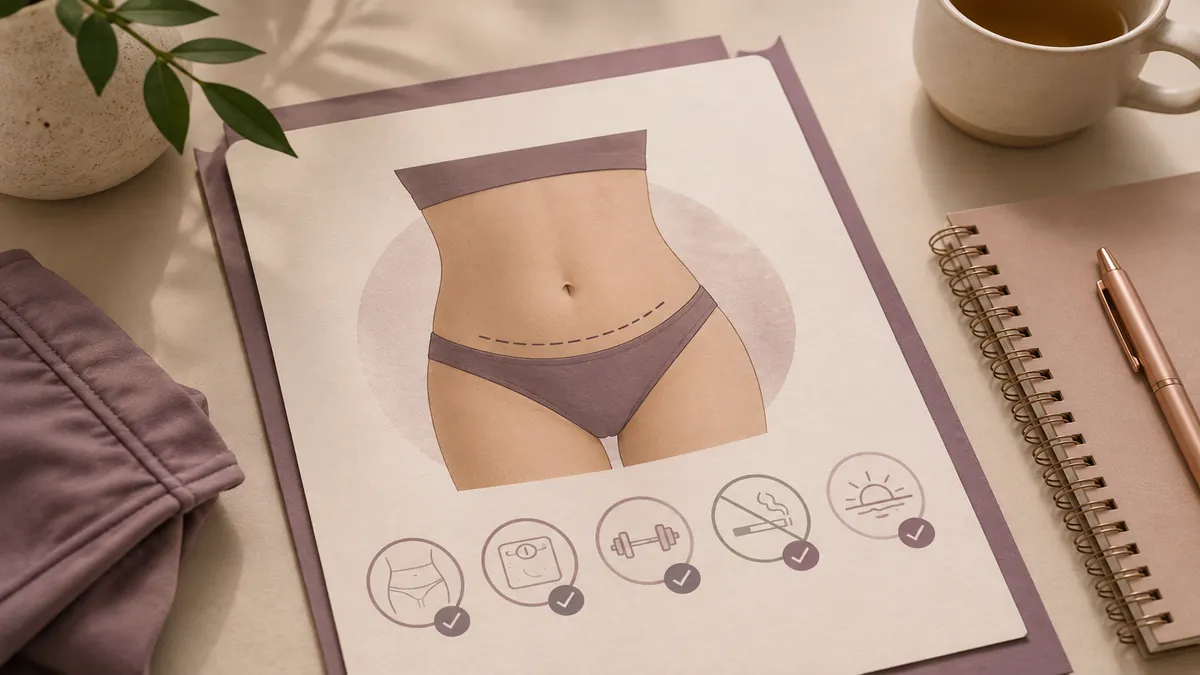
The term "mini tummy tuck" sounds smaller, simpler, and less intimidating than a full abdominoplasty — and for the right patient among the various tummy tuck types, it genuinely is. But the right patient is rarer than internet marketing suggests. The ASPS describes the mini abdominoplasty1 as appropriate for patients with "a small amount of excess skin" confined to the lower abdomen. In clinical practice, that means roughly 15% of people who walk into a consultation asking about a mini leave with a recommendation for a full. This guide helps you figure out which camp you are in.
What Makes Someone a Mini Tummy Tuck Candidate?
A mini abdominoplasty addresses the area between the pubic bone and the belly button. It uses a shorter incision (typically 10–20 cm, similar to a C-section scar), removes a limited amount of skin and fat, and either performs no muscle repair or tightens only the lower portion of the rectus muscles. The belly button stays in its original position — it is not relocated.
This limited scope means the procedure works only when the problem is limited too. The ideal mini tummy tuck candidate has all of the following characteristics:
- Skin laxity confined to below the navel. When you stand in front of a mirror, the loose skin that bothers you should be entirely below your belly button. If the laxity extends above the navel — even a little — a mini tummy tuck cannot address it.
- A small-to-moderate lower belly pouch. This is typically a soft fold of skin and a thin layer of subcutaneous fat, not a large pannus (apron of skin). Think "can't get rid of it with diet and exercise" — not "hanging over my waistband."
- Good skin elasticity above the navel. The skin on your upper abdomen should be relatively tight and smooth. A mini tummy tuck does not touch the upper abdomen, so whatever is there now stays.
- No significant muscle separation (diastasis recti). Or if diastasis is present, it should be limited to below the navel. Most post-pregnancy diastasis extends above the navel too, which requires a full-length repair.
- Near or at your goal weight. The procedure refines contour — it is not a weight-loss operation.
- BMI under 30. This is the single most important safety threshold. Data from the CosmetAssure database of 25,478 abdominoplasty cases2 identified BMI >30 as the strongest independent predictor of surgical complications.
Self-Assessment Checklist: Do You Qualify?
This checklist is not a substitute for an in-person consultation, but it will give you a strong starting indication. Be honest with each question — the goal is clarity, not getting a particular answer.
1. The Pinch Test (Above vs Below the Navel)
Stand upright in front of a mirror. With both hands, pinch the skin and fat on your lower abdomen — below your belly button. Note how much you can grab. Now do the same thing above your belly button.
- Below only: You can pinch a noticeable fold below the navel, but the skin above is relatively flat and tight. → Potential mini candidate.
- Both above and below: You can grab a meaningful fold in both areas. → Full tummy tuck territory. A mini will leave the upper laxity untouched and the result will look incomplete.
- Above only: Rare, but this pattern exists — it usually indicates upper-abdominal fat rather than skin laxity, and liposuction may be the better option.
2. The Diastasis Recti Check
Lie on your back with knees bent. Place your fingers horizontally across the midline of your abdomen, just above your belly button. Lift your head and shoulders slightly off the ground (like a partial crunch). Feel for a gap between the two ridges of muscle.
- No gap or <2 finger-widths: You likely do not have clinically significant diastasis. → Mini may be appropriate (if other criteria are met).
- 2+ finger-widths above the navel: You have diastasis recti that extends above the belly button. → A mini tummy tuck cannot repair this. A full tummy tuck with plication (muscle repair) from xiphoid to pubic bone is required.
- Gap below navel only: Less common. A mini may be able to repair this limited separation, depending on surgeon assessment.
Our diastasis recti overview covers diagnosis and treatment options in detail.
3. BMI and Weight Stability
Calculate your BMI (weight in kg ÷ height in m²). The safety data is clear: the CosmetAssure 25,478-case analysis2 and the ACS-NSQIP study of 18,891 abdominoplasty patients3 both show that complication rates climb meaningfully above BMI 30.
- BMI 22–28: Ideal range. Low complication risk, best aesthetic outcomes.
- BMI 28–30: Acceptable for most surgeons. Slightly elevated risk but still reasonable.
- BMI 30–32: Grey zone. Some surgeons will proceed on a case-by-case basis; many will recommend losing 10–20 lb first.
- BMI >32: Most board-certified surgeons will decline to operate and recommend weight loss before scheduling.
Weight stability matters too. If you have lost significant weight recently and are still losing, your body contour has not stabilized. Wait until your weight has been stable (±5 lb) for at least 3–6 months before considering surgery.
4. Skin Quality Assessment
A mini tummy tuck removes a relatively small amount of skin. If your remaining skin has poor elasticity — heavy stretch marks, thin or crepe-like texture, significant sun damage — the result may be disappointing because the skin that remains will not retract smoothly.
- Good elasticity: Skin snaps back when you pinch it. Minimal or fine stretch marks. → Mini can work well.
- Moderate elasticity: Some stretch marks, skin returns slowly when pinched. → Borderline. Your surgeon may still recommend a mini, or may suggest a full to excise more of the damaged skin.
- Poor elasticity: Heavy stretch marks, crepe texture, skin stays tented when pinched. → Full tummy tuck is usually the better option to remove more of the low-quality skin.
5. Future Pregnancy Plans
If you are planning to become pregnant in the future, most plastic surgeons will recommend waiting. Pregnancy stretches the abdominal skin and separates the muscles — partially or fully reversing the results of any tummy tuck, mini or full. There is no medical prohibition on getting pregnant after a mini tummy tuck, but the investment (financial and physical) is largely wasted if you become pregnant within a few years. Complete your family first.
What Disqualifies You from a Mini Tummy Tuck?
Some factors are absolute contraindications; others are relative (your surgeon will weigh risks and benefits). The following list draws on the ASPS candidacy guidelines1 and the complication data from the two largest US abdominoplasty analyses.23
Absolute Disqualifiers
- Significant skin excess above the belly button. This is the number one reason people are redirected from mini to full. If laxity extends above the navel, a mini tummy tuck literally cannot reach it — the incision is too low and the undermining too limited.
- Full-length diastasis recti. Muscle separation extending from the rib cage to the pubic bone requires repair through a full-length midline incision. A mini cannot access the upper rectus.
- Need for belly button repositioning. If significant skin is removed and the navel needs to be repositioned, you need a full tummy tuck. A mini does not create a new belly button opening.
- Active smoking. Nicotine constricts blood vessels and dramatically increases the risk of wound-healing complications, skin necrosis, and infection. Most surgeons require cessation of all nicotine products (cigarettes, vaping, patches, gum) for at least 4–6 weeks before and after surgery.
- Uncontrolled chronic conditions. Unmanaged diabetes, bleeding disorders, autoimmune conditions on immunosuppressants, or active infections all elevate surgical risk to unacceptable levels.
Relative Disqualifiers (Case-by-Case)
- BMI 30–32. Not an absolute prohibition but a strong yellow flag. Many surgeons will require pre-operative weight loss.
- Active weight loss. If you are currently losing weight and your body shape is still changing, operating on a moving target risks a suboptimal result. Wait until stable.
- Previous abdominal surgery with extensive scarring. Multiple prior surgeries (especially vertical midline incisions) can compromise blood supply and complicate tissue undermining. Your surgeon needs to assess scar patterns on a case-by-case basis.
- Unrealistic expectations. A mini tummy tuck is a refinement procedure, not a transformation. If you expect dramatic before-and-after results, you may be disappointed — or you may actually need the full procedure.
When You Actually Need a Full Tummy Tuck
The technical differences between mini and full are covered on our mini vs full comparison page. What matters here is the candidacy crossover — the situations where a patient walks in wanting a mini and walks out with a full tummy tuck recommendation.
| Factor | Mini TT Candidate | Full TT Candidate |
|---|---|---|
| Skin laxity location | Below navel only | Above and below navel |
| Amount of excess skin | Small to moderate pouch | Moderate to large apron |
| Diastasis recti | None or below-navel only | Extends above navel |
| Belly button | Stays in place | Repositioned |
| Stretch marks | Minimal, below navel | Extensive, above and below |
| Post-pregnancy changes | Minor lower-belly pouch | Significant skin + muscle laxity |
| Post–weight-loss | Rarely appropriate | Usually required (or extended TT) |
The most common scenario: a post-pregnancy patient with a lower-belly pouch assumes she is a mini candidate. During consultation, the surgeon identifies diastasis recti extending above the navel and loose skin that wraps around to the flanks. The recommendation changes to a full tummy tuck — or in some cases an extended tummy tuck — because the mini would leave half the problem unaddressed.
Body Type Indicators: Who Does Best with a Mini?
While every patient is individual, certain body profiles tend to cluster with good mini tummy tuck outcomes:
Profiles That Favour a Mini
- The "stubborn pooch" patient. Fit, exercises regularly, normal BMI — but has a small lower-belly bulge that does not respond to diet or exercise. Often caused by a small amount of excess skin or a localized fat deposit below the navel. The rest of the abdomen is flat.
- The post-C-section patient with minimal damage. One or two pregnancies, bounced back well, but left with a small shelf of skin and a widened C-section scar. No significant diastasis, no upper-abdominal laxity. The mini incision can revise the C-section scar and remove the small fold in one operation.
- The genetic lower-belly patient. Never been pregnant, normal weight, but genetically stores a disproportionate amount of skin and fat below the navel. The upper abdomen is lean and tight. This is a textbook mini candidate if the laxity is truly confined to the lower third.
- The minor-revision patient. A patient who previously had a full tummy tuck or liposuction and has developed a small amount of recurrent laxity below the navel. A mini can touch up the lower contour without repeating the full operation.
Profiles That Need a Full (or More)
- Post–massive-weight-loss patients. Losing 50+ lb typically leaves significant circumferential skin excess. A mini tummy tuck would be like hemming the bottom of a curtain that needs replacing. A full tummy tuck — often an extended or fleur-de-lis — is required.
- Multiple-pregnancy patients with visible muscle separation. Three or more pregnancies commonly produce diastasis extending the full length of the rectus muscles, plus significant skin laxity above and below the navel. This is full-tummy-tuck with-plication territory.
- Patients with a large pannus (skin apron). If the skin fold hangs over the pubic area or mons when standing, the volume of tissue to be excised exceeds what a mini tummy tuck can handle. A full tummy tuck (or a panniculectomy if insurance-eligible) is needed.
What to Ask Your Surgeon at the Consultation
Armed with your self-assessment, bring these questions to the consultation. A good board-certified plastic surgeon will examine you and give direct answers:
- "Based on your examination, am I genuinely a mini tummy tuck candidate, or do I need a full?" — Do not lead the surgeon toward the answer you want. Let them examine you and give their clinical opinion.
- "Do I have diastasis recti, and if so, how far does it extend?" — This is a hands-on exam. The surgeon palpates the midline from xiphoid to pubis to map the separation.
- "Will a mini tummy tuck address all of the areas that bother me?" — If the answer is "most but not all," that is a sign you may be settling for a compromise result.
- "What will the scar look like, and where will it sit?" — A mini tummy tuck scar is shorter (10–20 cm) and sits low, often hidden by underwear. But placement varies by surgeon.
- "What happens if you start a mini and find more laxity or muscle damage than expected?" — Most surgeons will discuss whether they would convert to a full intraoperatively, or whether they would stage it as a second procedure.
- "Would combining liposuction with a mini give me a better result than a mini alone?" — For patients with good skin elasticity but localized fat above the navel, adding lipo to the upper abdomen or flanks can complement a mini tummy tuck effectively.
Safety Comparison: Mini vs Full
A mini tummy tuck is generally safer than a full abdominoplasty because the scope of surgery is smaller — shorter incision, less tissue undermining, less operating time, and often performed under local anaesthesia with sedation rather than general anaesthesia. The ACS-NSQIP analysis of 18,891 abdominoplasty patients3 documented overall complication rates that correlate with operative extent.
| Factor | Mini TT | Full TT |
|---|---|---|
| Incision length | 10–20 cm | 40–60 cm |
| Tissue undermining | Below navel only | Navel to xiphoid |
| Anaesthesia | Local + sedation (often) | General (usually) |
| Operating time | 1–1.5 hours | 2–4 hours |
| Seroma risk | Lower | Higher |
| Recovery to desk work | 1–2 weeks | 2–3 weeks |
| Recovery to exercise | 4–6 weeks | 6–8 weeks |
However, the lower risk profile is only an advantage if the mini procedure addresses your actual problem. Choosing a mini to avoid the risks of a full — when your anatomy requires a full — means accepting a substandard result and possibly a revision surgery later. Two operations are riskier than one correctly scoped operation. See our general candidacy page for a full discussion of abdominoplasty safety criteria.
Cost Considerations for Mini Candidates
A mini tummy tuck typically costs $6,000–$12,000 in the United States, compared to $10,000–$18,000 for a full abdominoplasty — reflecting the shorter operating time, often simpler anaesthesia, and sometimes outpatient (no overnight stay) setting. The ASPS national statistics4 report average surgeon fees that do not include anaesthesia, facility, or garment costs.
The cost saving is real, but it should not drive the decision. If your anatomy requires a full tummy tuck and you choose a mini to save money, the result will be compromised — and a revision surgery to correct it will cost more than the full procedure would have in the first place. Our cost guide breaks down the full pricing picture.
Considering a Mini Tummy Tuck in Turkey
For patients whose self-assessment confirms mini candidacy, having the procedure in Turkey can reduce total cost by 50–70% compared to US pricing — typically $2,500–$4,000 all-inclusive (surgeon, facility, anaesthesia, hotel, transfers) versus $6,000–$12,000 all-in in the US. The candidacy criteria are identical regardless of where you have the procedure. A mini tummy tuck in Istanbul with a board-certified Turkish plastic surgeon follows the same clinical standards — the anatomy does not change because you cross a border.
Key due diligence: verify the surgeon is certified by the Turkish Board of Plastic Surgery, the facility is JCI-accredited or Turkish Ministry of Health–licensed, and the quote includes post-operative follow-up. Our choosing a surgeon in Turkey guide covers the vetting process.
Frequently Asked Questions
-
What BMI do I need for a mini tummy tuck?
Most board-certified surgeons prefer BMI under 30. The ideal range is 22–28. The CosmetAssure study of 25,478 cases2 found that BMI over 30 was the strongest independent predictor of complications. Some surgeons will operate at BMI 30–32 case-by-case, but most recommend weight loss first.
-
Can I get a mini tummy tuck after a C-section?
Yes, and the existing C-section scar is often an advantage — a mini uses a similar low incision and the surgeon may revise the C-section scar during the procedure. The key question is whether your laxity is truly limited to below the navel. Many post-pregnancy patients have upper laxity and diastasis too, which requires a full tummy tuck with muscle repair. See our tummy tuck after C-section page for details.
-
What disqualifies you from a mini tummy tuck?
The main disqualifiers: significant skin excess above the belly button, diastasis recti extending above the navel, BMI over 30–32, active smoking within 4–6 weeks of surgery, uncontrolled diabetes or bleeding disorders, plans for future pregnancy, and needing the belly button repositioned.
-
How do I know if I need a full tummy tuck instead of a mini?
Do the pinch test: stand up and pinch the skin above your belly button. If you can grab a thick fold, a mini will not reach it — you need a full. Also check for diastasis recti above the navel. Our mini vs full comparison covers the technical differences.
-
Is a mini tummy tuck less risky than a full?
Yes, modestly. Shorter incision, less tissue undermining, no belly button relocation, and often local-with-sedation anaesthesia. This translates to lower wound complication, seroma, and blood loss rates. But the same fundamental surgical risks (infection, bleeding, DVT) apply.
-
Can I combine a mini tummy tuck with liposuction?
Yes — it is one of the most common combinations. Liposuction of the flanks or upper abdomen complements a mini well when the patient has good skin elasticity but localized fat deposits the mini incision cannot reach. Your surgeon will assess safety based on total expected fat removal and your overall health.