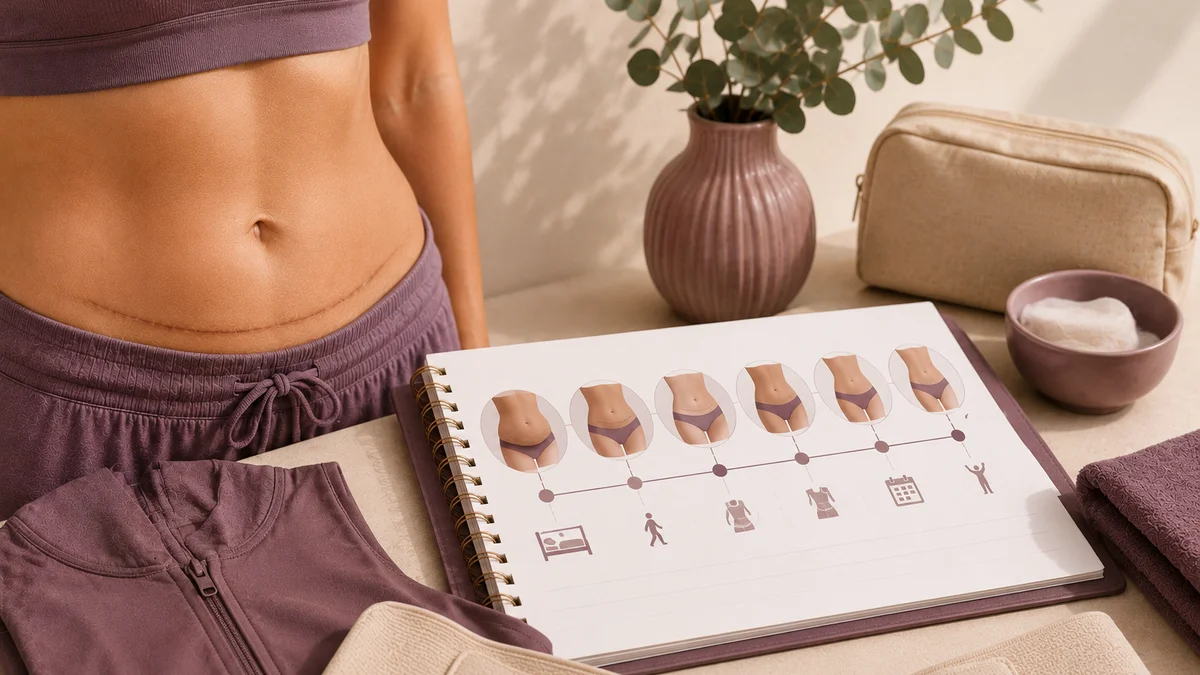
Every tummy tuck patient Googles "is this swelling normal?" at some point between weeks 2 and 8 — swelling is one of the most discussed topics in our complete recovery guide. The abdomen is bigger than expected, harder than expected, and looks nothing like the after photos that appeared on the surgeon's Instagram. This page walks through exactly what swelling looks like at each stage — what is happening under the skin, why the upper belly and lower belly behave differently, and which patterns are normal versus genuinely concerning. Timelines below are calibrated to the CosmetAssure database analysis of 25,478 abdominoplasty patients,2 the ACS-NSQIP analysis of 18,891 patients,3 and ASPS recovery guidelines.1
Why Tummy Tuck Swelling Happens
Abdominoplasty involves separating the skin and fat layer from the underlying muscle wall across the entire abdomen — from the pubic bone to the ribcage. This disrupts hundreds of tiny lymphatic vessels and blood capillaries. The body responds with an inflammatory cascade: fluid floods the surgical space, immune cells arrive to begin repair, and the lymphatic system (which normally drains tissue fluid) is temporarily severed. Until those lymphatic channels regenerate — a process that takes 3 to 6 months — fluid accumulates between the muscle and the skin flap faster than it can drain away. That accumulation is what you see and feel as swelling.
When muscle repair (diastasis recti plication) is performed — as it is in the vast majority of full tummy tucks — the abdominal wall itself becomes a rigid, swollen structure. The repaired muscle is inflamed and adds its own contribution to the overall abdominal girth. This is why post-tummy-tuck swelling is more dramatic and more prolonged than swelling after liposuction alone.
Days 1–3: Acute Inflammatory Peak
What it looks like: Immediately post-op, the abdomen appears flat under the compression garment — sometimes dramatically so. Within 24 to 72 hours, that flatness disappears as the inflammatory response floods the tissue with fluid. By day 3, the abdomen is visibly distended, firm to the touch, and in many patients looks larger than it did before surgery. The skin is taut and shiny. Bruising (purple-blue) begins appearing on the mons pubis, lower flanks, and sometimes the upper thighs as gravity pulls blood products downward.
What is happening: Capillary leak is at its maximum. The surgical site is releasing inflammatory mediators (histamine, prostaglandins) that increase vascular permeability. Drains (if placed) are collecting 30–100 mL of serous fluid per day. The compression garment is applying counter-pressure but cannot prevent the initial inflammatory surge.
Normal range: Abdomen circumference 3–6 cm larger than immediately post-op. Mild fever (up to 38°C / 100.4°F) on day 1–2 is normal and related to the inflammatory response, not infection.
Days 4–14: The Swelling Plateau
What it looks like: Swelling stabilises at its peak and stays there. The abdomen is firm, round, and "puffy" — patients describe it as feeling like a waterbed or a tight drum. The belly button area is particularly swollen and may protrude or look distorted. The lower abdomen (below the incision line) is less swollen because it has intact lymphatic drainage; the upper abdomen (above the belly button) carries the bulk of the edema. Standing upright pulls fluid downward, making the lower abdomen look worse in the evening.
What is happening: The body is transitioning from the acute inflammatory phase to the proliferative phase. Collagen synthesis is beginning. Lymphatic channels are starting to sprout but are nowhere near functional. Drains (if still in place) are reducing in output — typically removed when output drops below 30 mL per 24 hours. Bruising is evolving from purple to green-yellow as haemoglobin breaks down.
The diurnal pattern begins here: Every tummy tuck patient notices that the abdomen looks significantly flatter in the morning (after lying flat overnight) and progressively swells throughout the day (gravity pools fluid in the upright position). This morning-to-evening fluctuation will continue for 3 to 4 months and is the hallmark of normal post-operative edema.
Weeks 2–4: Entering "Swell Hell"
What it looks like: This is the phase most patients find psychologically difficult. The bruising is gone, the acute pain has receded, and you feel "almost normal" — but the abdomen is still meaningfully swollen, firm, and looks nothing like the result you were promised. The upper belly in particular develops what patients call a "shelf" or "hard mound" above the belly button. Clothes that were loose in the hospital now feel tight again. You may feel heavier than your actual scale weight because of retained fluid.
What is happening: The proliferative healing phase is in full swing. New blood vessels and collagen are being laid down. The repaired muscle wall is still inflamed and rigid. Lymphatic regeneration is progressing but inadequate — the body is producing tissue fluid faster than the healing lymphatics can carry it away. Activity (even walking) increases cardiac output and drives more fluid into the tissue; rest and elevation allow it to drain.
Upper belly vs lower belly: The upper abdomen (epigastric region) typically swells more and resolves later than the lower abdomen. This is because the skin flap is undermined most extensively in the upper region, severing the most lymphatic channels. The lower abdomen — particularly the pubic region and the area around the incision — has a shorter distance for fluid to travel to intact lymph nodes in the groin, so it clears faster.
What makes it worse: Salt (sodium causes water retention), heat (dilates capillaries and increases fluid leak), prolonged standing or sitting (gravity), dehydration (paradoxically causes the body to retain more fluid), and any physical exertion beyond gentle walking.
Weeks 4–8: The Swell Hell Peak
What it looks like: By this point many patients panic. The abdomen has "good days" and "bad days" — mornings where it looks pleasingly flat, evenings where it looks like surgery never happened. The upper belly shelf is still present. The area just above the pubic scar is often the last reservoir of persistent swelling — it creates a visible "pooch" that patients mistake for fat. Sitting for long periods (desk work, flights) causes dramatic worsening that can take 2–3 days to settle.
What is happening: Lymphatic regeneration is accelerating. The body is building new drainage pathways, but they are fragile and easily overwhelmed by activity. The muscle repair is beginning to soften — the rigid "board-like" feel of weeks 2–3 is transitioning to a firmer-than-normal-but-no-longer-rock-hard texture. Collagen remodeling is ongoing.
The "setback" phenomenon: Many patients report that swelling seemed to be improving, then suddenly got worse after a busy day, a long drive, a flight, or returning to work. This is not a regression — it is the fragile new lymphatics being overwhelmed by increased activity. The key reassurance: the baseline is improving even when individual days seem worse. Compare week 6 Monday morning to week 3 Monday morning, not week 6 Monday morning to week 6 Friday evening.
Months 2–3: Gradual Resolution Begins
What it looks like: The upper belly shelf is noticeably smaller. Morning flatness lasts longer into the day. The "pooch" above the pubic scar is softening. Clothes fit better consistently. The abdomen feels less firm and more like normal tissue. The diurnal fluctuation is still present but the magnitude is decreasing — the difference between morning and evening is centimetres rather than the dramatic change seen at week 4.
What is happening: Lymphatic drainage is approaching functional adequacy. The rate of fluid production and the rate of fluid clearance are coming into balance. Collagen remodeling continues — the scar tissue is softening and the internal adhesions are breaking down. The repaired muscle wall has healed structurally and is no longer contributing significant inflammation.
At 3 months you are seeing approximately 60–70% of your final result. The contour is recognisable. The waist is visible. But there is still a meaningful layer of edema between the muscle and the skin that will take another 3–9 months to fully resolve. Surgeons know this; patients often do not — which is why the ASPS guidelines emphasise setting realistic recovery expectations pre-operatively.1
Months 4–6: Near-Final Contour Emerges
What it looks like: The diurnal fluctuation has largely stopped. The abdomen looks essentially the same morning and evening except after very long days or high-sodium meals. The upper belly is flat or near-flat. The lower belly "pooch" is minimal. The overall contour matches what the surgeon showed you in pre-operative markings. Most patients feel genuinely happy with their result for the first time at this stage.
What is happening: Lymphatic regeneration is functionally complete. The new channels are mature enough to handle normal daily fluid loads without becoming overwhelmed. Residual swelling at this point is deep interstitial edema — fluid trapped in the tissue matrix itself — which resolves through slow passive reabsorption over the remaining months. Collagen remodeling has shifted from type III (immature, thick) to type I (mature, organized), and the scar tissue is thin and pliable.
At 6 months, 85–90% of the final result is visible. This is when most surgeons take their "after" photographs. The ACS-NSQIP outcomes data uses 30-day endpoints for complications, but aesthetic outcome assessment in the literature consistently uses the 6-month mark as the standard comparator.3
Months 6–12: Final Refinement
What it looks like: Minimal visible change from month 6 to month 12 in most patients. The remaining 10–15% of improvement is subtle: a slight further flattening of the lower abdomen, a touch more definition at the waist, the complete disappearance of any residual puffiness after flights or long days. The scar continues to fade from pink to skin-tone. Sensation returns to areas that were numb.
At 12 months: The result is final. Any residual contour irregularities at this point are permanent (or require revision). The CosmetAssure data shows that late complications (beyond 30 days) are rare — the 12-month mark represents both aesthetic maturity and physiological healing completion.2
Upper Belly vs Lower Belly Swelling: Why They're Different
One of the most common concerns during recovery is asymmetric swelling — the upper abdomen swelling more than the lower, or one side appearing larger than the other. Understanding the anatomy explains why:
- Upper belly (epigastric) — This region has the longest undermining distance from the nearest functional lymph nodes. Fluid must travel from the epigastric region down to the inguinal nodes in the groin. Until new lymphatic channels bridge that distance, the upper belly is essentially a fluid reservoir with no drain. Resolution: months 3–4.
- Lower belly (hypogastric) — Closer to the inguinal lymph nodes. Swelling clears faster because the drainage distance is shorter. However, this region is also gravity-dependent — fluid pools here when you're upright, creating the persistent "lower pooch" that worries patients. Resolution: months 4–6 for most, up to 12 months for some.
- Flanks / lateral — If liposuction was performed on the flanks (common with tummy tuck), these areas swell independently. Flank swelling follows its own timeline and can persist longer than central abdominal swelling because the lymphatic disruption from liposuction cannulae adds to the drainage burden.
- Mons pubis / pubic area — Gravity causes fluid to settle here. This area often appears swollen for 4–6 months and is the last area many patients notice improvement in. It is not fat — it is dependent edema.
When Swelling Is NOT Normal: Warning Signs
The vast majority of post-tummy-tuck swelling is normal healing. However, certain patterns warrant urgent contact with your surgeon:
- Sudden, one-sided swelling — If one side of the abdomen becomes dramatically more swollen than the other over hours (not gradually over days), this may indicate a seroma (fluid collection), hematoma (blood collection), or abscess. The CosmetAssure analysis reports seroma rates of 1.2–2.4% depending on technique.2
- Redness + warmth + increasing pain — Swelling alone is normal; swelling combined with spreading redness, skin warmth, and worsening pain (rather than improving pain) may indicate surgical site infection. Our warning signs guide details every red flag and when to seek emergency care.
- Calf swelling (one leg larger than the other) — Unilateral calf swelling after any abdominal surgery is a deep vein thrombosis (DVT) until proven otherwise.4 This requires same-day evaluation with ultrasound. DVT is a medical emergency because clots can travel to the lungs (pulmonary embolism).
- Fever above 38°C / 100.4°F after day 3 — Low-grade fever on days 1–2 is a normal inflammatory response. Persistent or new fever after day 3 warrants evaluation for infection or other complications.
- Swelling that was improving then suddenly worsened dramatically — A sudden increase after steady improvement (especially with pain) may indicate a late seroma or hematoma. This is different from the gradual day-to-day fluctuation of normal "swell hell."
The ACS-NSQIP dataset confirms that the overall 30-day complication rate for abdominoplasty is approximately 4–5%, with the majority being minor (seroma, wound healing delay) rather than major.3 In practical terms: 95 out of 100 patients progress through swelling without any complication at all.
The Three Phases of "Swell Hell"
"Swell hell" is patient slang for the weeks when swelling dominates the recovery experience. It can be broken into three recognisable phases:
Phase 1: "It looks worse than before" (Weeks 2–3)
The acute surgical tightness has relaxed enough that the swelling is now the dominant feature. The abdomen is visibly distended. Patients often feel they made a mistake having surgery. Reassurance: this is peak edema. It will not stay like this.
Phase 2: "Good days and bad days" (Weeks 3–8)
The unpredictability phase. Monday morning the abdomen looks great; Tuesday evening it looks terrible. A gentle 20-minute walk feels fine but the abdomen swells for 2 days afterward. Sitting at a desk for 4 hours causes visible worsening. Patients learn that their body responds to every activity with swelling — and that rest reverses it, but slowly.
Phase 3: "Mostly good, occasional flare" (Months 2–4)
The baseline is now visibly improved. Most days look good. But overexertion, high-sodium meals, air travel, or heat exposure cause temporary "flares" — a day or two of increased swelling that resolves with rest and compression. The flares become less frequent and less dramatic. By month 4, most patients have exited swell hell entirely.
How Long Until the Final Result Is Visible?
The honest answer, supported by both the ASPS recovery information and published outcome studies:1
| Timepoint | % of Final Result Visible | What You'll Notice |
|---|---|---|
| 2 weeks | 20–30% | Flat in OR, now swollen; worse than pre-op appearance |
| 6 weeks | 40–50% | Shape emerging on good mornings; still puffy by evening |
| 3 months | 60–70% | Contour visible; upper belly still slightly full |
| 6 months | 85–90% | Near-final; "after photo" standard; minimal daily fluctuation |
| 12 months | 100% | Final result; no further improvement expected |
Factors that slow this timeline: smoking (impairs circulation), diabetes (slows healing), BMI above 30 (more tissue to drain), combined procedures (lipo + TT = more swelling), and non-compliance with compression garment. For a detailed week-by-week breakdown, see our recovery timeline.
What Actually Helps Reduce Swelling Faster
Some interventions are evidence-supported; others are popular but unproven:
- Compression garment (evidence-supported) — Reduces dead space, supports lymphatic return, prevents seroma. Wear as directed (typically 23 hours/day for 6–8 weeks, then daytime-only for 2–4 more weeks).
- Elevation (evidence-supported) — Sleeping with trunk elevated 30° for the first 2 weeks, and elevating legs when seated. Gravity assists lymphatic drainage toward the heart.
- Gentle walking (evidence-supported) — Calf muscle contraction pumps venous and lymphatic return. Short, frequent walks (10–15 minutes, 3–4 times daily) are superior to one long walk. Avoid walks long enough to cause visible swelling increase.
- Low-sodium diet (physiologically sound) — Sodium causes water retention in interstitial tissues. Reducing dietary salt to <2,000 mg/day during the first 3 months minimises unnecessary fluid retention.
- Hydration (physiologically sound) — Counter-intuitive but correct: adequate water intake (2–3 litres/day) signals the kidneys to excrete fluid. Dehydration triggers ADH release, which causes fluid retention.
- Manual lymphatic drainage massage (widely used, moderate evidence) — Gentle massage by a trained therapist can encourage fluid movement into functioning lymphatic channels. Typically started 2–4 weeks post-op with surgeon approval. Not a substitute for compression and activity.
- Arnica / bromelain supplements (popular, minimal evidence) — Widely used by patients; limited high-quality evidence for meaningful swelling reduction after major surgery. Not harmful, but expectations should be modest.
For comprehensive swelling management strategies, see our dedicated swelling management cluster page.
Frequently Asked Questions
How long does swelling last after a tummy tuck?
Most visible swelling resolves by 3 months. Residual low-grade swelling (especially lower abdomen) persists for 6 to 12 months. The near-final contour is visible at 6 months; true final result at 12 months.
Why is my upper belly swollen after a tummy tuck?
Upper belly swelling is caused by disrupted lymphatic drainage in the most extensively undermined region. Fluid accumulates above the repaired muscle wall because it has the longest distance to travel to functioning lymph nodes. It resolves by months 3–4 as new lymphatic channels regenerate.
What does "swell hell" mean after a tummy tuck?
"Swell hell" is patient slang for weeks 2–8 when swelling peaks, fluctuates unpredictably, and makes the result look like a failure. It is a normal phase — the abdomen has good mornings and bad evenings, and activity causes visible worsening that takes days to settle.
When should I worry about swelling after a tummy tuck?
Contact your surgeon if swelling is sudden and one-sided, accompanied by redness/warmth, associated with fever above 38°C, or if one calf is significantly more swollen (possible DVT). Gradual, symmetrical swelling that fluctuates with activity is normal.
Does wearing a compression garment reduce swelling?
Yes. Compression applies steady pressure supporting lymphatic drainage and reducing the space where fluid accumulates. Most surgeons recommend 6–8 weeks of near-continuous wear, then daytime-only for an additional 2–4 weeks.
Will my result look good if I still have swelling at 3 months?
Yes — residual swelling at 3 months is normal. You're seeing 60–70% of your final result. The remaining swelling resolves gradually between months 3 and 12. Surgeons take "after" photos at 6 months because 85–90% is visible by then.