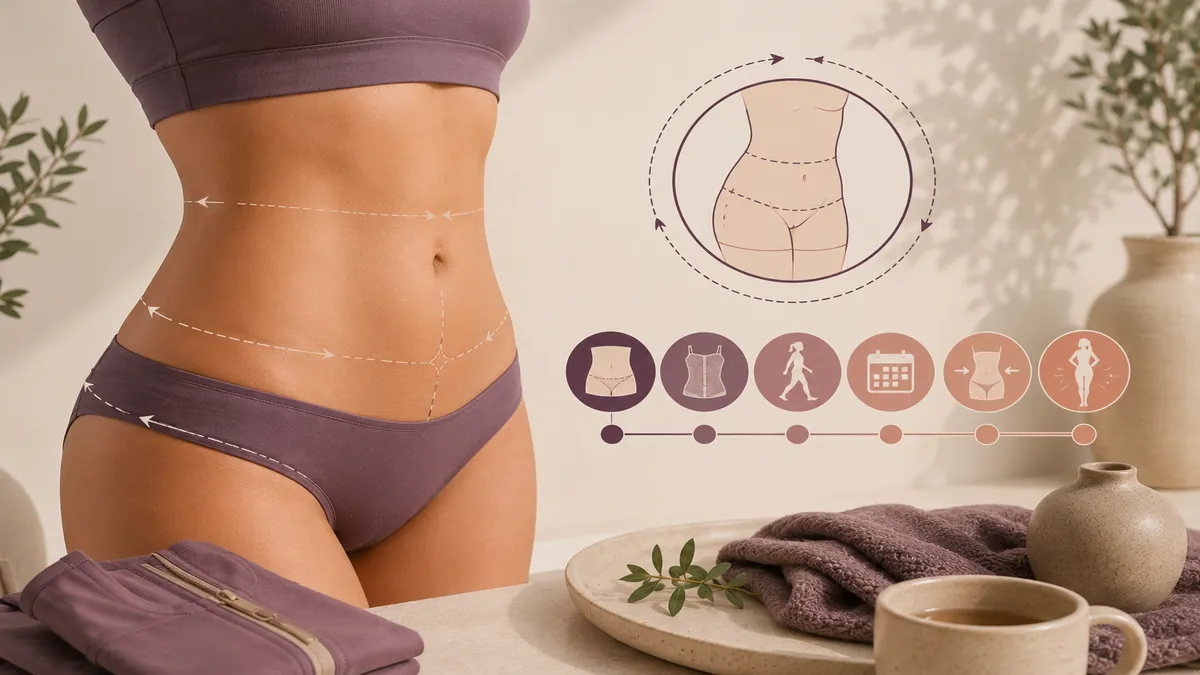
360 tummy tuck before-and-after galleries online show two snapshots: a "before" taken under clinic lighting and an "after" taken at the surgeon's best-case 6- or 12-month follow-up. What they leave out is the 8-to-12-week stretch when the torso looks swollen, the circumferential scar is red and raised, and many patients believe the operation has failed. This guide fills in that gap — walking through what a circumferential abdominoplasty really looks like at each recovery stage, what it can and cannot achieve visually, and how the 360 scar heals differently from the other tummy tuck types. All timelines reflect data from the largest US abdominoplasty safety review, the ACS-NSQIP analysis of 18,891 patients, and the ASPS national statistics.234
What a 360 Tummy Tuck Actually Reshapes
A standard full tummy tuck addresses only the front of the abdomen: the incision runs hip to hip, excess skin is removed from the navel down, and the rectus muscles are tightened. A 360 tummy tuck — also called a circumferential abdominoplasty — continues the incision around the entire circumference of the torso.1 The surgeon removes a belt of excess skin and fat from the front, both flanks, and the lower back in a single procedure. The result is a 360-degree contour improvement that no front-only operation can replicate.
For a detailed comparison of 360 vs reverse techniques, candidacy criteria, and surgical approach, see our reverse & 360 tummy tuck overview. This guide focuses exclusively on the visual timeline of results and what to realistically expect from before-and-after photographs.
360 vs Extended vs Lower Body Lift
These three terms overlap in practice, but each describes a slightly different scope:
| Procedure | Incision scope | Back/buttock component |
|---|---|---|
| Extended tummy tuck | Hip to hip + wraps onto flanks | Flanks only; no posterior lifting |
| 360 tummy tuck | Full circumference, low on hips | Posterior skin excision; minimal buttock lift |
| Lower body lift | Full circumference | Deliberate buttock lift and repositioning |
The visual distinction matters for before-and-after expectations: a 360 tummy tuck will dramatically improve your side and back profile, but it does not lift the buttocks the way a lower body lift does. If gluteal sagging is a primary concern, discuss lower body lift specifically with your surgeon.
Week 0–2: Swelling Dominates Everything
In the operating room, the result looks remarkable — the belt of excess tissue is gone, the waist is defined, and the torso appears sculpted. Within 72 hours, that changes. Swelling peaks between Day 3 and Day 7, and because a 360 procedure involves circumferential dissection, the swelling is more extensive than in a front-only tummy tuck. The entire torso — abdomen, flanks, and lower back — becomes firm, puffy, and uncomfortable.
Bruising tracks with gravity. It appears on days 2–5 and can spread to the mons, upper thighs, lower chest, and buttocks. The compression garment covers the full circumference and is essential — it reduces seroma formation, one of the most common complications identified in the CosmetAssure analysis of 25,478 abdominoplasty patients.2 Sleeping is limited to your back; the posterior incision makes side-sleeping and stomach-sleeping impossible for the first 2–3 weeks.
Drains are common in 360 procedures — typically two anterior and two posterior — and stay in place for 7 to 14 days depending on output volume. The combination of drains, garment, and positional restrictions makes the first two weeks the hardest phase, both physically and psychologically.
Week 3–8: The "Swell Hell" Phase
By week 3, most patients are upright, walking regularly, and feeling significantly better than the first two weeks. But the body does not look better — in many cases it looks worse than the patient's pre-operative body. This is the phase when the swelling is high enough to obscure the result but low enough that the compression garment feels unnecessary (it is still necessary).
Specific things patients notice during swell hell:
- The abdomen appears bloated, especially in the late afternoon and evening. Morning swelling is lower; gravity redistributes fluid during the day.
- The flanks feel hard, and it can seem like the lateral skin was not removed at all. It was — the tissue is swollen.
- The posterior incision itches and pulls. This is nerve regeneration and scar maturation, not a complication.
- The belly button looks odd — too tight, too round, or asymmetric. It is healing under tension and has not settled.
- The scar is bright red and raised around the full circumference. Scar maturation has barely begun.
Patients who compare themselves to 6-month "after" photos during this phase will believe the operation failed. It has not. The body at 6 weeks is approximately 40% of the final result.
Month 3: The First Real Preview
At the 3-month mark, roughly 60–65% of the final circumferential result is visible. The swelling has reduced enough that the new waistline is discernible from every angle — front, side, and back. The flanks have started to soften. The scar is transitioning from bright red to a darker pink.
Key visual changes at 3 months:
- The waist appears defined in clothes and in the mirror.
- Back rolls — one of the primary reasons patients choose 360 over standard — are visibly improved.
- The belly button is approaching its final shape.
- The scar is palpably flatter than at 6 weeks, though still obviously visible.
- Late-day swelling persists — this is normal and may continue to 6 months.
This is the point at which patients begin to feel the operation was worthwhile, but it is not yet the result. The posterior and lateral tissues continue to settle.
Month 6: Near-Final Contour, All 360 Degrees
At 6 months, 85–90% of the final result is visible. Swelling is largely resolved — residual puffiness may appear after long flights, sodium-heavy meals, or extended standing, but it resolves overnight. The circumferential scar has faded from red to pink and is palpably flat in most segments.
The 6-month point is when most surgeons take their "after" photographs. Clinically, the key milestones at 6 months are:
- Full exercise capacity is restored (many patients resume earlier, at 10–14 weeks, per their surgeon's clearance).
- The abdomen, flanks, and lower back feel normal — sensation has largely returned, though some patches of numbness around the incision may persist for 12+ months.
- The torso profile from behind shows a smoother, more defined waist-to-hip transition.
- Any minor irregularities (small dog-ears at the posterior closure, slight asymmetry) are now apparent and can be discussed with the surgeon for revision planning.
Month 12: The True Final Result
At 12 months, the circumferential result is fully stable. All residual swelling is gone. The scar has reached its mature color — typically a flat, pale line in lighter skin or a slightly hyperpigmented line in darker skin. Internal healing is complete: the muscle repair is at full strength, the tissue planes have settled, and the body contour is what you can expect for the long term.
Minor revisions — dog-ear corrections, scar refinement, small liposuction touch-ups — are typically scheduled at 12 to 14 months if needed. The ACS-NSQIP data suggests that reoperation rates for abdominoplasty in general are around 2–3%.3
If you are satisfied with your 12-month result, durability is excellent — provided your weight remains stable. The ASPS notes that abdominoplasty results can be long-lasting when patients maintain their weight.1 Patients who maintain their operative weight within 5–10 lb (2–4 kg) can expect the contour to hold for 10 years or more.
The Circumferential Scar: A 360-Degree Healing Timeline
The scar is the trade-off of a 360 tummy tuck. It is longer than any other abdominoplasty variant — 90 to 120 cm around the full torso — and heals at different rates in different zones. Understanding this prevents unnecessary concern.
Why Different Zones Heal at Different Speeds
The anterior scar (across the lower abdomen) tends to heal fastest because blood supply to this area is robust and tension is moderate. The lateral scars (on the flanks) experience more mechanical stress from twisting and bending, so they may remain raised or reddened slightly longer. The posterior scar (across the lower back) is subject to constant tension from sitting and lies over thicker skin, which can produce a wider scar initially but one that matures well by 12 months.
| Stage | Anterior (front) | Lateral (flanks) | Posterior (back) |
|---|---|---|---|
| Week 0–2 | Red, raised, taped | Red, raised, taped | Red, raised, taped |
| Month 1 | Red-purple, healing | Red-purple, firm | Red-purple, wider |
| Month 3 | Pink, softening | Pink-red, itchy | Pink-red, widest point |
| Month 6 | Fading pink, flat | Pink, flattening | Pink, narrowing |
| Month 12 | Skin-tone, mature | Skin-tone, mature | Light pink, nearly mature |
| Month 18+ | Fully faded | Fully faded | Fully faded |
Scar Care Essentials
Scar management for a 360 incision follows the same principles as any abdominoplasty scar, but the full circumference makes compliance harder. Key steps:
- Silicone strips or gel from week 3 (once the incision is fully closed), applied for at least 12 hours per day for 3–6 months. Circumferential application means multiple strips and potentially silicone gel in areas where strips don't adhere well (posterior curve).
- Sun protection for 12+ months — UV exposure during the first year can permanently darken the scar.
- Avoid tension — no heavy lifting, twisting, or core exercises until the surgeon clears you (typically 8–12 weeks).
- Massage — gentle scar massage from month 2 can help soften raised segments.
For an in-depth scar healing protocol, see our scar healing guide.
What a 360 Tummy Tuck Cannot Fix
Realistic before-and-after expectations require knowing the operation's limits. A 360 tummy tuck cannot:
- Remove visceral (intra-abdominal) fat — this is fat inside the abdominal wall, around organs. Only weight loss addresses it. If your abdomen protrudes despite loose skin removal, visceral fat is the likely cause.
- Prevent weight regain effects — the skin and fat removed are gone forever, but remaining fat cells can expand. Weight gain of 10–15 lb will noticeably change the contour; gain of 20+ lb can substantially reverse the result.
- Survive pregnancy unchanged — subsequent pregnancy stretches the repaired muscles and skin. Most surgeons recommend completing your family before any abdominoplasty.
- Eliminate all cellulite — cellulite is a structural skin issue, not an excess-tissue issue. Skin removal may modestly improve it but will not eliminate it.
- Guarantee perfect symmetry — small differences in scar height, belly button position, or contour between sides are normal and occur even with the most skilled surgeons.
- Replace weight loss — patients with a BMI above 30–32 are generally advised to reach a stable, lower weight before surgery. Operating at higher BMI raises complication rates, as documented in the CosmetAssure complication data.2
Setting Realistic Before-and-After Expectations
The most important predictor of patient satisfaction after a 360 tummy tuck is not the surgical technique — it is the expectation the patient brought into the operating room. Three principles help set those expectations:
1. The Timeline Is Non-Negotiable
No amount of compression, massage, supplements, or scar cream will accelerate the biological healing timeline. Swelling resolves at its own pace. Patients who understand that the 3-month mark is a preview — not a verdict — handle the recovery with far less anxiety. The operation delivers its result gradually, not immediately.
2. Online Photos Are Curated
Before-and-after galleries on surgeon websites and social media are marketing materials, not clinical documentation. They show best-case outcomes under optimal lighting, often on patients with ideal anatomy (good skin elasticity, moderate laxity, stable weight). Your result will be uniquely yours. Comparing your 8-week appearance to a curated 12-month result photograph is a recipe for unnecessary distress.
3. Combined Procedures Affect the Timeline
A 360 tummy tuck is frequently combined with liposuction (flanks, back, inner thighs) or breast surgery. Combined procedures increase total swelling and extend the time to final result. If you had simultaneous liposuction to the flanks, those areas may take an additional 1–2 months to resolve compared to skin-only excision areas. The CosmetAssure data also shows that combined procedures carry modestly higher complication rates.2
Reverse Tummy Tuck Before and After: How It Differs
A reverse tummy tuck is a different operation that addresses the upper abdomen rather than the lower. The incision is placed under the breast crease (inframammary fold), and excess skin is pulled upward and removed. The result is an upper-abdominal contour improvement with the scar hidden in the breast fold. It is much less common than standard or 360 abdominoplasty and is typically indicated for patients with upper abdominal laxity but a relatively normal lower abdomen.
Before-and-after expectations for a reverse tummy tuck differ substantially from a 360:
- Scar location: under the breast fold (not around the waist).
- Swelling pattern: concentrated in the upper abdomen and chest, not circumferential.
- Recovery: generally shorter — 2 weeks to desk work, 6–8 weeks to exercise.
- Contour change: upper-abdominal only; lower abdomen and flanks are unaffected.
For a full comparison of 360 and reverse techniques, see our reverse & 360 tummy tuck technical overview.
Long-Term Durability: What Keeps Results Looking Good
The ASPS emphasises that abdominoplasty results can be long-lasting with proper maintenance.1 In practice, the three factors that most influence the durability of a 360 tummy tuck result are:
- Weight stability — remaining within 5–10 lb (2–4 kg) of your operative weight. This is the single most important factor.
- Core strength maintenance — regular core exercise (once cleared) supports the muscle repair and helps maintain the contour.
- No subsequent pregnancy — pregnancy partially reverses the diastasis repair and stretches the tightened skin. Completing family before surgery is strongly recommended.
Patients who maintain stable weight report high satisfaction rates 5, 10, and even 15 years after surgery. The ASPS national statistics indicate that abdominoplasty remains one of the top 5 cosmetic surgical procedures in the US, reflecting sustained patient demand and satisfaction.4
FAQ
How long does it take to see 360 tummy tuck results?
You will see a meaningful preview at 3 months, a near-final result at 6 months, and a fully stable result at 12 months. The circumferential scar continues fading for 12 to 18 months. What you see at 3 weeks — swollen, bruised, tight, sometimes asymmetric — is not the result. 360 patients often go through a difficult "swell hell" phase in the 6–12 week window before the true contour emerges. Photos taken by patients on their phone in the first month rarely reflect the final outcome.
What does a 360 tummy tuck scar look like after 1 year?
A flat, pale line (lighter skin) or slightly hyperpigmented line (darker skin) that runs the full circumference of the torso, sitting low enough to be hidden by underwear or swimwear. Total length is typically 90 to 120 cm. Scar quality depends on genetics, sun protection, and silicone-based scar care.
Is a 360 tummy tuck the same as a lower body lift?
They overlap but are not identical. A 360 tummy tuck removes a circumferential belt of excess skin. A lower body lift adds a deliberate buttock-lifting and reshaping component. Many surgeons use the terms interchangeably, but a true lower body lift includes gluteal contouring that a pure 360 tummy tuck does not.
Can a 360 tummy tuck fix my back rolls?
Yes — this is one of its primary advantages over standard or extended TT. The circumferential incision allows the surgeon to excise loose skin on the posterior flanks and lower back. Adding liposuction to the posterior flanks enhances the result further.
How does 360 tummy tuck recovery compare to standard TT?
Longer. Expect 3–4 weeks before desk work (vs 2 for standard), 10–14 weeks before full exercise (vs 6–8), and more positional discomfort from the posterior incision in the first 2 weeks. Total healing to final result is 12 months for both.
What can a 360 tummy tuck NOT fix?
Visceral (internal) fat, future weight gain, cellulite, or perfect symmetry. Patients with BMI above 30–32 are generally advised to lose weight first. Pregnancy after the operation partially reverses the result.