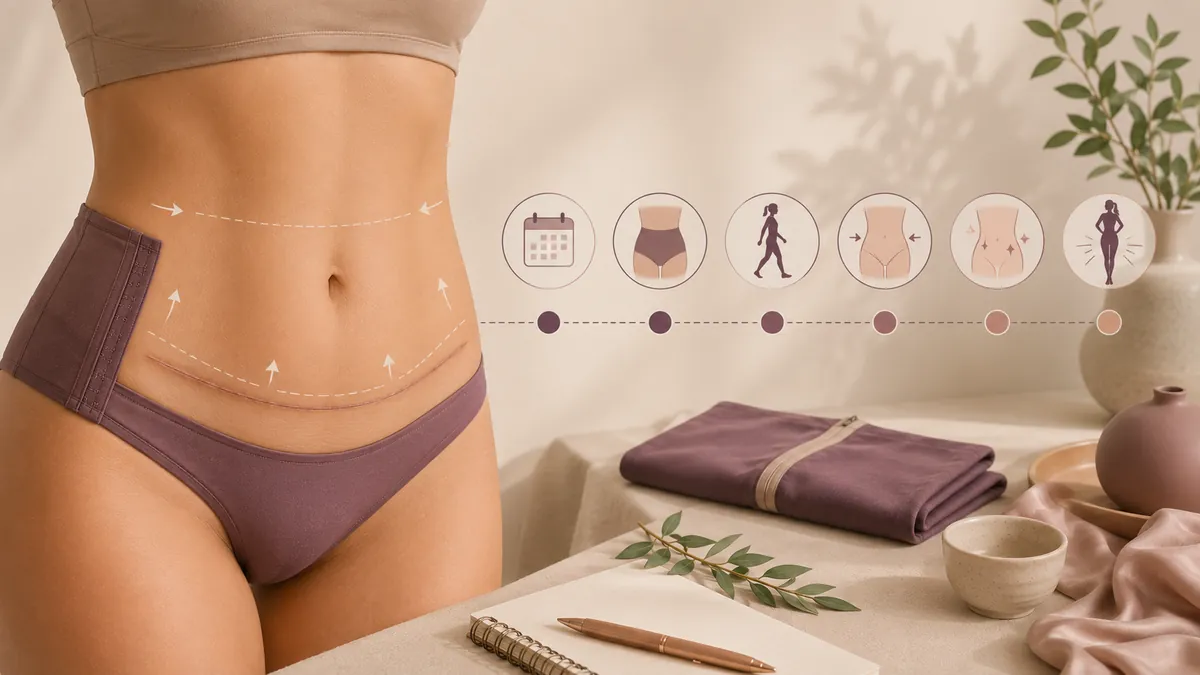
Extended tummy tuck before-and-after photos on the internet skip the phase every real patient lives through: the 8-week stretch when the abdomen looks worse than before, the scar is red and raised, and the swelling makes the result seem to have failed. Among the various tummy tuck types, the extended version produces one of the most dramatic transformations — but also one of the longest visual recoveries. This page walks through what an extended tummy tuck actually looks like at each stage — from the operating room, through the six-month "swell hell", to the durable one-year result the operation is judged on. All timelines below reflect data from the largest US abdominoplasty safety review, the ACS-NSQIP analysis of 18,891 patients, and the ASPS national statistics.234
What the "Extended" Part Actually Does
A standard full tummy tuck's incision goes from one hip bone to the other. An extended tummy tuck's incision continues onto the flanks and can wrap around toward the lower back. That extra length is not decorative — it is what allows the surgeon to excise the loose skin over the love handles and reshape the flank contour.1 If your primary concern is the roll of skin that hangs over your waistband when you sit down, a standard full tummy tuck will not address it and an extended one will.
Detail on candidacy for extended vs standard is on our extended tummy tuck cluster page. This guide is specifically about the visual timeline of results.
Week 0–2: The "Nothing Looks Right Yet" Phase
Immediately after surgery, the abdomen is flatter than you expected in the operating room but rapidly gets worse over 72 hours as swelling peaks. By Day 3 to Day 7, the abdomen is often larger and firmer than your pre-op abdomen. This is normal. Bruising appears on days 2–5 and can extend to the mons, upper thighs, and lower chest as gravity pulls it down. The compression garment is uncomfortable but non-negotiable — it is one of the specific measures shown to reduce seroma formation in the abdominoplasty complication literature.2
Week 3–6: The Bumpy Middle
By 3 weeks most patients can return to desk work and feel meaningfully better. The abdomen is still swollen; the scar is raised, red, and firm; the belly button often looks odd because it is healing under tension. Patients frequently panic here — the reality does not match the before-and-after photos they saw before booking. The abdomen at 3 weeks is not the result. Continue garment wear, walk daily, resist the temptation to compare to online photos of 6-month results.
Month 3: First Genuine Preview
At the 3-month mark, roughly 60% of your final result is visible. Swelling has come down enough that you can see the new waist and flank contour. The scar is still visibly pink or red but is starting to soften. The belly button has begun to look normal. Clothes fit differently. This is the point at which most patients start to think "OK, this worked."
Month 6: Near-Final Contour
At 6 months, 85–90% of your final result is visible. Swelling is largely resolved — there may still be some intermittent lower-abdominal fullness after long days or long flights. The scar is fading from red to pink to skin-tone. The abdomen feels normal, no longer numb, no longer tight. Exercise is back to full capacity if you're following the standard protocol. This is the point at which surgeons typically take the "after" photograph for their portfolios.
Month 12: True Final Result
At 12 months, the result is stable. Any residual swelling is gone. The scar has faded to its final color and texture (further fading may continue to 18 months). The abdomen is fully healed internally — the muscle repair is at full strength, the umbilicus is settled, the flanks have stabilized. Any revisions (small dog-ear touchups) are typically scheduled at 12–14 months. If you like your result at 12 months, you will like it at 5 years and 10 years — provided your weight stays stable and you do not become pregnant.
What an Extended TT Cannot Fix
Realistic expectations require knowing what the operation cannot do:
- Visceral (intra-abdominal) fat — this is inside the abdominal wall and requires weight loss.
- Poor skin quality — heavy stretch marks or thin, damaged skin will still be present after healing.
- Weight regain — the fat cells removed are gone forever, but the ones remaining can expand.
- Pregnancy-proof result — subsequent pregnancy partially reverses the muscle repair.
- Perfect symmetry — small asymmetries in scar height, belly button position, or contour are normal.
- Erase all lower-abdominal fat — significant fat volume typically requires added liposuction.
Scar Progression (What to Actually Expect)
- Week 0–2: raised, red, tender, tape or steri-strips in place
- Month 1: still raised, red-purple, edges healed
- Month 3: flatter, pink, itchy phase
- Month 6: soft, pink, palpably flat, sun protection critical
- Month 12: skin-tone or light pink, fully mature, permanent
- Month 18+: minor additional fading in fair skin
Scar-management fundamentals — silicone strips or gel from week 3, strict sun protection for 12+ months — are the same for extended TT as for standard, and are detailed on our scars cluster page and 5-year scar guide.
FAQ
When will I see my final extended tummy tuck result?
Final contour result: 6 to 12 months. Swelling is meaningful at 3 months, largely resolved at 6, fully resolved at 12. The scar continues to fade for 12 to 18 months.
How long is the extended tummy tuck scar?
The extended tummy tuck scar typically runs 60 to 90 cm across the lower abdomen and onto the flanks, depending on your body dimensions and how much horizontal skin excess needs to be addressed. It is meaningfully longer than a standard full tummy tuck scar (40–60 cm) but shorter than a fleur-de-lis, which adds a vertical component. Placement is designed to sit within underwear or swimwear whenever possible, though the flank extensions can sometimes appear above bikini lines.
Will an extended tummy tuck get rid of my love handles?
Yes — this is the specific reason to choose extended over standard full. The extended incision continues past the hips onto the flanks so that loose skin and fat over the "love handles" (posterior iliac region) is excised and pulled taut with the abdominal closure. Adding liposuction to the flanks at the same operation further enhances the contour by removing residual fat that the skin resection alone doesn't address. For circumferential (front-and-back) issues, a 360 body lift may be more appropriate — see our reverse & 360 guide.
How does the extended TT scar compare to a full TT scar at 1 year?
At 1 year, both scars follow the same maturation curve — raised and pink through months 0–6, then flattening and paling through 6–12, mature at 12–18 months. Color and texture are similar. The main difference is length: the extended scar wraps further onto the flanks, so more of its length ends up in areas that swimwear may not cover. Silicone-based scar therapy started at week 3–4 helps the appearance of both. In darker skin types, hyperpigmentation is more common along the flank portions.
Is recovery from an extended TT longer than a full TT?
Only slightly. Return to desk work is typically 2–3 weeks (similar to standard full). Standing fully upright takes 2–3 weeks. Return to unrestricted exercise moves to 8–12 weeks, versus 6–8 for a standard full. The extended incision length means slightly more wound area to heal but the deep tissue work (muscle repair, undermining) is the same. Most patients don't notice a dramatic difference day-to-day. Our full recovery timeline covers the shared milestones.
Can extended TT results reverse if I gain weight?
Yes, meaningfully. A tummy tuck removes skin and fat but does not remove the underlying fat cells throughout the body. If you gain weight after surgery, the remaining fat cells can expand, including in the abdominal wall and flanks — potentially creating new laxity and undoing much of the contour improvement. Stable weight within 5–10 lb (2–4 kg) of your surgical weight is the single biggest determinant of long-term result. Wait until your weight has been stable for 6+ months before surgery.