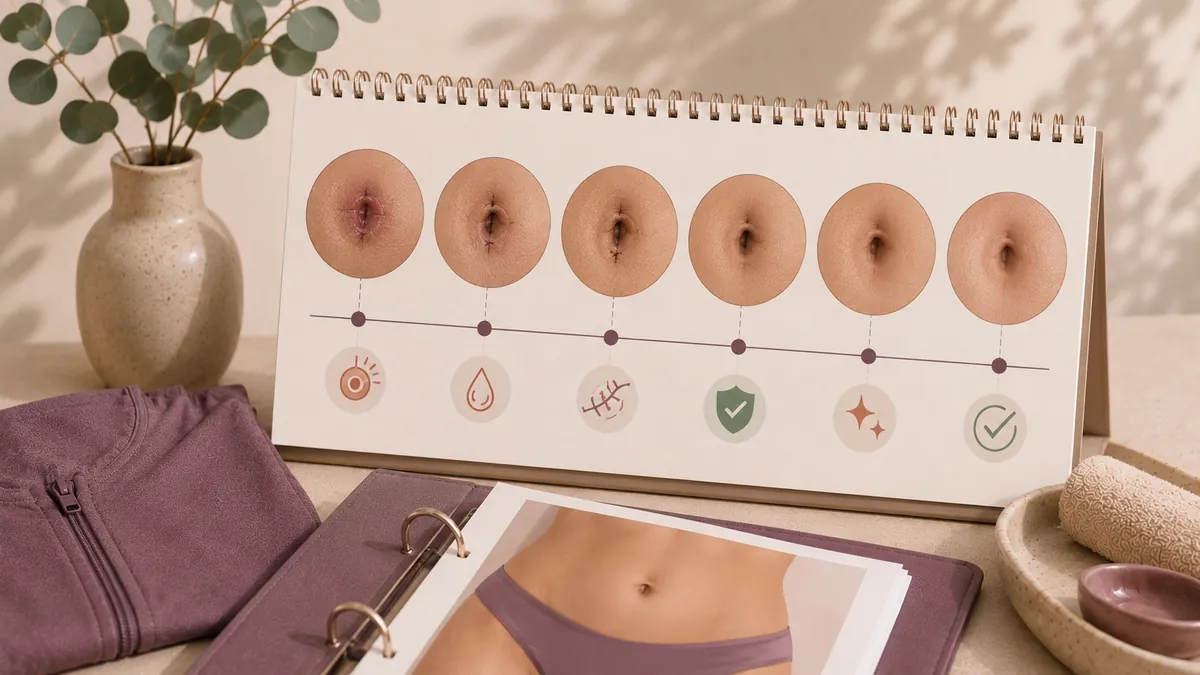
Why the Belly Button Changes During a Tummy Tuck
During a full abdominoplasty, the surgeon does not remove the belly button. The navel stalk — the tube of tissue connecting the umbilicus to the abdominal wall — remains intact. What changes is the surrounding skin: after the excess abdominal skin is excised and the remaining skin flap is pulled downward, the surgeon cuts a new hole in the repositioned skin and brings the navel stalk through it, suturing it to the new opening. This is why the belly button effectively has a fresh surgical wound even though the navel itself was never detached internally. The ASPS procedure description confirms this approach as standard for full abdominoplasty.1
The result is a belly button that needs to heal through the same stages as any incisional wound: inflammation, proliferation, and remodeling — except it is healing under tension, in a concave space, and around a 360-degree incision. This explains why navel healing takes significantly longer than the main hip-to-hip scar and why most patients find the belly button the last thing to "look normal." For a broader overview of belly button recovery, see our belly button recovery cluster page, and for the full post-operative picture, consult our complete recovery guide.
Week 1: Immediate Post-Op
What it looks like: The belly button is swollen, often unrecognisable. The opening is packed with gauze or covered with a bolster dressing (a foam plug held with sutures) to maintain depth and shape during initial healing. The surrounding skin is taut, bruised, and edematous. The stalk itself may appear dark red or purple due to surgical handling. Sutures are visible — either interrupted nylon sutures at the skin edges or buried absorbable sutures depending on surgeon preference.
What is normal: Serosanguinous drainage (thin pinkish fluid) from the navel wound, mild-to-moderate pain around the belly button, difficulty seeing the actual shape due to dressings and swelling. The entire mid-abdomen is firm and distended — the belly button sits in this swollen landscape and looks worse for it.
What is not normal: Heavy bright-red bleeding that saturates dressings, spreading erythema (redness extending more than 1–2 cm from the wound edge), foul-smelling discharge, or tissue turning grey/black. These require same-day surgeon contact.
Week 2: Sutures Dissolving, Swelling Persisting
What it looks like: Bolster dressing is typically removed at 7–10 days, revealing a belly button that looks shallow, wide, and round. The skin edges are pink-red and slightly raised. Mild crusting is common where sutures dissolve or where dried serous fluid accumulates. The surrounding abdominal skin is still shiny and tight from swelling. Many patients describe the navel as looking "flat" or "stuck on" at this stage.
What is normal: The belly button appearing too large, too shallow, or asymmetric. Minor wound-edge crusting that lifts off with gentle saline cleaning. Itching around the suture sites. Continued abdominal firmness. Numbness around and inside the navel (nerves were disrupted and will regenerate over months).
What is not normal: Wound edges separating more than 2–3 mm (partial dehiscence), pus (thick yellow-green discharge with odour), increasing pain rather than gradually decreasing pain, or a fever above 38°C / 100.4°F.
Month 1: Early Remodelling Begins
What it looks like: The belly button is beginning to take shape but remains swollen and round. The incision line around the navel is a raised, pink-to-red scar. The surrounding skin has softened slightly but is still noticeably tighter than normal. Depth is developing — the navel is no longer flat against the skin surface but is not yet at its final depth. Patients often describe it as looking like a "smiley face" or a "round hole" rather than a natural navel at this stage.
What is normal: The belly button looking round (not yet oval). Scar tissue feeling firm or ropy around the edges. Intermittent itching deep inside the navel. The navel being slightly higher or lower than expected (final position settles as swelling resolves). Small areas of numbness persisting around the navel.
Care at this stage: Scar management begins now. Silicone strips or gel applied to the navel incision line once the wound is fully closed (no open areas, no scabs). This is the critical window — starting silicone at week 3–4 has the greatest impact on final scar quality. Sun protection is mandatory; any UV exposure to the fresh scar risks permanent hyperpigmentation.
Month 3: First "Looks Normal" Milestone
What it looks like: At 3 months, most patients have a belly button that passes casual inspection. The round shape is beginning to narrow into a vertical oval. The scar around the navel has transitioned from red to pink. Depth has increased as swelling resolved and the stalk settled into its pocket. The surrounding abdominal skin feels more natural and less drum-tight. In clothing, the navel contour looks normal.
What is normal: A lingering pink hue to the scar (not yet skin-tone). Mild asymmetry between left and right sides. The upper hood of the navel being slightly more defined than the lower border. Occasional "pulling" sensations during exercise or stretching — this is scar tissue, not a structural problem.
What to expect next: Between months 3 and 6, the scar contracts and softens further. The shape continues to narrow. For a week-by-week breakdown of every recovery milestone, see our recovery timeline. Patients who felt their belly button was "too round" at month 1 typically see meaningful improvement by month 3 and further improvement to month 6. The complication literature from the ACS-NSQIP database (18,891 abdominoplasty patients) shows that most wound-healing endpoints are reached by 90 days, though cosmetic refinement continues well beyond.3
Month 6: Near-Final Appearance
What it looks like: The belly button at 6 months is 85–90% of its final result. The shape is a natural-looking vertical oval (or the patient's genetic variant — some people naturally have round navels). The scar has faded from pink to light pink or near-skin-tone. Depth is established. The tissue is soft and pliable — no more firmness from early scar tissue. The surrounding abdominal skin has fully softened and no longer appears shiny or taut.
What is normal: Minor residual pinkness in patients with very fair skin (blondes, redheads fade slowest). A thin white line where the incision was — this is the mature scar. Slight textural difference between the inner navel skin and the outer abdominal skin. Full sensation may not yet have returned to the area immediately inside the navel.
At this point, surgeons assess whether the result is acceptable or whether minor revision will be needed. If the shape, depth, or scar quality is not satisfactory at 6 months, the surgeon will typically recommend waiting until 12 months before performing any revision — allowing full scar maturation before intervening.
Month 12: Final Result
What it looks like: The belly button has reached its permanent shape, depth, and color. The scar is mature — flat, soft, and skin-tone (or a thin white line in fair-skinned patients). The navel sits naturally within the abdominal contour. Sensation has returned to normal or near-normal in most patients. Any further change from this point is negligible unless significant weight fluctuation occurs.
Assessment at 12 months: This is the standard revision-eligibility milestone. If the patient is unhappy with the shape, size, depth, or scarring of the belly button at 12 months, umbilicoplasty revision can be discussed. The tissues are fully healed, scar tissue is mature, and the surgeon can predict exactly what a revision will accomplish.
Normal vs Concerning: The Complete Guide
The following table summarises what is expected at each stage versus what warrants a call to your surgeon. The complication data draws from the CosmetAssure database of 25,478 abdominoplasty cases2 and the ACS-NSQIP analysis.3
| Sign | Normal (Expected) | Concerning (Contact Surgeon) |
|---|---|---|
| Drainage | Clear or light pink (serous) for 1–2 weeks | Yellow-green, foul-smelling, or increasing after day 5 |
| Redness | Pink/red within 1 cm of incision edges | Spreading redness beyond 2 cm, hot to touch, streaking |
| Swelling | Moderate for 4–8 weeks, gradually decreasing | Sudden increase after initial improvement, localized fluid collection |
| Pain | Decreasing daily from day 3 onward | Increasing pain after initial improvement, throbbing, pulsating |
| Shape | Round for 3–6 months before narrowing | Tissue retracting inward (buried navel), edges pulling apart |
| Color | Pink/red transitioning to skin-tone over 6–12 months | Grey, black, or white tissue (possible necrosis or poor blood supply) |
| Sensation | Numbness for 3–9 months, gradual return | No return of any sensation after 12 months (rare, not dangerous) |
Common Belly Button Complications
Navel-specific complications after abdominoplasty are relatively common cosmetically but rarely dangerous. The ASPS notes that the belly button is the most aesthetically scrutinised element of abdominoplasty results.1 Below are the most frequent issues patients report.
Too Round / Unnatural Shape
The single most common complaint. A natural belly button is typically a slightly vertical oval with a defined upper hood (a small fold of skin shadowing the top of the navel). After tummy tuck, the new skin opening is cut as a circle, and scar contraction is relied upon to reshape it into an oval over 6–12 months. In some patients — particularly those with thick skin or aggressive scar formation — the circular shape persists.
Timeline for concern: Before 6 months, a round shape is normal and expected. If the belly button remains perfectly circular at 12 months with no upper-hood formation, revision is an option.
Visible Periumbilical Scar
The incision around the belly button is a full-thickness wound. In patients prone to hypertrophic scarring, the circular scar can remain raised, pink, and visible long-term. This is more common in patients with darker skin tones (Fitzpatrick IV–VI) who are genetically predisposed to hypertrophic scarring.
Management: Silicone sheeting or gel from week 3, continued for 6–12 months. If the scar remains hypertrophic at 6+ months, steroid injection (triamcinolone) into the scar tissue can flatten it. Laser scar treatment is an option at 12+ months for persistent redness or texture. For a longer-term perspective on how scars evolve, see our guide on tummy tuck scars after 5 years.
Too Tight / Too Small
Some patients find the belly button opening contracts excessively during healing, leaving a navel that appears pinched, too small, or slit-like. This is the result of aggressive scar contraction in the periumbilical tissues. It is more common when the initial skin opening was cut conservatively (small) — a trade-off some surgeons make to avoid the "too large" outcome.
Management: If identified early (month 2–3), gentle scar massage and silicone application may prevent further contraction. If established at 12 months, a small revision can widen the opening.
Too Shallow / Flat
A belly button that lacks depth — appearing "stuck on" or "flat" rather than naturally recessed — can result from the stalk being sutured too superficially, excessive scarring filling the depth, or the tension of the pulled-down skin flap flattening the navel pocket. Some depth typically develops as swelling resolves (months 2–4), but if the belly button remains flat at 12 months, revision can deepen it.
Stenosis (Closure)
In rare cases, the belly button opening narrows to the point of near-closure. This is an extreme form of scar contraction and occurs in fewer than 1–2% of patients. It is managed surgically — the scar tissue is released and the opening reconstructed.
Minor Wound Separation (Partial Dehiscence)
Small areas (2–5 mm) where wound edges separate are not uncommon, particularly at the lower border of the navel where tension is highest. These typically heal by secondary intention (the body fills the gap with granulation tissue) without intervention, though the resulting scar may be slightly wider in that area. Complete dehiscence — the belly button opening entirely — is rare and usually indicates infection or blood supply compromise.
Belly Button Care Instructions by Phase
Days 1–14 (Wound Phase)
- Follow surgeon's dressing protocol exactly — do not remove bolster early.
- Keep the navel dry until instructed otherwise (typically no shower for 48–72 hours; no bath/pool for 4–6 weeks).
- Clean gently with saline or dilute hydrogen peroxide as directed — do not pick at crusts.
- Wear compression garment continuously; it supports the navel stalk position.
- Sleep on your back, slightly flexed at the hips (reduces tension on the navel).
Weeks 3–12 (Scar Maturation Phase)
- Begin silicone gel or strips once the wound is fully closed (no scabs, no open areas).
- Apply SPF 50+ to the belly button scar if any sun exposure is possible — a scar that tans will remain darker permanently.
- Gentle scar massage (circular, with silicone gel) for 5 minutes daily starting at week 4–6.
- No heavy abdominal exercises (crunches, planks) until surgeon clears — typically 6–8 weeks.
- Continue compression garment as directed (usually 6–8 weeks, some surgeons longer).
Months 3–12 (Long-Term Optimisation)
- Continue silicone and sun protection for the full 12 months — this is when the scar is still actively remodeling.
- Resume all normal activities including core exercises once cleared.
- Monitor shape: if the belly button is "too round" at 6 months, discuss revision timeline with surgeon.
- Avoid belly button piercings for a minimum of 12 months (ideally never — the tissue is scarred and blood supply is compromised).
Revision Options (Umbilicoplasty)
Umbilicoplasty — surgical revision of the belly button — is a minor procedure that addresses shape, depth, scar quality, or size concerns that persist after full healing. It is typically performed:
- Timing: 12+ months after the original tummy tuck (full scar maturation required).
- Anaesthesia: Local anaesthesia with or without sedation — rarely requires general.
- Duration: 30–60 minutes.
- Recovery: 1–2 weeks of light dressings; minimal downtime; results visible at 3–6 months post-revision.
- Cost: Typically a fraction of the original tummy tuck cost; varies by complexity.
Common revision techniques include: excising the circular scar and creating a vertical-oval opening (for "too round"), releasing scar contracture and placing a bolster to deepen the pocket (for "too shallow"), or Z-plasty/W-plasty to break up a visible linear scar into a less noticeable pattern. The ASPS procedure overview notes that minor revisions are a normal part of the abdominoplasty process and do not indicate a failed primary surgery.1
Frequently Asked Questions
How long does it take for the belly button to heal after a tummy tuck?
The belly button takes 6 to 12 months to reach its final appearance. Initial wound closure happens within 2–3 weeks, but swelling, redness, and shape changes continue evolving for up to a year. Most patients see a presentable result by 3–4 months.
What should a belly button look like 2 weeks after a tummy tuck?
At 2 weeks, the belly button is swollen, possibly bruised, and the surrounding skin is tight and shiny. Sutures may still be visible. The shape appears round, shallow, and slightly larger than it will ultimately be. Mild crusting around the incision edges is normal.
Is it normal for the belly button to look weird after a tummy tuck?
Yes, completely normal in the first 3–6 months. The belly button typically looks too round, too shallow, too tight, or asymmetric during early healing. It needs months of settling and scar maturation before it looks natural.
When should I worry about my belly button after a tummy tuck?
Contact your surgeon if you notice: spreading redness or hot skin, foul-smelling yellow-green discharge, fever above 38°C / 100.4°F, wound edges separating more than 2–3 mm, or tissue turning dark/black. These warrant urgent evaluation.
Can a bad belly button result be fixed after tummy tuck?
Yes. Umbilicoplasty revision is a minor procedure typically performed under local anaesthesia at 12+ months post-op. Common fixes include reducing scar width, deepening a too-shallow navel, correcting asymmetry, or reshaping an overly round opening.
Why does my belly button look so round after a tummy tuck?
The surgeon creates a circular opening in the abdominal skin to bring the stalk through. As swelling resolves and scar tissue contracts over 6–12 months, the shape typically narrows into a more natural vertical oval. If it remains too round at 12 months, minor revision can reshape it.
Do you get a new belly button with a tummy tuck?
You keep your original belly button — the umbilical stalk stays attached to the abdominal wall throughout the operation. What is created is a new opening in the drawn-down abdominal skin for the existing umbilicus to come through. So the belly button itself is not replaced; only its skin surroundings are repositioned. Mini tummy tucks skip this step because they don't undermine the skin above the navel.
Will there be a scar around the belly button?
Yes. A full tummy tuck leaves a small circular or oval scar where the repositioned umbilicus meets the new skin opening. It follows the same 12–18 month maturation as the main horizontal scar — raised and pink through months 0–6, then flattening and paling. Silicone gel or sheeting once the wound is sealed helps it mature well. Mini tummy tucks do not create this scar because the belly button is not repositioned.
Does a mini tummy tuck move the belly button?
No. A mini tummy tuck works only below the belly button, so the umbilicus and the skin around it are not disturbed. There is no circular umbilical scar and no umbilical necrosis risk. The trade-off: the mini leaves the belly button untouched but cannot address skin laxity or muscle separation above it. If your loose skin extends above the navel, a full tummy tuck is required.