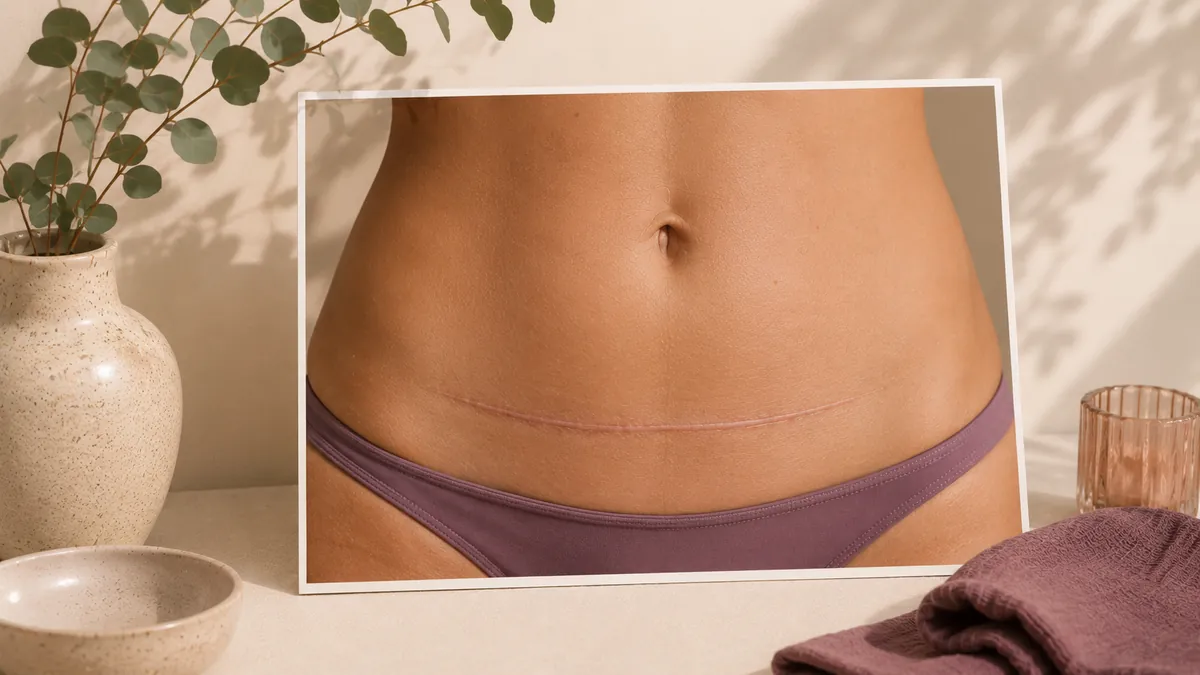
Every tummy tuck patient asks the same question at some point: what will my scar actually look like years from now? This guide is the honest long-term answer — a companion to our full recovery overview. Scars fade — meaningfully. They also don't disappear. Knowing what to realistically expect at each stage (and what determines whether you end up on the good or bad end of the spectrum) is one of the most useful things you can know both before deciding to have surgery and after.
The Full Maturation Timeline
Scar maturation follows a fairly predictable biological sequence — collagen deposition, remodeling, and pigmentation changes over months and years:
| Timepoint | Typical appearance | What's happening |
|---|---|---|
| 0–6 weeks | Fresh, red, sometimes raised; sutures/tape | Wound closure, collagen deposition |
| 3 months | Red, raised, firm; can be itchy | Peak of scar hyperactivity |
| 6 months | Beginning to fade; softer; still visible | Remodelling accelerating |
| 12 months | Pale pink, flat in most; texture soft | Most visible improvement done |
| 18 months | Pale, close to surrounding skin color | Continuing refinement |
| 2 years | Thin pale line in favorable cases | Slower change beyond this |
| 5 years | Mature: thin, pale, flat, often hidden | Fully mature scar |
| 10+ years | Similar to 5-year appearance | Minimal further change |
The critical insight: most of what your 5-year scar looks like was determined in the first 12 months — through initial wound quality, sun exposure, scar care adherence, and genetic response. A poorly cared-for first year rarely produces a great 5-year scar.
What Affects Long-Term Scar Quality
Genetics and skin type
The single biggest factor you cannot change. Some patients scar beautifully regardless of what they do; others scar poorly regardless. Patients with darker skin tones (Fitzpatrick IV to VI) have higher rates of hypertrophic scarring and hyperpigmentation. Patients with a family history of keloids are at elevated risk of keloid formation. Ashkenazi Jewish, African, and Asian ancestry have documented elevated hypertrophic scar rates in the literature.4
Surgical technique
The base scar quality is set by the surgeon:
- Precise wound edge approximation.
- Tension-free closure — tension is the enemy of scar quality.
- Multi-layer closure (deep sutures + skin closure) distributes tension.
- Suture material and technique selection.
- Incision placement low enough to be hidden by underwear/swimwear.
Choosing an experienced board-certified plastic surgeon with meaningful abdominoplasty volume is the single biggest surgeon-side decision you make.
Wound complications in the first weeks
Infection, dehiscence (wound separation), delayed healing, or seroma all lead to wider, more visible scars. This is another reason to take post-op care seriously — problems in weeks 1–4 produce visible scars at year 5.
Sun exposure
UV exposure to a scar in the first year causes permanent hyperpigmentation — the scar becomes darker than surrounding skin and stays that way. This is especially important because the scar is in the lower abdomen where it may not be regularly protected. Rules of thumb:
- Physical cover (clothing, high-waisted swim bottoms) for the first 3–6 months whenever the scar might be exposed to sun.
- SPF 30+ sunscreen every day if there's any chance of UV exposure, for the first 12 months minimum.
- Extra caution on beach holidays in the first year.
Smoking
Smoking impairs wound healing at the cellular level (reduced oxygen delivery to healing tissue, vascular constriction, impaired collagen synthesis). Smokers have meaningfully worse scars than non-smokers, all else equal. Complete cessation before surgery and for at least 6 months post-op is the standard recommendation.
Scar care
Published Cochrane evidence supports silicone sheeting or silicone gel as effective scar care in the first year post-op.2 The protocol:
- Start at 4–6 weeks post-op (once the wound is fully closed).
- Silicone sheeting: 12+ hours daily for 3–6 months.
- Silicone gel (easier compliance): applied twice daily, letting it dry, for 3–6 months.
- Continue longer if the scar is hyperactive at 6 months.
Vitamin E oil, cocoa butter, and other "scar creams" without a silicone base have weaker evidence and are generally less recommended by dermatologists and plastic surgeons.
Weight stability
Significant weight fluctuation post-op stretches or thickens scars. Weight loss after tummy tuck can leave the scar looking "loose" if a lot of skin has been removed; weight gain can widen the scar. Stable weight for at least the first year is important.
What a Well-Healed Scar Looks Like at 5 Years
The typical favorable 5-year appearance:
- Location: horizontal line low on the lower abdomen, typically at or below the underwear line (hip-to-hip).
- Width: 2–5 mm.
- Color: pale pink to matching skin tone; may be slightly lighter or darker than surrounding skin.
- Height: flat (no raised appearance).
- Texture: soft, pliable, similar to surrounding skin.
- Visibility: not immediately obvious; visible on close inspection or in specific lighting.
- Umbilical scar: circular scar around the belly button; similar characteristics at 5 years — for the earlier maturation phases of this scar specifically, see our week-by-week belly button healing guide.
Full scar care detail for the first year in our recovery scars guide.
Less Favourable Long-Term Outcomes
Not every scar matures ideally. Common less-favorable patterns and what to do about them:
Wide scar
A stretched or spread scar wider than 5–10 mm. Often related to wound tension or genetic factors. Can be revised (re-excised and re-closed) once mature (typically 12+ months post-op).
Hypertrophic scar
Raised, red, firm scar that stays within the original wound margins. Can be improved with silicone, steroid injections, or laser therapy. May benefit from surgical revision if severe.
Keloid scar
Raised, growing scar that extends beyond the original wound margins. More common in patients with darker skin tones or family history of keloids. Treatment: steroid injections, silicone, sometimes surgical revision followed by immediate steroid injection or radiation therapy. Prevention via preoperative discussion in high-risk patients.
Hyperpigmentation or hypopigmentation
Scar significantly darker (hyperpigmentation, often from sun exposure) or lighter (hypopigmentation, sometimes long-term) than surrounding skin. Treatment: laser therapy for hyperpigmentation; camouflage tattooing for hypopigmentation.
Revision and Improvement Options
If your 5-year scar is problematic, several options exist — often used in combination for best results (ASPS scar revision):3
| Option | Best for | Typical cost |
|---|---|---|
| Silicone (topical) | Ongoing scar management | $20–$100/tube |
| Steroid injections | Hypertrophic, keloid | $100–$300 per session |
| Fractional CO2 laser | Texture, color, general improvement | $500–$1,500 per session (multi-session) |
| Pulsed-dye laser | Persistent redness | $300–$700 per session |
| Microneedling | Texture improvement | $300–$800 per session |
| Scar revision surgery | Wide, poorly placed, or complicated scars | $2,000–$5,000 |
| Camouflage tattooing | Color matching | $500–$2,000 |
The goal is meaningful improvement — not disappearance. Scars can be made much less noticeable but cannot be truly removed.
FAQ
Do tummy tuck scars fade over time?
Yes, meaningfully — but they never disappear entirely. The maturation follows a fairly predictable timeline: at 3 months, scars are typically red, raised, and firm; at 6 months they begin to soften and flatten; at 12 months most of the visible improvement has occurred, with scars becoming pale, thin, and flat in most patients;1 at 2 to 5 years they continue to fade in color and refine but change less dramatically. By 5 years, a well-healed tummy tuck scar in most patients is a thin, pale, flat line that is much less noticeable than at 3 or 6 months — but still visible on close inspection. Patients whose scars mature poorly (hypertrophic, keloid, or wide scars) will still see some improvement by year 5 but generally not full resolution without revision or laser treatment.
What do tummy tuck scars look like after 5 years?
In most patients, a mature 5-year tummy tuck scar is: thin (typically 2 to 5 mm wide); pale (closer to surrounding skin color than the original red); flat (no raised appearance); soft and pliable; located low on the abdomen where it is typically hidden by underwear and swimwear. In patients with less favorable healing, the 5-year scar may be: wider (5 to 10+ mm); hyperpigmented (darker than surrounding skin, especially in patients with darker skin tones); or hypopigmented; occasionally still raised (hypertrophic) or keloid; sometimes with texture or minor irregularity. Patient factors that most affect the long-term result include skin type (Fitzpatrick), genetic tendency to keloid, quality of initial wound healing, sun exposure during the first year, and adherence to scar care.
What affects tummy tuck scar quality long-term?
The main factors: (1) Genetics and skin type — some patients scar better than others. Patients with darker skin tones (Fitzpatrick IV to VI) have higher rates of hypertrophic scarring. (2) Surgical technique — precise wound closure, tension-free approximation. (3) Wound complications in the first weeks — infection, dehiscence lead to wider scars. (4) Sun exposure — UV in the first year causes permanent hyperpigmentation. (5) Smoking — impairs wound healing at the cellular level. (6) Scar care — silicone sheeting or gel has published evidence for improving scar appearance in the first year.2 (7) Weight stability — significant fluctuation stretches or thickens scars.
Can tummy tuck scars be removed after 5 years?
Scars cannot be truly removed — but a 5-year scar that is problematic can often be meaningfully improved with several approaches (ASPS scar revision).3 Scar revision surgery can address wide, hypertrophic, or poorly placed scars — the operation converts the existing scar into a new fresh incision that then heals with fresh scar. Laser therapy (fractional CO2, pulsed-dye) can improve color, texture, and pliability over multiple sessions. Steroid injections can flatten and soften hypertrophic or keloid scars. Micro-needling can improve scar texture. Camouflage tattooing can visually match a very pale scar to surrounding skin tone. In most cases, no single treatment produces complete disappearance — the goal is meaningful improvement rather than removal. Combining approaches often gives the best result.
Why is my tummy tuck scar still red after 2 years?
Persistent redness at 2 years post-op is on the slower end of normal but not necessarily abnormal. Scar maturation is highly variable — while most patients see substantial fading by 12 to 18 months, a meaningful minority have scars that continue to appear red for 2 to 3 years before finally maturing to pale. If your scar at 2 years is: still red but flat, soft, and thin — this is normal slow maturation and will continue to improve; still red AND raised AND firm — this may be hypertrophic scarring that would benefit from active treatment (silicone, steroid injection, or laser); red AND itchy AND growing beyond original margins — this may be keloid formation and should be evaluated. If concerned about persistent redness at year 2 or beyond, consult your surgeon or a dermatologist; laser therapy is often effective for persistent scar redness.
How do I get the best possible tummy tuck scar?
The best scar comes from a combination of surgeon-side and patient-side factors. Surgeon-side: choose a board-certified plastic surgeon with meaningful abdominoplasty volume; the incision should be placed low enough to be hidden by underwear/swimwear; tension-free closure matters. Patient-side: (1) do not smoke — the single biggest patient-controlled factor in scar quality; (2) protect the scar from UV exposure for the first 12 months (SPF 30+ every day, or physical cover); (3) use silicone sheeting or gel starting at 4 to 6 weeks post-op for at least 3 to 6 months (published Cochrane evidence supports this);2 (4) maintain stable weight; (5) attend all follow-up appointments so early scar issues can be treated when treatable. Most 5-year scars are the product of decisions made in the first 12 months.