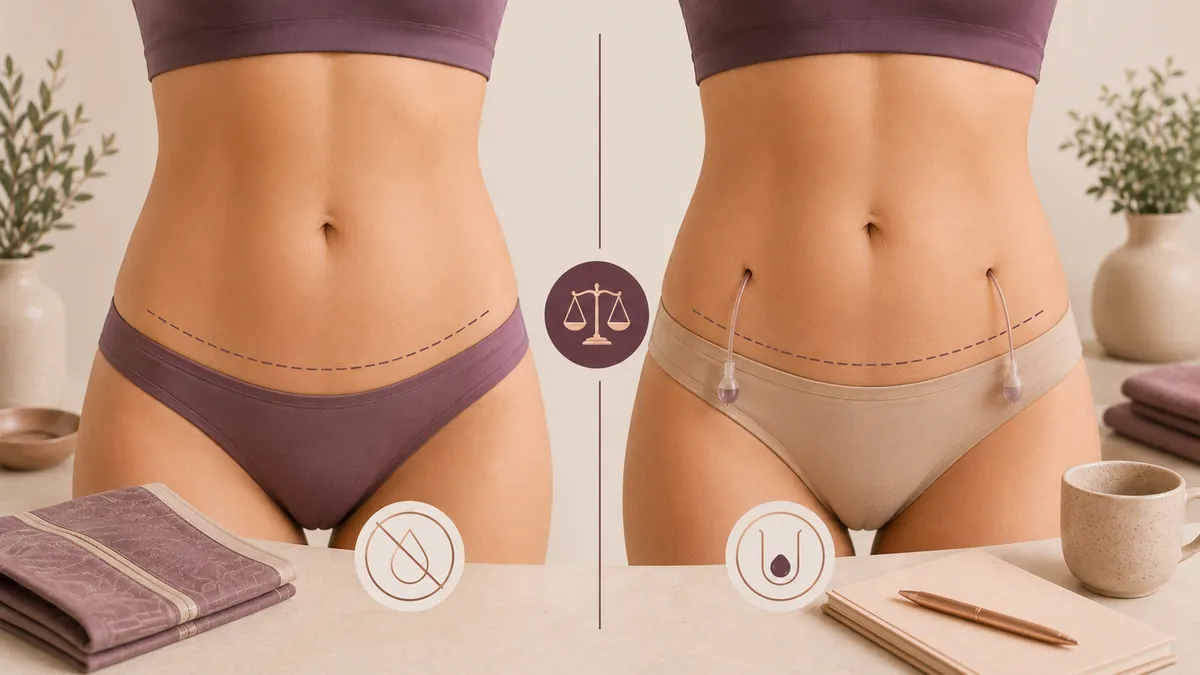
When comparing tummy tuck types, the "drainless" option is less about the procedure itself and more about a technical decision: closing the tummy tuck with progressive tension sutures (PTS) that eliminate the potential fluid-collection space, rather than placing drains to remove any fluid that does collect. Both approaches are answering the same problem — post-operative seroma — from two directions.
Detail on how PTS works technically and the anatomy involved is on our drainless tummy tuck cluster page. This guide is specifically about the head-to-head comparison and the evidence for each.
What the Published Evidence Actually Says
A meta-analysis of progressive tension suture vs conventional drain-based abdominoplasty pooled data across multiple studies and found the PTS group had a lower incidence of seroma — the specific complication drains are placed to prevent.1 Overall complication rates were otherwise similar. In the large CosmetAssure database of 25,478 abdominoplasty cases, technique variables including drain use are not identified as independent complication risk factors after controlling for surgeon experience and patient factors.3
Translation: in the aggregate, drainless is no worse and probably slightly better for seroma specifically. Both are safe. A separate ACS-NSQIP analysis of 18,891 abdominoplasty patients reinforces this: patient-level factors like BMI, not drain technique, are the dominant predictors of wound complications.4
The seroma reduction with PTS is thought to work through two mechanisms. First, the tension sutures physically obliterate the potential space between the abdominal wall and the overlying skin flap — the space where fluid otherwise collects. Second, they distribute closure tension across many anchor points instead of concentrating it at the wound edge, which reduces the shearing forces that irritate lymphatic vessels and drive fluid production. Both effects were mechanistically proposed in the early PTS literature and have been supported by the reduced seroma incidence in subsequent cohorts.
Patient Experience — The Actual Difference
The published seroma-rate difference is meaningful but modest. The patient-experience difference is large:
- With drains: 5–14 days of managing 2 drains (typical). Stripping tubes, emptying bulbs 2–4× daily, recording output. Sleeping with drains is awkward. Showering is complicated. Removal is uncomfortable.
- Drainless: none of the above. Shower earlier. Sleep more normally. Focus on healing.
This is why patients disproportionately prefer drainless when given the choice. The actual clinical difference is small; the daily-life difference is large.
A Day-in-the-Life Comparison
Day 1 with drains: two silicone bulbs pinned to your compression garment, tubes exiting through small incisions on either flank. Every 4–6 hours you empty the bulbs, measure output in cc, and log it. Stripping the tubes (running fingers along them to prevent clot occlusion) is uncomfortable and needs to be done multiple times a day. Sleeping means positioning the bulbs so they don't tug on the incisions. Showering is delayed 5–10 days until output drops below the threshold for removal.
Day 1 drainless: compression garment on, no external hardware. You focus on walking short distances to reduce DVT risk, eating, and hydrating. Shower is often permitted by day 2–3 once the wound edges have sealed. Sleep is easier because there are no tubes to work around. Follow-up visits check the incision and swelling rather than measuring drain output.
Both patients hit similar recovery milestones on the same clinical timeline. The difference is the daily texture of the first two weeks — and that texture is almost entirely in favor of drainless.
When Drainless Is Not the Right Choice
A few scenarios where drains are still preferred:
- Very large tissue excision (post-massive-weight-loss, fleur-de-lis)
- Combined operations with large fluid-shift potential (TT + extensive liposuction)
- Patients on anticoagulants where post-op bleeding needs monitoring — see DVT/PE safety guide
- Surgeons whose PTS experience is limited and whose drain-based outcomes are excellent
The Specific Question to Ask
"Do you perform drainless tummy tucks routinely, or occasionally?" — is the diagnostic question. A surgeon who performs PTS on most tummy tucks has the experience for it to work well. A surgeon who performs PTS occasionally at patient request is a higher-risk choice. Volume matters.
FAQ
Is drainless safer than drains?
In pooled meta-analysis data, drainless (PTS) shows equivalent-or-lower seroma rates compared with drain-based closure, and comparable overall complication rates.1 "Safer" is not the right frame — both are safe in trained hands. The larger safety variable is surgeon experience and patient factors like BMI, not the drain-vs-drainless choice itself. Choose a surgeon whose portfolio and outcomes are strong in whichever technique they use routinely.
Does drainless mean no fluid collection?
No. Drainless reduces seroma risk but does not eliminate it. Small seromas can still form and are usually managed by needle aspiration in the surgeon's office at follow-up. What drainless does is close the internal potential space (where fluid pools) with progressive tension sutures, so there is less room for a large collection to accumulate. If a persistent seroma does form despite PTS, drainage can still be performed as a minor office procedure — it doesn't undo the operation.
Is recovery faster without drains?
Meaningfully more comfortable, marginally faster in objective milestones. Drainless patients typically shower sooner (once wound edges are sealed, often at day 2–3 vs day 7–10 with drains), sleep more comfortably from the start, and skip drain stripping and output measurement entirely. Return-to-desk-work and unrestricted-activity dates track similar timelines to drain-based recovery because those are gated by the deep tissue healing, not drain removal. The full recovery timeline gives the day-by-day breakdown.
Do all surgeons offer drainless?
No — drainless requires specific training in progressive tension suture technique, which not every plastic surgeon has adopted. If drainless matters to you, ask directly at consultation: "Do you perform drainless tummy tucks routinely, or occasionally?" A surgeon who does most of their tummy tucks drainless has the volume for it to work well. A surgeon who does one occasionally at patient request is a higher-risk choice. Surgeon technique preference is not a red flag — inconsistent execution is.
Do drainless tummy tucks cost more?
In the US, drainless typically carries a 0–15% premium because it takes 20–40 minutes longer of operative time and involves specific technique training. Some surgeons absorb the cost, others itemise it. In Turkey, drainless is frequently included at no premium as part of standard packages, because it reduces the daily-care burden on the international patient (no drain management on the flight home). If a surgeon charges a very large premium (>25%), that's a signal to ask what's driving it — the technique itself does not justify a big cost jump.
Which is right for me?
Both techniques deliver excellent outcomes in trained hands. The honest answer is that surgeon experience matters more than technique choice. Pick the surgeon first — the one whose portfolio, credentials, and consultation feel strongest — and let their preferred technique follow. If two candidate surgeons are otherwise equal and one offers routine drainless, that daily-life comfort difference is a legitimate tiebreaker. But choosing a lower-volume surgeon just because they offer drainless is the wrong trade.