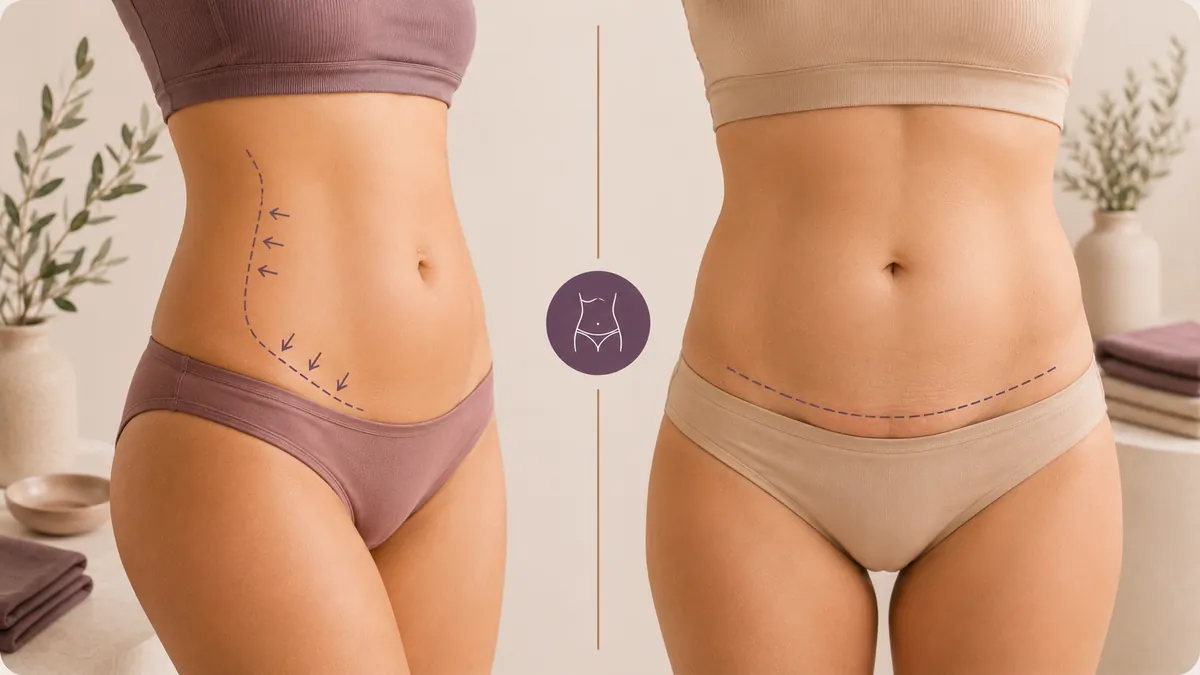
"Liposuction vs tummy tuck" is one of the highest-volume search queries in body-contouring. Most patients arrive at this question hoping liposuction alone will solve their problem — it is smaller, cheaper, scarless, and has a faster recovery. Sometimes it does. Often it doesn't. This guide is designed to help you know which of the two operations actually addresses your anatomy, and when the combined operation (lipoabdominoplasty) is the right answer.
The short version, up front: liposuction removes fat. A tummy tuck removes skin and repairs the muscle wall — and there are several tummy tuck types depending on how much correction is needed. They address different problems, and no amount of one will substitute for the other. Choosing right is a physical-exam-driven decision that this page will help you understand before consultation.
What Each Operation Actually Does
Liposuction
Liposuction removes localized deposits of fat through small incisions using a thin hollow tube (cannula) connected to suction. The overlying skin is expected to retract onto the new contour. It does not remove skin, does not tighten skin (beyond what the skin retracts on its own), does not repair muscle separation, and does not reposition the umbilicus. Modern techniques include tumescent liposuction (the standard), power-assisted, ultrasound-assisted (VASER), and laser-assisted variants — the fat removal is essentially the same; the technique differences affect precision and tissue trauma more than final result.
Best use: localized fat that has not responded to diet and exercise, in a patient with good skin elasticity and no muscle separation. Areas: abdomen, flanks, thighs, arms, back, neck.
Tummy tuck (abdominoplasty)
A tummy tuck removes excess skin, repairs the abdominal wall by re-approximating separated rectus muscles (diastasis recti plication), and repositions the umbilicus in a full or extended operation. It does not primarily remove fat — although modern practice often adds liposuction to the flanks and upper abdomen as part of the same operation (lipoabdominoplasty). The scar is the hip-to-hip horizontal scar plus the small circular scar around the repositioned umbilicus.
Best use: loose skin (particularly post-pregnancy or post-weight-loss), rectus diastasis, visible "pouch" or apron, distorted umbilicus. Full detail in our What Is a Tummy Tuck? guide.
Side-by-Side Comparison
| Feature | Liposuction (abdomen) | Full Tummy Tuck |
|---|---|---|
| What it addresses | Excess fat only | Excess skin + muscle separation + umbilicus |
| What it does not | Skin, muscle, umbilicus | Not a primary fat-removal operation |
| Scar | Several small (mm-size) puncture scars | Hip-to-hip + umbilicus circle |
| Anaesthesia | Local + sedation or general | General |
| Operative time | 1–3 hours | 2–4 hours |
| Hospital stay | Outpatient typical | 1–2 nights typical |
| Return to desk work | ~1 week | 10–14 days |
| Return to exercise | 3–4 weeks | 6 weeks |
| Result visible | Weeks 4–8; final 3–6 months | Month 3 close; final 6–12 months |
| Cost — US (all-in) | $3,500 – $7,000 | $10,000 – $18,000 |
| Cost — Turkey (all-in) | $2,000 – $4,000 | $3,500 – $5,500 |
| Ideal candidate | Good skin elasticity, no muscle separation, localized fat | Loose skin, diastasis, post-pregnancy or post-weight-loss |
Who Needs Which — The Real Decision Framework
The decision decomposes into three anatomical questions. Physical exam at consultation confirms the answers; this framework helps you know what the surgeon will be assessing.
Question 1: How is your skin elasticity?
Pinch the skin on your abdomen and lift it. Good elasticity: the skin snaps back quickly and shows no lingering fold. Poor elasticity: the skin holds a fold, has visible stretch marks (striae), or shows lingering wrinkles when you sit or lean. Good elasticity favours liposuction; poor elasticity favours tummy tuck.
Skin elasticity is largely determined by prior stretching history (pregnancy, weight fluctuation), age, sun damage, and genetics. It is one of the two big variables surgeons check.
Question 2: Do you have muscle separation?
Lie flat on your back, tuck your chin, and do a small crunch. Feel the midline between your abdominal muscles — if you feel a soft "gap" that fingers can sink into, you may have rectus diastasis. Post-pregnancy patients almost always have some; the question is whether it is enough to warrant repair. Diastasis cannot be fixed by liposuction — it requires the muscle plication that only a tummy tuck includes. Detail in our diastasis recti guide, and see the full muscle repair guide for when repair is needed.
Randomized evidence at 1-year follow-up confirms the durability of muscle repair, giving weight to the decision to include it when indicated.2
Question 3: Do you have skin excess?
Stand and lean forward slightly. Is there a visible "pouch" or apron of skin? A horizontal fold above or below the belly button? Loose skin that sits above the pubic area? These are markers of skin excess that liposuction cannot address; a tummy tuck removes the excess skin.
Decision summary
- Good skin + no diastasis + only fat → Liposuction.
- Loose skin + diastasis + fat → Tummy tuck (often with liposuction added → lipoabdominoplasty).
- Loose skin + no diastasis + minimal fat → Tummy tuck.
- Diastasis + no skin laxity + no fat → Rare; may need a limited muscle-only repair or a mini TT.
- Good skin + no diastasis + no excess fat → Neither operation is right; skincare or non-surgical options.
Most post-pregnancy patients fall into the second category (skin + muscle + often fat). Most patients who have never been pregnant and are just carrying stubborn fat fall into the first (liposuction). The mistake is patients in the second category choosing liposuction because it's smaller, cheaper, and scar-free — the result is unaddressed loose skin and muscle separation, and often a subsequent tummy tuck a year or two later. For a deeper look at how panniculectomy differs from a tummy tuck (especially post-bariatric), see our dedicated comparison.
When to Combine: Lipoabdominoplasty
Modern abdominoplasty increasingly includes liposuction as part of the same operation — the combined procedure is called lipoabdominoplasty. Liposuction is typically added to the flanks and sometimes the upper abdomen to refine the final contour beyond what skin excision alone achieves.
The safety data on combined procedures comes from the same Winocour CosmetAssure analysis (n=25,478) that provides the baseline abdominoplasty complication rate.1 The finding: combined lipoabdominoplasty in appropriately selected patients has a safety profile broadly comparable to standalone abdominoplasty. Combining with other operations (breast surgery in mommy makeover, extensive body contouring) has additive risk profiles that need surgeon-driven judgement.
Not everyone needs the combination. Some patients get an excellent result from tummy tuck alone; others benefit meaningfully from adding liposuction. This is a physical-exam decision at consultation, not a marketing bundle.
Recovery & Cost
Recovery differences
Recovery from liposuction is meaningfully shorter than from a tummy tuck. Typical liposuction: patients return to desk work in ~1 week, unrestricted exercise in 3–4 weeks, close-to-final result at 3–6 months. Typical tummy tuck: desk work at 10–14 days, unrestricted exercise at 6 weeks, close-to-final at 3 months (with continued refinement through 6–12 months). Full TT recovery detail is in our recovery timeline. Swelling after either operation follows a long tail — see swelling guide.
Cost comparison
| Operation | US range | Turkey range |
|---|---|---|
| Liposuction (abdomen only) | $3,500 – $7,000 | $2,000 – $4,000 |
| Liposuction (multiple areas) | $6,000 – $12,000 | $3,500 – $6,000 |
| Mini tummy tuck | $6,000 – $12,000 | $2,500 – $4,000 |
| Full tummy tuck | $10,000 – $18,000 | $3,500 – $5,500 |
| Lipoabdominoplasty (combined) | $12,000 – $22,000 | $4,500 – $6,500 |
Cost should not drive the decision. Choosing liposuction because it's cheaper when your anatomy actually calls for a tummy tuck is a false economy — the loose skin and muscle separation remain unaddressed, and many patients end up paying for the tummy tuck later anyway. Full cost breakdown in the cost guide; Turkey package pricing detail in the Turkey cost guide.
Safety Considerations
Both operations have well-characterised safety profiles when performed by board-certified surgeons in accredited facilities. The CosmetAssure database analysis provides the reference numbers for abdominoplasty (major complication rate ~4%) and for combined procedures.1 Higher-BMI patients face elevated complication rates across both operations — the ACS-NSQIP analysis (n=18,891) documented dose-dependent effects on wound complications, DVT, and reoperation.3
Specific safety considerations by operation:
- Liposuction — main risks are contour irregularities (waviness, lumps), asymmetry, prolonged swelling, and — for large-volume liposuction (> 5 L) — fluid balance and fat embolism risk. Large-volume liposuction should only be performed in accredited facilities with overnight monitoring.
- Tummy tuck — the ~4% major complication rate covers seroma, hematoma, wound issues, VTE, and less common events. Full detail in complications guide and DVT/PE guide.
- Combined (lipoabdominoplasty) — safety profile broadly comparable to standalone TT in appropriately selected patients; combined procedures with BBL or other major operations have additive risk.
FAQ
What is the difference between liposuction and a tummy tuck?
Liposuction removes excess fat but does nothing about loose skin or muscle separation. A tummy tuck (abdominoplasty) removes excess skin, tightens the abdominal wall by repairing separated muscles, and repositions the umbilicus — but does not primarily remove fat. They address different problems. Choosing between them is a candidacy decision: if the issue is stubborn fat with good skin quality and no muscle separation, liposuction alone is right. If the issue is loose skin, a "pouch" from stretched skin, or muscle separation from pregnancy, no amount of liposuction will fix it and a tummy tuck is needed.
Am I a candidate for liposuction or a tummy tuck?
You are likely a liposuction candidate if you have good skin quality (elastic, no significant laxity), no muscle separation, and localized fat that has not responded to diet and exercise. You are likely a tummy tuck candidate if you have loose skin (particularly after pregnancy or weight loss), muscle separation (diastasis recti), a visible "pouch" or apron of skin, or a distorted umbilicus. Many patients need both — the combined operation is called lipoabdominoplasty. Physical exam at consultation confirms candidacy; skin pinch test and rectus diastasis check are the key exam findings.
Which is better — liposuction or tummy tuck?
Neither is "better" — they address different problems. Liposuction is a smaller operation (less recovery, no scar or very small scars, lower cost) but only removes fat; it cannot tighten skin or repair muscles. A tummy tuck is a bigger operation (longer recovery, hip-to-hip scar, higher cost) but produces changes liposuction cannot: skin removal, muscle repair, umbilicus repositioning. The right operation is the one that matches your anatomy. Choosing liposuction for a problem that requires a tummy tuck leaves the underlying issues unaddressed; choosing a tummy tuck for a problem that liposuction could solve is over-treatment.
Can I have liposuction and a tummy tuck at the same time?
Yes — the combined operation is called lipoabdominoplasty and is increasingly common. It is a full tummy tuck with liposuction added, typically to the flanks and upper abdomen, for a more refined final contour. Published safety data from the largest US abdominoplasty database indicates combined-procedure safety is broadly comparable to standalone abdominoplasty in appropriately selected patients.1 Not everyone needs the combination — some patients get an excellent result from tummy tuck alone; others benefit meaningfully from adding liposuction. This is a surgeon-driven decision based on physical exam.
Does liposuction leave loose skin?
It can, particularly in patients whose skin does not have adequate elasticity. Removing the fat under skin that is already stretched or has poor elasticity often leaves the skin visibly loose or "draped." This is one of the biggest single reasons patients who thought they wanted liposuction end up needing a tummy tuck. Skin elasticity is assessed at consultation — younger patients with never-been-stretched skin generally retract well after liposuction; post-pregnancy and post-weight-loss patients often do not, and are usually better served by a tummy tuck that removes the excess skin along with the fat.
How much do liposuction and tummy tuck cost?
In the US, liposuction of the abdomen typically costs $3,500 to $7,000 depending on the areas treated. A full tummy tuck typically costs $10,000 to $18,000. Combined lipoabdominoplasty typically costs $12,000 to $22,000. In Turkey, liposuction typically costs $2,000 to $4,000; full tummy tuck $3,500 to $5,500 all-in package; combined lipoabdominoplasty $4,500 to $6,500 all-in. Cost should not drive the operation choice — the right operation for your body is worth spending on. Choosing liposuction because it's cheaper when you actually need a tummy tuck is a false saving that usually leads to needing the tummy tuck anyway.
Do I need lipo or a tummy tuck after pregnancy?
For most post-pregnancy patients, the honest answer is a tummy tuck — not liposuction. Pregnancy creates three problems at once: stretched abdominal skin that will not fully retract, separation of the rectus muscles in the midline (diastasis recti), and often localized fat. Liposuction only addresses the fat. It cannot tighten stretched skin and cannot repair separated muscles. Post-pregnancy patients who choose liposuction expecting a flat, tight abdomen almost always end up disappointed and later need a tummy tuck anyway. The exception is a small subset of women who retained good skin elasticity and had no diastasis — a physical exam at consultation confirms this.
Which has a longer recovery — liposuction or tummy tuck?
A tummy tuck has a substantially longer recovery. Liposuction: back to desk work in 3–7 days, resuming exercise at 3–4 weeks, near-final result by 3 months. Full tummy tuck: back to desk work at 2–3 weeks, no heavy lifting for 6 weeks, standing fully upright by 2–3 weeks, unrestricted activity at 6–8 weeks, near-final result at 3–6 months, full scar maturation at 12–18 months. Combined lipoabdominoplasty follows the tummy tuck timeline. The bigger operation is a real trade-off — but it is the trade-off required when the anatomy needs skin removal and muscle repair, not just fat removal. See our full recovery timeline for the day-by-day picture.