
What a panniculectomy is
A panniculectomy is a reconstructive operation that removes the overhanging apron of abdominal skin and subcutaneous fat. Surgeons call that apron a pannus or panniculus. Unlike a cosmetic tummy tuck, its central purpose is removing the symptomatic hanging apron rather than tightening the full abdominal contour.1
Patients usually arrive after major weight loss — bariatric surgery, medically supervised dieting, or large natural loss — or after years of a heavy abdominal fold that never retracted. The clinical problem is not appearance. It is the pocket of skin that stays moist, rubs, restricts walking, and makes hygiene hard.1
What the operation removes — and what it does not
The surgeon removes the hanging lower-abdominal skin and fat and closes the remaining tissue. The operative plan and incision length depend on the pannus and the patient's anatomy.1
A panniculectomy does not include:
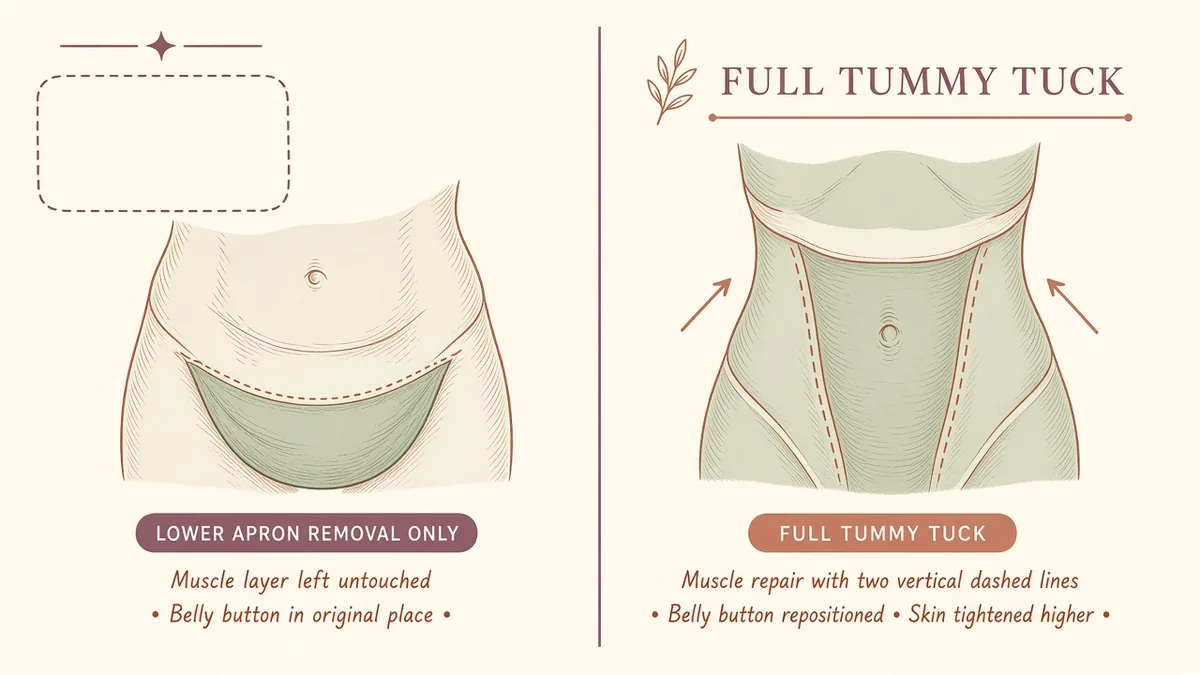
- Muscle repair. Separated rectus muscles (diastasis recti) are left alone. If that is your problem, see our diastasis recti guide — it is a different operation.
- Belly-button repositioning. The umbilicus stays where it is. A full tummy tuck creates a new opening and moves it.
- Liposuction. Fat under the remaining flap is not sculpted as part of a standard panniculectomy. Adding liposuction changes the case and usually the billing.
Those exclusions are why payer policies can separate functional panniculectomy from cosmetic abdominoplasty. They are also why removing the apron alone does not promise the same contour as a tummy tuck.24
What a pannus is
People searching “pannus stomach” are usually describing a fold of abdominal skin and fat that hangs over the belt line, the pubic area, or the thighs. It is not visceral fat inside the abdomen, and it is not the same as a postpartum pooch from muscle separation. A pannus is extra tissue hanging off the abdominal wall.1
It commonly follows prolonged abdominal enlargement and major weight change. The underside can remain warm and moist, creating friction and conditions associated with intertrigo, infection, odor, and ulceration.12
Panniculus grades and what they mean clinically
Surgeons grade how far the apron hangs using the five-level scale published by Igwe and colleagues in Obesity Surgery (2000).1 Grade is about coverage, not weight. A smaller person can have a grade 3 apron; a larger person can have a grade 1.
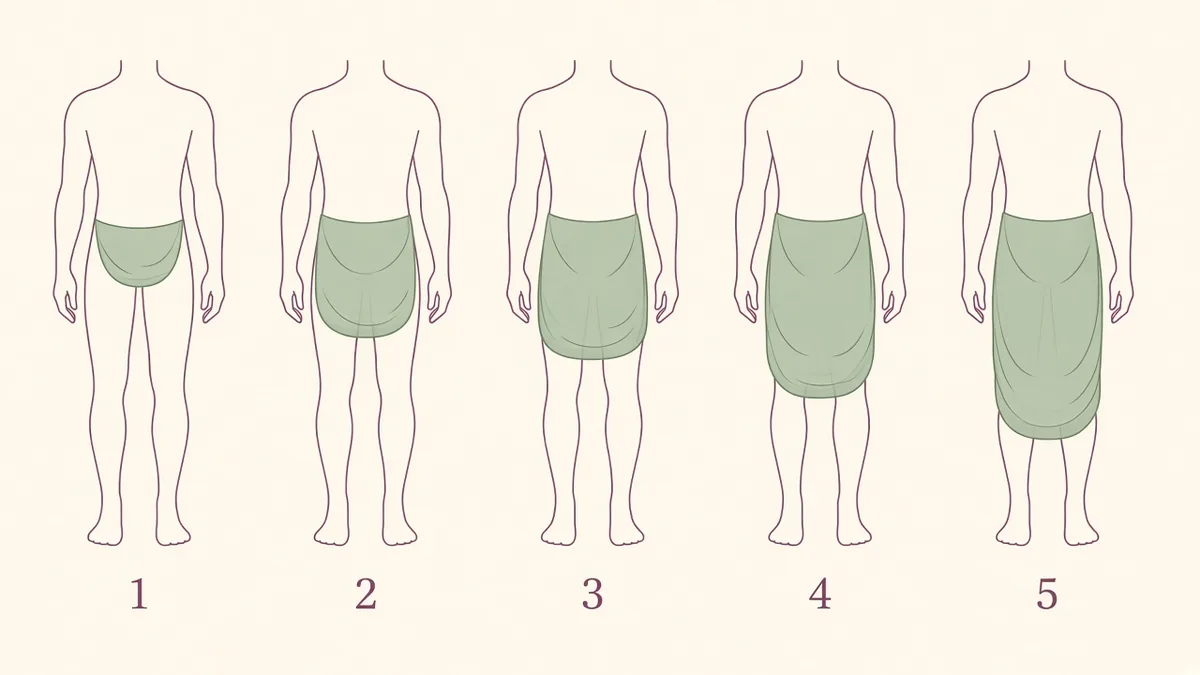
| Grade | How far the apron hangs | Typical clinical picture |
|---|---|---|
| 1 | Covers the pubic hairline / mons but not the genitals | Mild fold; skin irritation possible but less common |
| 2 | Covers the genitals / entire mons pubis | Hygiene harder; intertrigo more frequent |
| 3 | Extends to the upper thigh | Recurrent rash, odor, walking discomfort common |
| 4 | Extends to mid-thigh | Heavy functional load; ulceration risk rises |
| 5 | Extends to the knees or beyond | Severe mobility and skin problems; giant pannus |
Medicare local coverage language uses the same idea in shorter form: grade 1 reaches the mons; grade 5 reaches or passes the knees. Insurers rarely name a minimum grade in the policy text. They ask whether the pannus hangs below the pubis and whether it is causing a documented medical problem.2
Why a pannus causes medical problems
The fold creates a closed, damp surface where skin rubs on skin. Published coverage criteria recognize persistent intertrigo, ulceration, infection, and functional difficulty as medical problems that can support a reconstructive claim when documented.24
Those documented problems are the medical case; wanting a flatter stomach alone is cosmetic. Coverage records commonly need the rash or functional limit, the conservative treatment tried, and the result.24
Panniculectomy vs. tummy tuck
From the outside, both operations remove abdominal tissue, but payer policies treat them as different procedures: a tummy tuck (abdominoplasty) is body-contouring surgery, while a panniculectomy removes the hanging apron.24 The eight-row comparison below is the short version; the full decision path is in our panniculectomy vs tummy tuck guide.
| Panniculectomy | Tummy tuck | |
|---|---|---|
| Purpose | Relieve medical problems from a hanging apron | Flatten and contour the abdomen |
| Muscle repair | No | Usually yes (rectus plication) |
| Belly button | Left in place | Repositioned in a full tuck |
| Incision | Low horizontal, often longer if the apron is large | Low horizontal; variants add vertical or flank extensions |
| Insurance | May be covered when medically necessary | Almost never covered as cosmetic |
| Aesthetic result | Apron gone; remaining skin may still be lax | Tighter contour is the point of the operation |
| Recovery | Weeks; similar wound care, often less muscle pain | Weeks; muscle repair adds tightness and lifting limits |
| Typical candidate | Post-weight-loss patient with a symptomatic pannus | Patient seeking contour, often after pregnancy |
After massive weight loss, some patients have excess tissue in both horizontal and vertical dimensions and may be evaluated for a fleur-de-lis pattern rather than apron removal alone. That is an individualized contour decision, not an insurance label.1
Who qualifies
“Qualifies” here means two things that get mixed together: who is a reasonable surgical candidate, and who is likely to meet an insurer’s medical-necessity test. You can be a candidate for a safe operation and still be denied. You can meet paper criteria and still be a poor operative risk.
Medical criteria insurers typically look for
Published Medicare and commercial policies cluster around the same facts. A representative Medicare local coverage determination (LCD L39051) treats abdominal lipectomy / panniculectomy as medically necessary when the panniculus hangs below the pubis and records show chronic intertrigo that stayed or returned after about three months of appropriate treatment, or difficulty walking / impaired daily activities from pannus size, chronic pain, or ulceration.2
Commercial Blue Cross plans use nearly the same list. Blue Cross NC, for example, covers panniculectomy when the pannus hangs at or below the pubic symphysis and causes cellulitis, ulceration, or persistent dermatitis that failed at least three months of non-surgical care, or when there is documented functional impairment expected to improve.4 Abdominoplasty on that policy is cosmetic for all applications.
Weight stability requirements
After major weight loss, Medicare’s LCD asks for a stable weight for at least six months. If the loss followed bariatric surgery, the same document says the operation should wait at least 18 months after that surgery, with the most recent six months stable, and with skin infection or inflammation still present for the most recent three months.2
Commercial plans rhyme with that. Blue Cross NC uses the same 6-month stability rule without bariatric surgery and the same 18-month / 6-month pair after bariatric surgery.4 Operating while weight is still falling can compromise the durability of the result and wound healing; the surgeon should set the timing after reviewing the patient's weight trend.6
Documented conservative treatment
“Failed conservative treatment” is not a sentence in a consult note. Insurers want a timeline: topical antifungals, corticosteroids, antibiotics, hygiene measures, or dressings, used for a stated period — usually three months — with dates, prescriptions, and the result. Medicare’s billing article for the related LCD also asks for a description of the pannus and underlying skin, the functional limits, the treatment tried, and preferably photographs.2
Who is not a candidate
People who want a flatter waist, a repaired diastasis, or a moved belly button are describing a tummy tuck, not a panniculectomy. Active smoking and higher BMI are associated with more major complications after panniculectomy; diabetes and other comorbidities require individual pre-operative assessment.6 An apron that does not hang to the pubis and has no documented skin or function problem will not meet the Medicare or representative commercial criteria cited here.24
How US insurance coverage works
Coverage is the main reason this page exists as a procedure guide rather than a tourism page. Medicare, state Medicaid programs, and commercial insurers publish different rules. The examples below show why a reader must obtain the current policy for the exact plan rather than assume that one payer's approval criteria apply nationwide.234
That is the honest first question for a US reader with a symptomatic pannus: does your plan already have a path? The walk-through of letters, appeals, and timelines lives on our panniculectomy insurance page. This section is the rule set those letters have to satisfy.
What “medically necessary” means on a claim
On a claim, “medically necessary” means the plan's written policy matches the chart: hanging pannus, a covered indication, conservative care that was tried and dated, and any required weight stability. The exact covered indications and documentation differ by payer, as the Medicare and Blue Cross NC policies demonstrate.24 Cosmetic components must be identified separately from the reconstructive request.
Documentation insurers ask for
Build this packet before the pre-authorization goes in. Use the current plan's checklist because documentation requirements differ by payer.24
- Clinic notes describing the pannus (how far it hangs) and the skin underneath.
- Diagnosis codes for the skin condition or mobility limit (for example intertrigo, ulceration, difficulty walking).
- A dated log of conservative treatment — drugs, hygiene, dressings — and the response.
- Photographs that show the apron relative to the pubis, if the plan asks for them.
- Weight history: starting weight, current weight, months of stability, and bariatric dates if any.
- A surgeon letter of medical necessity that uses the plan’s own criteria, not marketing language.
- Office visit notes from primary care or dermatology that pre-date the plastic-surgery consult.
Medicare and Medicaid
Traditional Medicare does not pay for cosmetic abdominoplasty. It may pay for panniculectomy when a local coverage determination such as LCD L39051 is met: pannus below the pubis plus refractory intertrigo or functional impairment, with the weight-stability rules above after massive loss.2 Medicare Advantage plans can write their own medical policy on top of that.
Medicaid coverage is state-specific. For example, New Hampshire's CMS-approved state plan lists panniculectomy among procedures requiring prior authorization, while other state plan documents may use different criteria or exclusions.3 This example does not establish coverage in another state. Ask the state Medicaid agency for its current written policy and authorization requirements before planning travel or self-pay.
Commercial plans (including Blue Cross Blue Shield)
Blue Cross and Blue Shield is a family of independent plans, not one national rule. The published Blue Cross NC surgery policy is a public example: panniculectomy can be medically necessary; abdominoplasty is cosmetic; and weight-stability rules include six-month and post-bariatric timing requirements.4 Obtain the current policy tied to your member ID rather than applying this example to another BCBS plan.
What to do if the claim is denied
Read the denial letter and compare the stated reason with the policy and documentation that governed the request. Use the appeal rights, deadline, and review steps printed in the letter or plan document; these are plan- and state-specific. Ask the surgeon's billing team whether corrected records or a clinician review are available. Do not assume another insurer's appeal process applies to your claim.
What it costs without insurance
ASPS does not publish a standalone national average panniculectomy price. Its panniculectomy cost guide confirms that the final bill can include the surgeon, facility, anesthesia, prescriptions, garments, tests, and imaging. For context, ASPS currently reports an $8,174 average for the related tummy-tuck surgeon fee, before those other charges.5
The table below is a US self-pay planning framework, in US dollars, current as of October 2026. A national hospital-price dataset reports an average cash price of about $13,830 for CPT 15830, while individual facility prices vary widely and may exclude separately billed professional services. Use $10,000–$20,000 only as a planning range and obtain a written, itemized estimate.5
| Component | Typical range | Notes |
|---|---|---|
| Surgeon fee | $8,174 benchmark | Current ASPS average for the related tummy-tuck surgeon fee; not a panniculectomy total.5 |
| Facility / hospital | Quoted separately | Ask whether the facility price is included and whether an overnight stay changes it. |
| Anesthesia | Quoted separately | Confirm whether the anesthesiologist bills independently. |
| Pathology | Confirm in writing | Ask whether pathology, tests, prescriptions, and garments are included. |
| Typical all-in total | $10,000–$20,000 planning range | Centered on a $13,830 national cash-price average; complex hospital cases can exceed it.5 |
If the plan approves the case, the cash total is no longer the relevant estimate. Patient responsibility depends on the deductible, coinsurance, network status, authorization, and the plan's allowed amount. For a combined operation, request separate written estimates for the potentially covered panniculectomy and every cosmetic add-on.
Should you consider having it done abroad?
If US insurance is likely to cover this, going abroad is usually the wrong first move
US payer policies can treat a medically necessary panniculectomy as reconstructive.24 If you have a hanging, symptomatic pannus and US coverage, the first job is the coverage file — not a flight. Wound complications require follow-up, and arranging that follow-up across countries adds practical risk.6
That is the spine of this guide, and it is the opposite of a medical-tourism sales page. The reason is practical:
- Follow-up sits at home. Seroma, wound separation, and infection show up after you would already be on a plane back.
- Complication management needs a local surgeon. A US board-certified plastic surgeon who did not do the case may still help in an emergency, but planned aftercare and revisions become a new, unpaid problem.
- Insurance is a paper trail. A covered US operation lives in the plan’s record. An operation abroad does not convert a later US claim into “already approved.”
- Pathology belongs in a retrievable system. Excised tissue is examined. Getting that report, and acting on an unexpected finding, is simpler when the lab is in the same health system as your follow-up.
Abroad can still be a narrow option if you have no realistic US coverage path, can stay for early wound checks, and accept that revisions will be your cost. Even then, a medically indicated panniculectomy is a poor first use of medical travel compared with a cosmetic tummy tuck that was never going to be insured.
Recovery
Recovery instructions vary with the amount of tissue removed and the patient's health. ASPS advises following the surgeon's directions for incision and drain care, activity limits, and warning signs; swelling can persist for months.6 Use our tummy tuck recovery timeline only as general preparation, then follow the operating team's panniculectomy-specific plan.
Risks
Panniculectomy can cause wound-healing problems, seroma, infection, bleeding, and other major complications. In a 238-patient series, higher BMI and active smoking were independently associated with major complications.6 The full complication map for abdominal contour surgery is on our risks and complications page. Discuss personal risk and the appropriate facility with a qualified plastic surgeon.
Frequently asked questions
-
What is a panniculectomy?
-
Is a panniculectomy covered by insurance?
It can be, when the member's plan treats it as medically necessary rather than cosmetic. Published Medicare and commercial examples require a hanging pannus plus documented skin disease or functional impairment and conservative care. Exact requirements vary, so obtain the current policy for your plan.24
-
How much does a panniculectomy cost without insurance?
A practical US self-pay planning range is about $10,000 to $20,000, although complex hospital cases can cost more. Figures are in US dollars, current as of October 2026. If insurance approves the case, out-of-pocket cost depends on the plan's deductible, coinsurance, network, and authorization terms.5
-
Does Medicaid cover a panniculectomy?
Sometimes, and it depends on the state and the member's plan. For example, New Hampshire's CMS-approved state plan lists panniculectomy among procedures requiring prior authorization. That does not establish coverage elsewhere. Ask your state Medicaid agency for the current written policy and authorization requirements before assuming the operation is covered.3
-
What is the difference between a panniculectomy and a tummy tuck?
A panniculectomy removes the hanging apron. A tummy tuck may also tighten remaining skin, repair separated muscles, and reposition the belly button for contour. Published payer examples distinguish medically necessary apron removal from cosmetic abdominoplasty, which is why coverage decisions differ.24
-
Can I have a panniculectomy and a tummy tuck at the same time?
Yes, in selected patients after a separate clinical risk assessment. The functional apron can be removed while cosmetic muscle repair or contour work is added. A payer may cover only the medically necessary panniculectomy portion, so request separate authorization and written pricing for every cosmetic component.46